

Gold-Plated vs Gold-Filled Jewelry: What's the Difference?
Last Updated: October 29, 2026
Quick Summary
The difference in gold plated vs gold filled jewelry comes down to how much gold sits on the surface and how it is attached. Gold-plated pieces carry a microscopic gold coating over a base metal, while gold-filled pieces carry a thick layer of gold mechanically bonded to the core that cannot peel off in sheets.
- A 14/20 gold-filled stamp means 14-karat gold makes up one-twentieth, or 5%, of the piece's total weight.
- Gold vermeil requires a sterling silver base and a gold layer at least 2.5 microns thick.
- Thin gold plating wears through at high-contact points like clasps, chain links, and the back of a pendant.
- Put plated jewelry on last, after perfume and lotion have dried, and take it off before showers and swimming.
- Gold-filled is not hypoallergenic by definition, since the 14-karat alloy can contain trace nickel.
Table of Contents
- Gold-Filled vs Gold-Plated: The Core Difference
- Gold Content, Layer Thickness and Labeling Standards
- Gold-Filled vs. Gold-Plated Durability: How Long Each Really Lasts
- How to Tell Gold-Plated from Gold-Filled Jewelry Before You Buy
- Is 14K Gold-Filled Real Gold? Karats, Alloys and Skin Sensitivity
- Gold-Filled Jewelry Care and Gold-Plated Maintenance
- Price, Value and Total Cost Over Time
- Choosing Your Everyday Piece at Carlotta
- Frequently Asked Questions
Gold-Filled vs Gold-Plated: The Core Difference
The difference in gold plated vs gold filled jewelry comes down to how much gold sits on the surface and how it is attached.
That distinction drives durability, price, how the piece ages, and whether it survives daily wear. The two are not interchangeable. One is a budget-friendly fashion finish, the other a semi-precious material, and knowing which you are buying stops you from paying gold-filled money for a plated chain.
Below, we explain the differences between the two materials.
What Gold-Plated Jewelry Is
Gold-plated jewelry is a base metal piece, usually brass or copper, covered with a very thin layer of gold through electroplating. The gold layer is measured in microns, and many plated pieces sit under one micron thick.
Because the coating is thin, plated jewelry is affordable and comes in every style imaginable, but the finish is the first thing to go. Perfume, sweat, chlorine, and friction wear through a thin layer, and once the gold is gone, the base metal shows.
What Gold-Filled Jewelry Is
Gold-filled jewelry is a base metal core, typically brass, with a much thicker layer of gold bonded to it using heat and pressure. The gold is not painted or plated on; it is mechanically fused, so it behaves like a single sheet of metal.
Gold-filled pieces are usually marked with a ratio, such as 14/20, meaning 14-karat gold at one-twentieth of the item's total weight. That thick, bonded layer is why gold-filled jewelry resists tarnishing far longer than plated pieces and can handle years of regular wear.
Gold Content, Layer Thickness and Labeling Standards
Gold content and layer thickness are where the marketing gets fuzzy, so read the label like a contract. "Gold-filled" and "gold-plated" are not regulated the same way, and the numbers on a stamp mean specific things you can calculate.
What the gold-filled stamp actually means
A gold-filled mark typically appears as a ratio such as "14/20" or "12/20," sometimes followed by "GF." The first number is the karat of the gold layer. The second number is the fraction of the item's total metal weight that is gold.
You can turn that into a gold-content estimate. Fourteen-karat gold is 58.3% pure gold by weight, so if the gold layer is 5% of total weight, the pure gold is roughly 0.583 × 0.05, or about 2.9% of total weight. That explains why gold-filled pieces cost more than plated ones and why the ratio is worth checking.
What the gold-plated label does not tell you
In common retail labeling, "gold plated" carries no universal minimum thickness. A gold-plated piece can have a coating well under one micron, and the label need not disclose thickness, karat, or base metal. Terms like "gold tone," "gold finish," and "gold wash" are marketing language, not standardized marks.
Gold vermeil is the one plated category with a commonly cited standard: the base must be sterling silver and the gold layer must be at least 2.5 microns thick, typically at least 10-karat. That is still a plating process, but the thickness and base-metal requirements make it a more defined product than generic gold-plated jewelry.
How to read a listing without being misled
- Look for a ratio stamp on gold-filled pieces (14/20, 12/20) and treat a missing ratio as a reason to ask the seller directly.
- Treat "gold plated" as a finish description, not a content claim, and ask for the micron thickness if the seller has it.
- Distinguish "gold vermeil" from "gold plated", vermeil implies a sterling silver base and a thicker gold layer.
- Do not assume a stamp proves composition on its own; stamps can be applied by manufacturers and are not a laboratory test.
| Feature | Gold-Plated | Gold-Filled |
|---|---|---|
| Gold layer | Microscopic, often under 1 micron | Thick, bonded layer (e.g. 1/20 of weight) |
| How gold attaches | Electroplating | Heat and pressure bonding |
| Typical marking | "Gold plated," "gold tone," "gold wash" | "14/20," "12/20," or "GF" |
| Base metal | Brass, copper, steel | Usually brass |
| Gold content | Trace amount, undisclosed | Measured fraction by weight |
| Expected lifespan | Months of regular wear | Years of regular wear |
The takeaway: a gold-filled ratio lets you calculate roughly how much gold is in the piece. A gold-plated label usually tells you almost nothing about thickness or content. When a listing is vague about either, treat that silence as information and ask before you buy.
Gold-Filled vs. Gold-Plated Durability: How Long Each Really Lasts
When it comes to gold plated vs gold filled durability, it is not a close contest.
What kills plated jewelry fastest is not age but exposure. Perfume, sweat, chlorine, and lotions break down a thin gold layer. Gold-filled pieces tolerate the same conditions far better, though no gold jewelry is indestructible.
Watch out: the most common mistake is judging a piece by its first month. Plated jewelry often looks perfect at purchase and starts showing dull patches or a darker base metal at friction points within a season of daily wear.
How to Tell Gold-Plated from Gold-Filled Jewelry Before You Buy
You can tell gold-plated from gold-filled jewelry before you buy by checking three things: the stamp, the price relative to weight, and the wear pattern on any used piece. Learning how to identify durable gold plated jewelry with a few simple checks saves you from a chain that looks great in photos and green on your neck by summer.
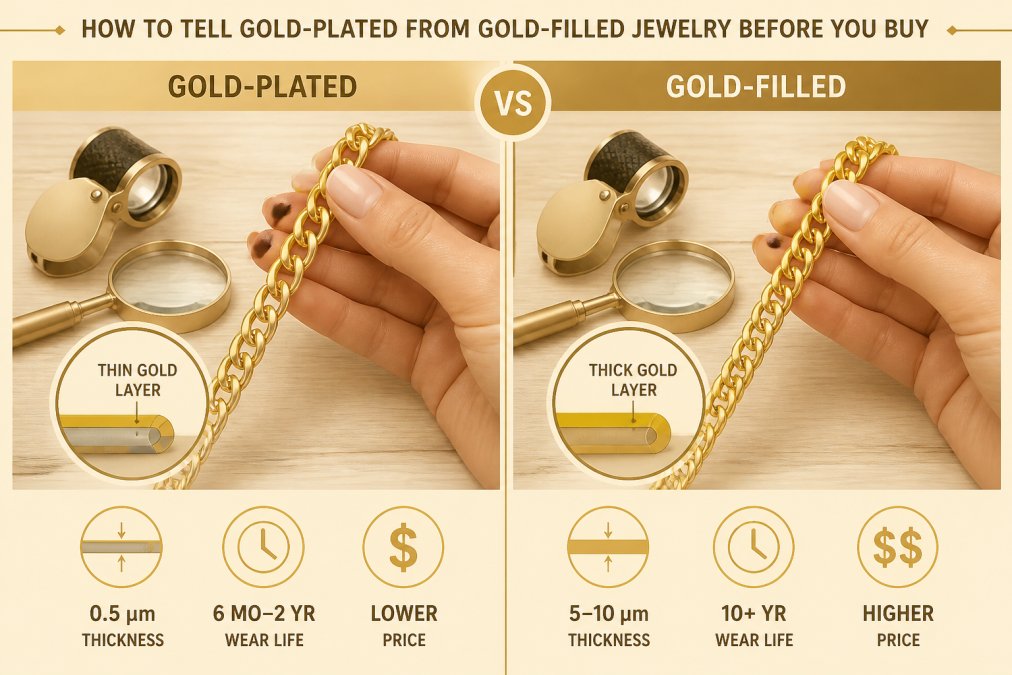
Start with the stamp. A gold-filled mark reads something like "14/20 GF" or "1/20 14K." A plated piece usually says "gold plated," "gold over brass," or nothing at all. Then check the price against the weight.
A quick field test helps too: hold the piece under bright light and look for uniform color. Plated pieces sometimes show a different tone at edges where the coating thinned during manufacturing. None of these checks is foolproof, but together they catch most mismatches between a listing and reality.
Is 14K Gold-Filled Real Gold? Karats, Alloys and Skin Sensitivity
Yes, 14K gold-filled jewelry contains real 14-karat gold, but only in the bonded layer, not through the entire piece. The "14K" refers to the gold alloy used for the outer layer, which is 58.3% pure gold mixed with other metals for hardness and color. The core underneath is usually brass.
What "real gold" means in a gold-filled piece
The gold layer is a genuine gold alloy, not a gold-colored coating, the meaningful difference from gold-plated jewelry, where the layer may be a fraction of a micron thick and the base metal sits close to the surface. In a gold-filled piece, the bonded layer is thick enough that the gold alloy, not the brass core, contacts your skin during normal wear.
Why the base metal matters for sensitive skin
Skin reactions to jewelry are most often linked to nickel, and sometimes cobalt or chromium, in the metals that touch the skin. Brass and copper cores can also irritate some people, particularly when the gold layer wears thin or moisture and friction keep the base metal against skin.
The practical difference between the two materials is exposure. A thin gold-plated coating can wear through at high-contact points, clasps, chain links, the back of a pendant, and once it does, the base metal is directly against your skin. A gold-filled piece keeps a thick gold alloy barrier in place far longer, so the base metal is less likely to become exposed during normal wear.
The nickel caveat nobody should skip
Even gold-filled jewelry is not hypoallergenic by definition. The 14-karat gold alloy in the outer layer can contain trace nickel, and some people with nickel sensitivity react to gold alloys themselves.
If you have a known nickel allergy, the safest approach is to ask the seller about the alloy and the base metal before buying, and to patch-test a new piece by wearing it for a short period before committing to all-day wear. A "hypoallergenic" label is not a standardized guarantee (the FDA).
Practical guidance for sensitive skin
- Ask what the base metal is and whether the gold alloy contains nickel.
- Prefer thicker gold layers, gold-filled over thin gold-plated, when you plan to wear a piece daily.
- Keep lotions, perfumes, and sweat off the piece where possible, since moisture and chemicals accelerate wear that exposes base metal.
- If a piece starts to discolor your skin or cause itching, stop wearing it and check whether the gold layer has worn through at contact points.
For a fuller look at which base metals and finishes to favor, see our guide to gold plated jewelry for sensitive skin. The honest summary: gold-filled reduces exposure risk compared with thin plating, but neither material is universally hypoallergenic, and the alloy and base metal matter as much as the label.
Gold-Filled Jewelry Care and Gold-Plated Maintenance
Gold-filled jewelry care is forgiving; gold-plated maintenance is not, and the difference is mostly about timing. Gold-filled pieces can be worn through most of your day and cleaned occasionally with mild soap and a soft cloth. With plated pieces, prevention is the whole game.
For plated jewelry, the routine that actually works is simple:
- Put jewelry on last, after perfume and lotion have dried
- Take it off before showers, workouts, and swimming
- Wipe it with a dry soft cloth after each wear to remove oils
- Store it in a dry pouch or box, not a humid bathroom
- Keep chains untangled so links do not rub against each other
Skip abrasive polishes and ultrasonic cleaners on plated pieces, since both can strip a thin coating. For a fuller routine, see our guide on how to maintain the shine of gold jewelry, which walks through cleaning and storage step by step.
Price, Value and Total Cost Over Time
Gold-plated jewelry costs less up front, often dramatically so, which is why it dominates fashion jewelry. Gold-filled jewelry costs more because it contains a measurable amount of real gold, and that premium buys years rather than months of wear.
Total cost over time flips the comparison. A plated piece worn daily may need replacing within a year or two, so buying it three times can cost more than one gold-filled piece, but that math only works if you actually wear the item constantly. For a deeper breakdown, read is gold plated jewelry worth the price.
Choosing Your Everyday Piece at Carlotta
If you want a piece for daily wear that holds up to real life, prioritize gold-filled when your budget allows, and check the stamp before anything else. Browse durable everyday cross necklaces for women to put that advice into action. If you want variety, trend-led styles, or a meaningful gift without a heavy spend, gold-plated is a sensible choice, provided you follow the care routine above.
Our seasonal offers take up to 30% off favorites, so you can build a look without stretching your budget.
Frequently Asked Questions
What wears better, gold-plated or gold-filled jewelry?
Gold-filled and gold-plated jewelry differ in how gold is attached to the underlying material. Which is right for you depends on the piece and your preferences.
Does gold-filled jewelry tarnish?
Whether jewelry tarnishes depends on its materials and construction. Check the product information for care guidance.
Can you shower with gold-filled or gold-plated jewelry?
Check the product information for care guidance before exposing jewelry to water or other substances.
Is 14K gold-filled real or fake?
The term “gold-filled” describes a jewelry material. Check the product listing for details about a specific piece.
The real challenge is not choosing between gold-plated and gold-filled; it is finding plated pieces you actually want to wear every day. That is where we come in. Carlotta offers a curated collection of chains, bracelets, and cross-themed accessories, with a specialized cross collection and seasonal savings of up to 30% on favorites. Get started with Carlotta and find the finishing piece your everyday look has been missing.
