

How to Maintain the Shine of Gold Jewelry: 2026 Guide
Table of Contents
- Why Gold Jewelry Loses Its Shine
- The Best Way to Clean Gold Chains at Home
- Gold Jewelry Cleaning Kit Essentials
- How to Store Gold Jewelry to Prevent Tarnishing
- What Not to Use on Gold Jewelry
- When to Get Professional Inspection and Cleaning
- Daily Habits That Protect Gold Jewelry Shine
- Frequently Asked Questions
Last Updated: September 12, 2026
Why Gold Jewelry Loses Its Shine
Gold jewelry loses its shine when a thin layer of oils, lotions, and airborne sulfur compounds settles on the metal surface and dulls how light reflects off it. This guide from Carlotta explains how to maintain the shine of gold jewelry at home, what tools work, and when to see a professional.
The metal itself is not the problem. Gold is one of the least reactive jewelry metals. What dulls a ring or chain is what lands on top of it: skin oils, sunscreen residue, soap film, and sulfur compounds, which build a hazy film that scatters light instead of bouncing it back.
There is also a structural issue most guides skip. Pure gold is soft, so jewelers mix it with other metals to make it wearable (geology.com). Those alloy metals, usually copper, silver, or zinc, are the parts that react and discolor over time.
Everyday Causes of Dullness
Daily wear is the biggest cause of dull gold. Every time you apply lotion, handle cleaning products, or cook with oil, a microscopic layer stays behind.
The usual suspects:
- Sunscreen and moisturizer. These leave a waxy film that traps dust and makes gold look cloudy within days.
- Hairspray and perfume. Alcohol and fragrance compounds can strip the surface finish and leave residue behind.
- Chlorine and salt water. Pools and hot tubs oxidize alloy metals and weaken the structure of thin chains over repeated exposure.
- Household cleaners. Ammonia and bleach-based products attack alloy metals directly.
A common mistake is assuming a piece is "worn out" when it only needs a proper clean. Most dull gold is dirty gold, not damaged gold.
How Karat and Plating Affect Shine
Higher-karat gold holds its shine longer because it contains more pure gold and fewer reactive alloy metals. A 14K or 18K piece resists discoloration better than 10K, which carries more copper and silver.
Plated jewelry behaves differently. Gold plating is a thin layer over a base metal that wears down with daily friction. Once it thins, the base metal shows through and the piece looks patchy rather than dull. Re-plating restores the finish, but it is a professional job, not a home fix.
White gold adds another variable. Most white gold is rhodium plated for its bright silver tone, and that layer wears off over time, giving the piece a warmer, slightly yellow cast (gia.edu). That is not tarnish, and no amount of cleaning will fix it, it needs re-plating.
The Best Way to Clean Gold Chains at Home
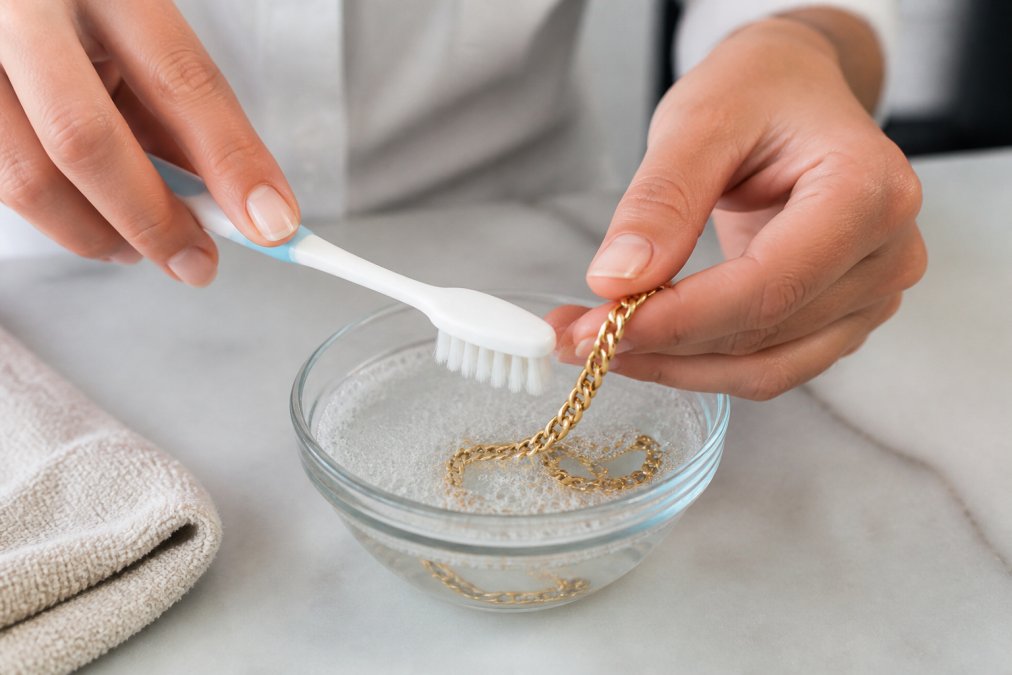
The best way to clean gold chains is a short soak in warm water with a few drops of mild dish soap, gentle agitation with a soft-bristled toothbrush, and a rinse under clean running water. Chains need this more often than rings because their links trap skin cells, soap residue, and lint.
Step-by-Step Cleaning Method
Follow this sequence every two to four weeks for pieces worn daily.
- Fill a small bowl with warm water. Add two or three drops of mild dish soap. Skip anything labeled antibacterial, lemon-scented, or heavy-duty.
- Soak the chain for 10 to 15 minutes. This loosens dried residue inside the links so you are not scrubbing it free.
- Work each link with a soft-bristled toothbrush. Use light circular strokes. Do not press down hard on the metal.
- Rinse under lukewarm running water. Plug the drain first. Chains slip.
- Pat dry with a lint-free microfiber cloth. Do not rub. Rubbing thin chains can stretch or kink them.
- Lay flat to air dry for 30 minutes before wearing or storing.
For solid gold rings and bracelets without stones, the same method works. For pieces with gemstones, skip the soak and use a damp cloth only, since some stones absorb water or loosen in soapy solutions.
Gold Jewelry Cleaning Kit Essentials
A workable gold jewelry cleaning kit costs very little and covers almost every home situation. You do not need a cabinet full of products, but you must match the tool to the piece, a kit safe for a 24K chain can ruin a rhodium-plated white gold ring.
| Item | What It Does | Notes |
|---|---|---|
| Mild dish soap | Lifts oils and residue | Fragrance-free, no additives, no antibacterial agents |
| Soft-bristled toothbrush | Cleans link gaps and settings | Dedicate one to jewelry only; baby toothbrushes reach tight links |
| Two small bowls | Soak and rinse | One for soapy water, one for clean water |
| Microfiber polishing cloth | Dries and restores luster | Lint-free, machine washable |
| Anti-tarnish pouch or lined box | Prevents tarnish between wears | Sulfur-absorbing lining preferred |
| Jeweler's polishing cloth (rouge-impregnated) | Removes light surface haze | Use sparingly; abrasives remove a trace of metal each time |
A polishing cloth is the most underrated item here. Used after every wear, it removes the day's oils before they set, meaning fewer deep cleans overall.
Match the Tool to the Karat
Karat determines how aggressive you can be. Pure gold is soft, and the alloy metals that make it wearable are the same metals that react to chemicals and abrasives.
- 24K (99.9% gold). Too soft for most everyday jewelry and easily scratched. Stick to a microfiber cloth and mild soapy water. Skip the toothbrush unless the piece is a solid, heavy form.
- 22K and 18K. Still soft enough to dent and scratch. A soft toothbrush is fine on solid pieces; avoid any abrasive polish.
- 14K. The most common balance in the market. Tolerates gentle brushing and occasional polishing-cloth use.
- 10K. Hardest of the common karats because it carries the most alloy metal, but that also means it discolors fastest and reacts most to chlorine and sulfur. Clean it more often, not more aggressively.
When Not to Use an Ultrasonic Cleaner
An ultrasonic cleaner uses high-frequency vibration to shake loose grime. It works well on solid gold with no stones, and is the wrong tool for several common pieces.
Skip the ultrasonic if:
- The piece has gemstones set in prongs. Vibration can loosen a stone that was already marginal. Emeralds, opals, pearls, and tanzanite are especially vulnerable.
- The gold is plated or gold-filled. The vibration and heat can lift the plating at edges and seams.
- The piece is hollow or thin. Hollow chains and lightweight bangles can deform.
- The piece has glued components or enamel inlay. Adhesive softens in the cleaning solution.
- You are not sure of the karat or construction. When in doubt, use the soap-and-toothbrush method instead.
What to Leave Out of the Kit
Some tools sold as jewelry cleaners do more harm than good:
- Silver polish. Formulated for silver's chemistry, not gold's. It can leave a residue that dulls gold over time.
- Jewelry dips containing acid. They strip tarnish fast but also attack plating and some alloy surfaces.
- Steam cleaners. Fine in a jeweler's hands, risky at home near stones and adhesive.
- Compressed air. Forces debris deeper into settings instead of out.
A basic kit, mild soap, a soft brush, two bowls, a microfiber cloth, and a pouch, handles the vast majority of pieces. Add the ultrasonic only if a jeweler confirms your piece is safe for it.
How to Store Gold Jewelry to Prevent Tarnishing
Storing gold jewelry correctly prevents tarnish by cutting off its two causes: air and moisture. Humidity is the bigger threat, and a bathroom counter is the worst place to keep a jewelry box.
Why Gold Tarnishes at All
Pure gold does not tarnish. What tarnishes is the alloy, the copper, silver, and zinc mixed in to make the metal wearable. Those metals react with airborne sulfur compounds (trace hydrogen sulfide, rubber, some paper products, even certain foods) to form a dark surface film. The higher the alloy content, the faster the reaction.
That is why a 10K piece can discolor in weeks while a 22K piece may go months without tarnish, and why the same storage method does not work equally well for every piece.
Storage Rules That Actually Matter
- Keep pieces separate. Chains tangle, and metal-on-metal contact causes surface scratches that dull the finish. Use individual pouches or a compartment box.
- Store in a cool, dry place. A bedroom drawer beats a bathroom every time. Steam from showers drives oxidation.
- Use anti-tarnish pouches or lined boxes. These slow the reaction between alloy metals and airborne sulfur. Look for sulfur-absorbing linings, not just soft fabric.
- Fasten chains before storing. A closed clasp tangle is easier to undo than an open one.
- Never store gold in plastic wrap or rubber bands. Both can leave residue or react with the metal. Rubber in particular contains sulfur that accelerates tarnish.
- Avoid cardboard and newspaper. Both contain sulfur compounds that off-gas over time.
Karat-Specific Storage
Match the storage method to the metal:
- 10K and 14K. Highest alloy content, fastest to tarnish. Use an anti-tarnish pouch or a lined compartment, and check pieces monthly if they are not worn often.
- 18K and 22K. Slower to tarnish but softer. Store in individual soft pouches to prevent scratches from neighboring pieces.
- 24K. Rarely tarnishes but dents easily. A padded, single-piece box is the safest option.
- White gold (any karat). The rhodium plating is what you are protecting. Avoid abrasive contact with other jewelry, which wears the plating at high points.
- Gold-plated and gold-filled. The base metal underneath is the tarnish risk. Store sealed and dry; any moisture that reaches the base metal will show through as discoloration at the edges.
Long-Term Storage for Pieces You Rarely Wear
For pieces that sit for months:
- Clean and dry the piece completely before storing. Any residue left on the surface will set and be harder to remove later.
- Seal it in an anti-tarnish pouch, then place the pouch in an airtight container.
- Add a small silica gel packet to absorb ambient moisture.
- Store flat, not hanging, to avoid stress on clasps and thin links.
- Re-check every few months. A quick wipe with a polishing cloth prevents buildup from becoming a deep clean.
For rarely worn pieces, a sealed pouch in a drawer is enough. For daily-wear pieces, a lined tray keeps them accessible without exposing them to open air.
What Not to Use on Gold Jewelry
Baking soda, toothpaste, bleach, ammonia, and chlorine-based cleaners all damage gold jewelry. Each either scratches the surface or attacks the alloy metals that give the piece its structure.
The specific offenders:
- Toothpaste. The abrasives are designed for enamel, not metal. They leave fine scratches that permanently dull the finish.
- Baking soda paste. Same problem. It is abrasive, and it strips plating fast.
- Bleach and chlorine. These corrode alloy metals and can pit the surface. Even brief exposure in a pool does damage over time.
- Ammonia-based glass cleaners. They remove tarnish, but they also remove rhodium plating.
- Paper towels. The fibers are abrasive. They scratch polished gold.
- Ultrasonic cleaners. Safe for some solid gold pieces, risky for anything with stones, plating, or hollow construction.
If you have already used an abrasive and the piece looks scratched, a jeweler can often polish it out. If the damage is deep, polishing removes metal, so it is not a fix you can repeat indefinitely.
When to Get Professional Inspection and Cleaning
Professional inspection is worth it once a year for any piece you wear daily, and immediately if you notice a loose stone, a bent prong, or a clasp that no longer snaps shut. A jeweler sees problems you cannot, including micro-fractures in settings and worn solder joints.
Bring a piece in when:
- A stone feels loose or rattles when you tap the setting
- The clasp opens on its own or feels stiff
- The piece has visible scratches that cleaning will not remove
- White gold has turned yellow and needs re-plating
- You have not had the piece checked in over a year
A standard inspection and ultrasonic clean is quick and inexpensive, and it catches damage before a stone falls out. That is the real value: not the shine, but the structural check.
Daily Habits That Protect Gold Jewelry Shine
The habit that protects shine best is simple: put jewelry on last and take it off first. That single change keeps lotion, perfume, and hairspray off the metal.
Build these into your routine:
- Dress, then accessorize. Let skincare and fragrance absorb fully before putting on chains or rings.
- Remove before swimming, showering, and cleaning. Chlorine and cleaning chemicals are the two fastest ways to dull gold.
- Wipe with a polishing cloth after each wear. Ten seconds now saves a deep clean later.
- Store in a pouch, not on a dish. Open-air dishes expose metal to humidity and dust.
- Rotate pieces. Wearing the same chain every day accelerates plating wear and buildup.
Gentle cleaning done often beats aggressive cleaning done rarely. That is the whole principle behind jewelry care: small, consistent habits, not occasional deep treatments.
Frequently Asked Questions
How often should I clean my gold jewelry to keep it shiny?
For pieces you wear daily, a quick clean once a week with warm water and mild dish soap keeps buildup from dulling the surface. Deeper cleaning every two to four weeks works well for occasional-wear pieces. If you notice tarnish or heavy residue, clean immediately rather than waiting. Regular gentle cleaning is the best way to maintain the shine of gold jewelry without risking damage from harsh scrubbing.
What should I avoid using to clean gold jewelry?
Skip bleach, ammonia, chlorine, and abrasive cleaners like baking soda or toothpaste. These can scratch the surface, strip rhodium plating, and weaken the alloy in white gold or lower-karat pieces. Also avoid ultrasonic cleaners on plated or gemstone-set jewelry, since vibrations can loosen stones and wear away thin plating. Stick with warm water, mild dish soap, and a soft-bristled toothbrush for safe, effective cleaning.
How do I store gold jewelry to prevent tarnishing?
Store each piece separately in a soft pouch or a lined jewelry box to prevent surface scratches. Keep items away from humidity and extreme temperatures, which speed up oxidation. A tarnish-resistant storage pouch or an airtight container with a silica gel packet works well. For chains, fasten the clasp and lay them flat or hang them to avoid tangling and stress on the links.
Does perfume or lotion damage gold jewelry shine?
Yes. Perfume, lotion, hairspray, and sunscreen leave residue that builds up on gold and dulls its luster over time. Chemicals in these products can also react with the alloy in lower-karat or plated gold, accelerating tarnish. The fix is simple: apply perfume and lotion first, let them dry completely, then put on your jewelry. At the end of the day, wipe each piece with a microfiber polishing cloth before storing it.
Gold jewelry dulls because of what lands on it and how it is worn, not because the metal itself gives out. At Carlotta, our collection of chains, bracelets, and cross-themed accessories is built for daily wear, and our seasonal offers take up to 30% off favorites so you can build a rotation instead of relying on one piece. Explore our specialized cross-themed jewelry and shop the full collection to find pieces worth caring for. Get started with Carlotta and keep every chain looking new.