

Dainty Gold Bracelets: 2026 Review & Layering Guide
Table of Contents
- Dainty Gold Bracelets at a Glance: What to Know Before You Buy
- How to Layer Gold Bracelets Without Tangling
- Durable Gold Jewelry for Sensitive Skin: What to Look For
- How to Clean Gold Bracelets and Keep Them Tarnish-Free
- Gold Vermeil vs Solid Gold: Which Dainty Bracelet Lasts Longer?
- Styling Dainty Gold Bracelets for Different Wrist Sizes and Skin Tones
- Pricing, Repair, and Warranty: What You Get for Your Money
- Frequently Asked Questions
Last Updated: September 20, 2026
Dainty Gold Bracelets at a Glance: What to Know Before You Buy
Dainty gold bracelets are lightweight, fine-chain wrist accessories, typically under 3 mm wide, designed for everyday wear and easy layering. Pieces light enough to forget you're wearing them, finished well enough to keep their color. This guide covers what actually matters before you buy, from karat and plating to clasp design.
The category splits into three broad groups, and knowing which one you're shopping tells you most of what you need:
- Solid gold: 14k or higher, gold all the way through. The most expensive, the most durable, and the only option that never wears down to a base metal.
- Gold vermeil: a sterling silver base with a thick gold layer, usually 2.5 microns or more. A middle path between price and longevity.
- Gold plated: a thin gold layer over brass or steel. The most affordable, and the most dependent on how well it's made.
Three specs decide how a piece holds up: the base metal, the thickness of any gold layer, and the clasp. A pretty chain with a weak spring ring will fail long before the finish does.
How to Layer Gold Bracelets Without Tangling
Layering gold bracelets without tangling comes down to three things: chain weight, length spacing, and how many pieces you stack. Mix one fine chain with one slightly heavier link instead of wearing three of the same gauge. Different weights move at different speeds, so they slide past each other rather than knotting.
Length matters just as much. Stagger your pieces by roughly 1 to 1.5 cm so each bracelet sits on its own line on the wrist. If two chains sit at the exact same length, they'll twist together within a day.
Here's a layering setup that holds up in daily wear:
- Base layer: a fine 16-17 cm chain worn closest to the hand
- Middle layer: a curb link or satellite chain at 18 cm
- Top layer: a charm or cross piece at 19-20 cm
Wear the heaviest piece in the middle, not on top. It anchors the stack and keeps the lighter chains from riding up.
Durable Gold Jewelry for Sensitive Skin: What to Look For
Durable gold jewelry for sensitive skin starts with the base metal, not the gold color. The reaction most people blame on gold is actually a response to nickel, cobalt, or chromium leaching from the alloy underneath the finish. Gold itself is one of the least reactive metals used in jewelry, which is why a 14k piece rarely triggers what a brass-based plated piece will.
The mechanism matters because it tells you where to look. Sweat and friction break down the thin gold layer at the points of highest contact: the clasp, the jump rings, and the edges of any charm or tag. Once that layer thins, the base metal is exposed and the reaction starts.
Ranked by how well they hold up against reactive skin:
- Solid 14k or 18k gold: gold throughout, no base metal to expose. The safest option and the most expensive.
- Gold vermeil: a sterling silver core with a gold layer of 2.5 microns or more. Sterling silver is generally well tolerated, and the thick layer delays exposure.
- Stainless steel or titanium with gold plating: the base is inert, so even if the plating wears, what touches skin is usually fine.
- Gold plated over brass: the most common trigger. Brass often contains nickel or lead, and the plating is thin enough to wear through at the clasp within months.
A few practical checks before you buy:
- Look for "nickel-free" or "hypoallergenic" stated on the listing, and treat it as a starting point, not a guarantee
- Prefer sterling silver, stainless steel, or titanium bases over brass
- Check whether the clasp and jump rings are the same material as the chain, since that's where plating wears first
- Avoid pieces with unsealed edges or exposed solder joints where base metal sits against skin
- Ask whether the piece is plated over a nickel-containing alloy, and if the brand can't say, assume it is
If your skin has reacted to cheap chains before, the fix isn't a thicker chain or a coating you apply at home. It's a better base metal.
How to Clean Gold Bracelets and Keep Them Tarnish-Free
Cleaning gold bracelets takes about two minutes with warm water, a drop of mild dish soap, and a soft-bristled brush. Soak the piece for a few minutes, brush gently around the clasp and links, rinse, and pat dry with a lint-free cloth. That routine removes the skin oils and lotion residue that dull a finish fastest.
- Put bracelets on last, after lotion, perfume, and hairspray have dried
- Take them off before swimming, showering, or the gym
- Wipe them down after wear, especially in summer
- Store each piece separately so chains don't scratch each other
- Keep a silica packet in your jewelry box to pull moisture out of the air
Gold Vermeil vs Solid Gold: Which Dainty Bracelet Lasts Longer?
Solid gold lasts longer than gold vermeil, full stop. Solid 14k gold is the same material through the entire piece, so there's no layer to wear through. Vermeil has a sterling silver core with a gold layer on top, and that layer will eventually thin with daily wear, usually over years rather than months if it's made well.
| Feature | Solid 14k Gold | Gold Vermeil | Gold Plated |
|---|---|---|---|
| Base material | Gold throughout | Sterling silver | Brass or steel |
| Gold layer thickness | None needed | 2.5 microns or more | Under 1 micron |
| Typical lifespan | Decades | Several years | Months to a year |
| Sensitive skin friendly | Yes | Usually | Depends on base |
| Price level | Highest | Mid | Lowest |
Styling Dainty Gold Bracelets for Different Wrist Sizes and Skin Tones
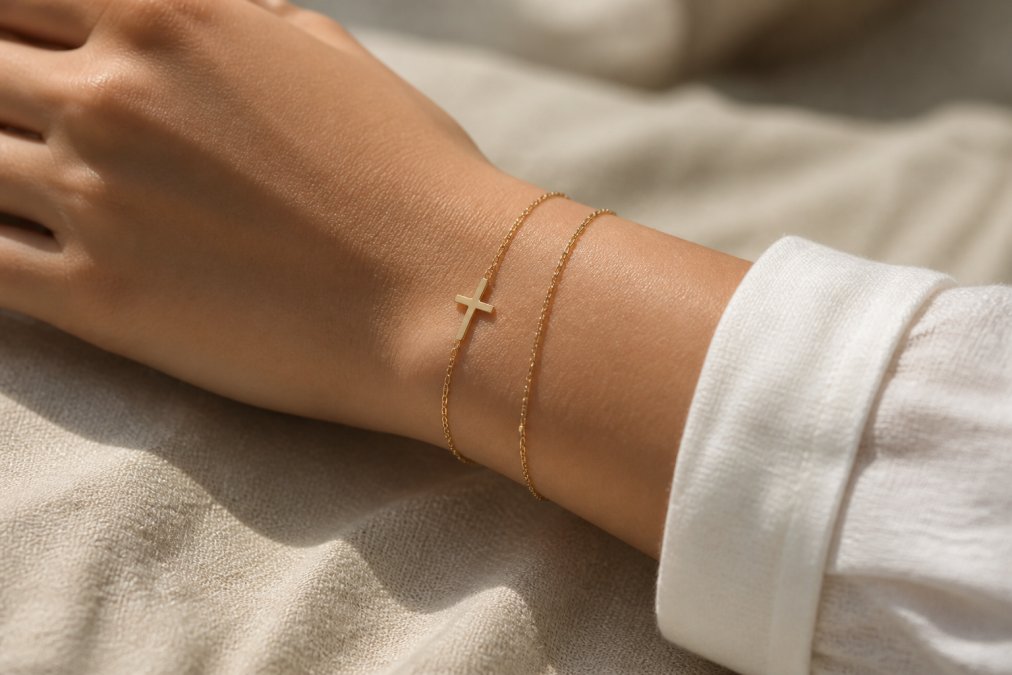
Wrist size and skin tone change which bracelets look best on you, and most guides skip both. A petite wrist gets swallowed by chunky links, while a wider wrist makes a single fine chain nearly invisible.
Pricing, Repair, and Warranty: What You Get for Your Money
Price tracks the base metal more than the design. A gold plated piece sits at the low end, vermeil in the middle, and solid 14k gold at the top. What you're paying for is how long the piece survives daily wear and whether the finish still looks right in two years. Cost per wear is the honest metric: a $40 vermeil bracelet worn daily for two years costs less per wear than a $15 plated one replaced three times in the same window.
Before you buy from anyone, ask four questions:
- What's the base metal, and is it stated on the listing?
- What's the gold layer thickness, in microns?
- What does the warranty cover, and for how long?
- How do I start a repair, and who pays shipping?
Frequently Asked Questions
Are dainty gold bracelets durable enough for daily wear?
It depends on construction and material. Solid 14k gold and stainless steel bases hold up best for daily wear, while plated and vermeil pieces need gentler handling. Look for tarnish-resistant finishes and secure clasps. Carlotta's S925 Cross Bracelet and Cross Bracelet (S925) are built for regular wear at $37.00 each, and the God First Bracelets at $24.60 work well as an everyday stack piece. Remove them before swimming, showering, or heavy workouts to extend their life.
How do you layer dainty gold bracelets without them tangling?
Mix chain weights and textures rather than stacking identical chains. Pair a fine satellite or curb link with a slightly heavier bangle so they sit at different depths. Keep the total to three or fewer bracelets per wrist, and use an adjustable clasp to control where each one rests. A single charm piece, like the S925 Cross Bracelet, anchors the stack without adding bulk. Take them off one at a time to avoid knots in storage.
What should I look for in durable gold jewelry for sensitive skin?
Skip brass or nickel-heavy bases, which are common triggers for green skin and irritation. Choose hypoallergenic materials such as stainless steel or sterling silver, and check that any gold layer is thick enough to resist wearing through. Tarnish-resistant finishes help too. The S925 Cross Bracelet uses a stainless steel base, which is a practical option if cheaper plated chains have caused reactions for you before.
How do you choose the right size for a dainty gold bracelet?
Measure your wrist snugly with a soft tape, then add roughly half an inch for a comfortable fit and up to an inch if you want a looser drape for stacking. Dainty chains look best when they sit close to the wrist without digging in. If you are between sizes, size up, especially if you plan to layer. Adjustable clasps give you room to fine-tune the fit across different wrists.
How do you clean gold bracelets without damaging the finish?
Mix a few drops of mild dish soap into warm water and soak the bracelet for five to ten minutes. Work a soft-bristled brush gently around the clasp and links, rinse under lukewarm water, and pat dry with a lint-free cloth. Avoid abrasive polishes, bleach, and ultrasonic cleaners on plated or vermeil pieces. Clean monthly, or more often if you wear your dainty gold bracelets daily and notice dulling around the clasp.