

How to Choose Jewelry for Your Skin Tone
Table of Contents
Why Your Skin Undertone Matters More Than Your Skin Tone
Most jewelry advice starts with how dark or light your skin is, but learning how to choose jewelry for your skin tone also means looking past that surface. That's only half the story. What really decides whether a gold chain or a silver bracelet looks radiant is your undertone, the subtle warm, cool, or neutral hue beneath the surface. A piece can look stunning on a product page and still feel "off" on your wrist. Usually the metal clashes with your undertone, not your complexion.
Undertone is the color that stays constant no matter how tan or pale you get. Two people with the same visible depth can have completely different undertones, which is why a single rule like "gold for dark skin, silver for light skin" fails so often. Knowing how to choose jewelry for your skin tone with undertone in mind gets you pieces that flatter every day.
- Skin tone changes with sun, season, and time of year
- Undertone stays the same, so it's the better guide for metal choice
- Matching metal to undertone creates a natural, glowing effect
How to Find Your Skin Undertone at Home
You don't need a lab to find your undertone. A few simple checks at home give a reliable answer for most people. Try them in natural daylight, away from colored walls or bright clothing that can shift how your skin looks.
The Vein Test and Its Limits
Look at the veins on the inside of your wrist. Greenish veins often suggest a warm undertone, while bluish or purple veins often point to a cool one. If you can't tell whether they look green or blue, you may be neutral.
This test is quick and popular, but it has limits. Lighting, skin thickness, and how much light your veins catch can all skew the result. Use it as a starting point, then confirm with the next check.
The Side-by-Side Fabric and Jewelry Test
Hold a white or cream fabric near your face, then compare it with a silver piece and a gold piece. If your skin looks brighter and clearer next to silver, your undertone leans cool. If gold makes your skin look warm and healthy, you likely have a warm undertone. If both metals look equally good, you're probably neutral.
This method works because it shows how your skin reacts to real metal in real light. It's the most practical test you can do at home.
- Use natural daylight near a window
- Remove other jewelry before testing
- Compare metals on the same wrist, one after another
Gold or Silver Jewelry for My Skin Tone
Once you know your undertone, the metal choice gets much simpler. Warm undertones usually glow in yellow gold, rose gold, and copper tones. Cool undertones tend to look sharpest in silver, platinum, and white gold. Neutral undertones have the most flexibility and can wear nearly any metal well.
If you're shopping for everyday wear, consider how a finish holds up over time. Gold-plated pieces offer a warm look at a lower price, but plating can wear with friction and contact with moisture. Compare gold plated and gold vermeil durability before you choose. Learn how durable cubic zirconia and plated finishes hold up over time.
Jewelry for Warm Skin Tones: Metals, Shapes and Stones
Warm undertones are often the easiest to style. Yellow gold, rose gold, and copper tones tend to make warm skin look luminous. See how gold-plated and gold-filled jewelry differ in quality and value.
Stones with golden or earthy hues also work well. Think amber, citrine, and warm-toned pearls. Shapes with soft curves often suit warm styles well.
Best Gemstone Colors for Skin Tone
Gemstone color can strengthen your metal choice. Cool undertones often pair well with blue and purple stones like sapphire and amethyst, as well as clear or icy stones. Warm undertones tend to shine with ruby, emerald, and golden stones. Neutral undertones can wear a wide range, so pick by mood or outfit.
Contrast is another tool. A deep emerald stone can make a fair complexion look brighter, while a soft pink stone can add gentle warmth to a deeper tone. Experiment until the stone makes your face look lively rather than washed out.
Mixing Metals, Materials and Your Personal Style
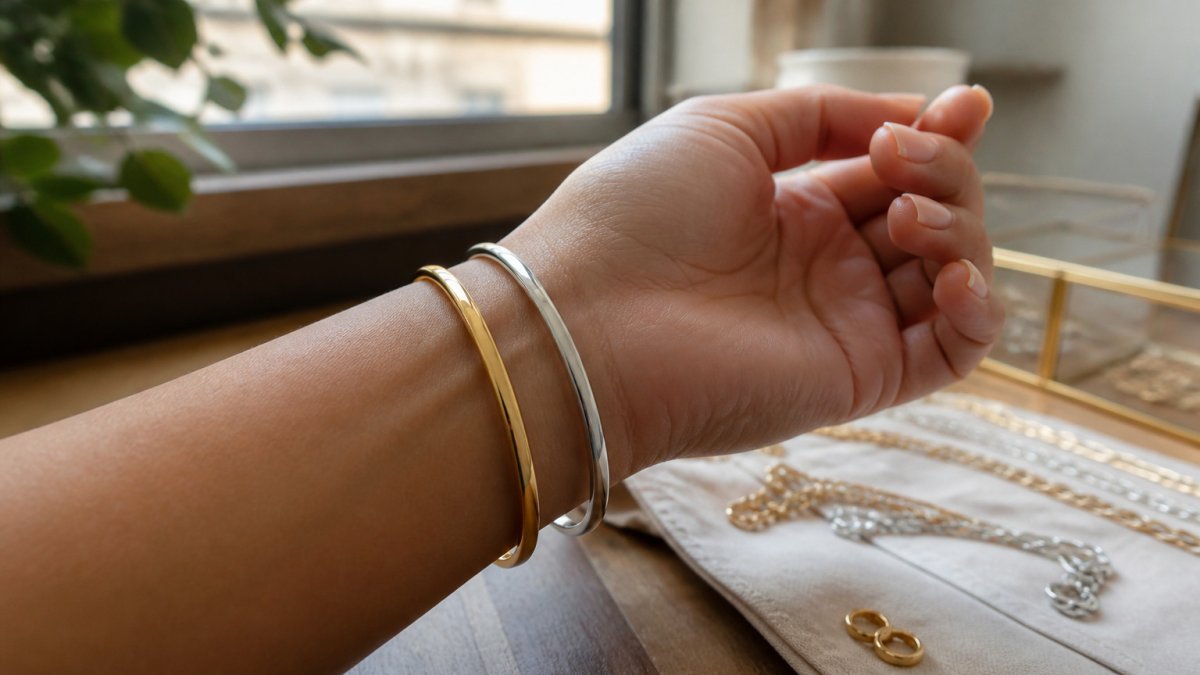
You don't have to stick to one metal. Mixing gold and silver pieces can look modern and intentional when you keep one metal dominant. Learn how to style layered gold bracelets with simple stacking rules. Start with a main metal that suits your undertone, then add a smaller accent in the other tone.
Materials matter too. If you have sensitive skin, check how a piece's materials are described before you buy. Sterling silver generally needs regular cleaning to stay bright. Follow these steps to clean sterling silver cross jewelry safely.
- Keep one dominant metal per outfit
- Use a smaller accent in a second metal
- Choose materials for comfort, not just color
Choosing Your Next Piece: Matching Jewelry to Occasion and Budget
The right piece depends on where you'll wear it. For everyday wear, choose durable metals, simple designs, and stones that hold up to daily activity. For special occasions, bolder pieces and richer stones can make a stronger statement.
Budget matters, too. Pricing depends on the piece, the finish, and the current promotions, so check our site for current prices. Seasonal offers may be available, so it's worth checking for current promotions before you buy.
Start with a piece that matches your undertone and your daily routine. Then build from there. A well-chosen chain or bracelet you wear every day will do more for your style than a dozen pieces that never leave the box. Shop the collection at Carlotta and find the metal and finish that fit your skin.
Frequently Asked Questions
How do I know what jewelry looks best with my skin tone?
Start by identifying your undertone rather than your overall complexion. Warm undertones usually suit yellow and rose gold, cool undertones tend to look best with silver, platinum and white gold, and neutral undertones can wear both. Test pieces in natural daylight, since indoor lighting can shift how metals appear. Your own comfort and what you already wear daily matter just as much as any rule.
Should I wear gold or silver jewelry for my skin tone?
Gold generally flatters warm undertones, which show golden or peachy tones, and silver or white metals often flatter cool undertones with pink or blue tones. If you are neutral, you have the most flexibility. Many people also simply prefer one metal because it matches their wardrobe. Gold-plated pieces are one option to consider when you're testing a metal.
How can I tell if I have warm, cool, or neutral undertones?
Look at the veins on the inside of your wrist in natural light. Greenish veins usually indicate warm undertones, bluish or purple veins suggest cool undertones, and a mix of both points to neutral. Also notice how your skin reacts to gold versus silver held against your face. If one consistently makes you look brighter, that is a useful clue, though results can vary with lighting and skin condition.
Can I wear gold and silver jewelry together?
Yes. Mixing metals is increasingly accepted, especially when one metal is dominant and the other acts as an accent. Choose a main metal for your largest piece, such as a chain, and add a smaller piece in the second metal. Keeping the overall palette limited to two metals helps the look appear intentional rather than accidental.
