

How to Clean Sterling Silver Cross Jewelry
Table of Contents
- Why Sterling Silver Cross Jewelry Needs Regular Cleaning
- What You'll Need Before You Start
-
How to Remove Tarnish From Silver Jewelry
- First, understand what you're removing
- Method 1: Polishing cloth (light tarnish, 2-5 minutes)
- Method 2: Mild soap and water (moderate tarnish, 5-10 minutes)
- Method 3: Commercial silver dips and liquids (heavy tarnish, 30 seconds to 2 minutes)
- Method 4: Aluminum foil and baking soda (heavy tarnish, no abrasion)
- Method 5: Baking soda paste (spot treatment only)
- Which method for which piece?
- Using a Sterling Silver Polishing Cloth for Quick Maintenance
- How to Clean Silver Jewelry With Gemstones
- How to Store Sterling Silver Jewelry to Prevent Tarnish
- Common Mistakes to Avoid When Cleaning Your Cross
- Frequently Asked Questions
Last Updated: October 9, 2026
Why Sterling Silver Cross Jewelry Needs Regular Cleaning
Sterling silver tarnishes, not a defect, but chemistry.
Tarnish is reversible, and regular cleaning protects the metal underneath from deeper damage.
We recommend how to clean sterling silver cross jewelry every few months, depending on wear frequency, tarnish traps moisture against the metal and causes corrosion.
The real benefit is longevity: a regularly cleaned cross bracelet or necklace maintains its shine and structural integrity for years.

What You'll Need Before You Start
Gather these items before you begin cleaning your sterling silver cross jewelry:
- A soft, lint-free cloth (microfiber works best)
- A polishing cloth designed for silver
- Mild dish soap
You don't need expensive products, household items handle light tarnish. If your cross pendant or bracelet has gemstones, avoid abrasive cleaners (covered below).
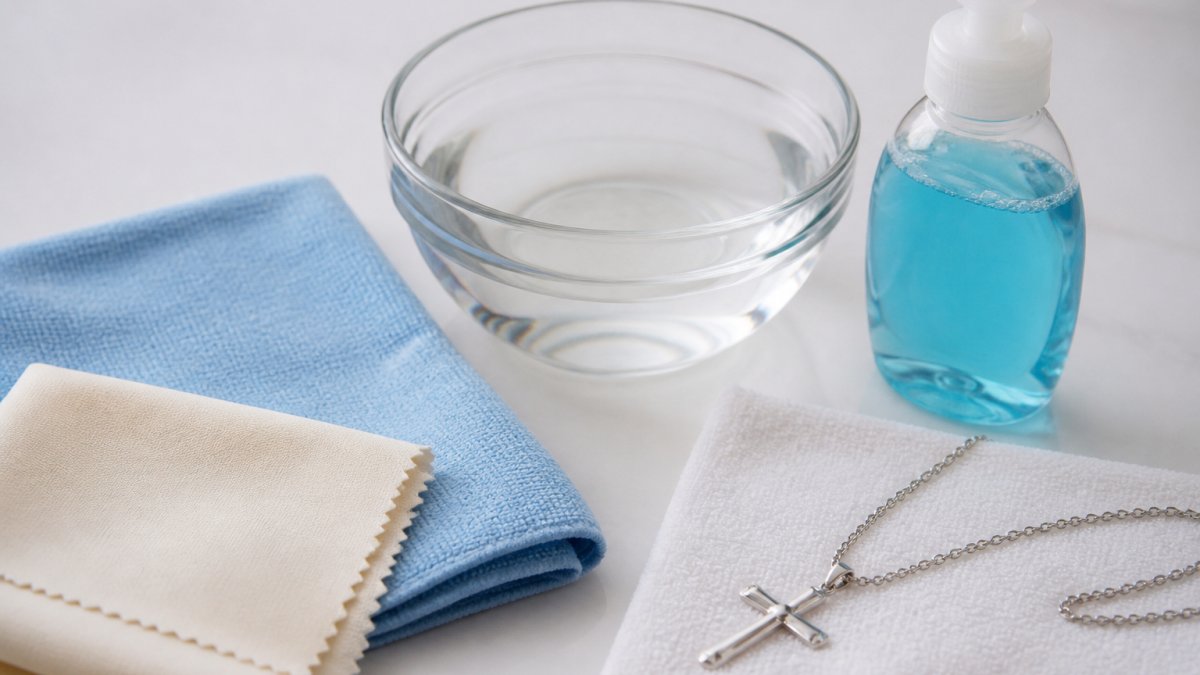
Paper towels and rough fabrics scratch silver, so stick with soft cloths. A polishing cloth removes tarnish without damaging the metal.
How to Remove Tarnish From Silver Jewelry
The right method depends on how much tarnish has built up, and on whether your cross has gemstones, enamel, or an oxidized (darkened) finish you want to keep. Match the method to the piece, not the other way around.
First, understand what you're removing
Tarnish is silver sulfide (Ag₂S), a dark compound that forms when silver meets sulfur in air, wool, rubber, and some foods. It's a reversible surface layer, not rust, but never scrub hard, because abrasion removes silver along with the sulfide, wearing away crisp edges over years of over-polishing.
Method 1: Polishing cloth (light tarnish, 2-5 minutes)
Best for: daily-wear crosses with a faint yellowish or gray haze.
- Work in good light so you can see the film.
- Rub the treated (usually inner) side of a silver polishing cloth over the piece in short, straight strokes, then small circles on flat areas.
- Fold the cloth into a point to reach the recesses of a cross pendant, the bail, and chain links.
- Buff residue with the untreated outer side.
Don't wash a polishing cloth, soap strips out the impregnated tarnish-removing compound. Replace it when it turns uniformly dark gray-black.
Method 2: Mild soap and water (moderate tarnish, 5-10 minutes)
Best for: pieces with textured surfaces, milgrain edges, or chain links where a cloth can't reach.
- Add two or three drops of mild, phosphate-free dish soap to a bowl of lukewarm water. Avoid "antibacterial" formulas and anything with ammonia, bleach, or citrus acids.
- Soak no more than 5 minutes, longer soaks wick moisture into settings and loosen glue on rhinestones.
- Agitate with a very soft baby toothbrush or makeup brush, using almost no pressure.
- Rinse under lukewarm running water with the drain stopped or over a fine strainer, so a small cross can't slip down the drain.
- Pat dry, then air-dry 10 minutes before wearing or storing.
Method 3: Commercial silver dips and liquids (heavy tarnish, 30 seconds to 2 minutes)
Best for: heavily blackened pieces with no gemstones, no enamel, and no intentional oxidation.
Products sold as "silver dip" or "liquid silver cleaner" (for example, Connoisseurs, Wright's, or Goddard's) dissolve silver sulfide chemically rather than abrading it. Follow the label exactly, and note three trade-offs:
- Dips strip intentional oxidation. If your cross has darkened recesses that give it an antique look, a dip will erase that contrast and leave the whole piece uniformly bright.
- Dips can damage some gemstones, pearls, and plated or rhodium-finished surfaces. Keep them away from anything but solid sterling.
- Repeated dipping dulls the surface over time. Reserve dips for genuine heavy-tarnish cases, not routine upkeep.
Method 4: Aluminum foil and baking soda (heavy tarnish, no abrasion)
This home method works by chemistry rather than scrubbing, reaching tarnish in crevices a cloth cannot.
- Line a glass or ceramic bowl with aluminum foil, shiny side up.
- Add one tablespoon of baking soda and one teaspoon of table salt per cup of hot (not boiling) water.
- Lay the sterling piece on the foil so it touches the metal, and pour the solution over it.
- Wait 2-5 minutes. The sulfur transfers from the silver to the foil, and the piece brightens without rubbing.
- Rinse, then dry thoroughly.
It can leave a slightly matte finish, so follow with a quick pass of a polishing cloth. Don't use it on pieces with glued stones or any lacquer or e-coat.
Method 5: Baking soda paste (spot treatment only)
A paste of three parts baking soda to one part water is mildly abrasive. Use it only on stubborn spots on plain sterling, apply with a fingertip or soft cloth, and rinse completely. Since it removes a trace of metal each use, treat it as a last resort.
Which method for which piece?
- Plain sterling cross pendant, light wear: polishing cloth weekly, soap-and-water every 2-3 months.
- Plain sterling chain and cross, heavy tarnish: foil-and-baking-soda bath, then a cloth buff.
- Cross with cubic zirconia or rhinestones: damp soft cloth only, no soaking, no dips.
Using a Sterling Silver Polishing Cloth for Quick Maintenance
A sterling silver polishing cloth keeps jewelry bright between deep cleans. These cloths have a special coating that lifts tarnish without water or chemicals.
How to use one:
- Take your cross necklace or bracelet in one hand
- Gently rub the cloth across the entire surface using light pressure
- Use small circular motions on flat areas
- For detailed sections, fold the cloth to reach crevices
- Flip to a clean section as it darkens
This takes 2-3 minutes and can be done weekly for daily-wear pieces. Replace the cloth when it's too dark to be effective.
At Carlotta, we recommend keeping a polishing cloth in your bedroom or bathroom for quick touch-ups, faster than a full cleaning and a form of preventive maintenance.
How to Clean Silver Jewelry With Gemstones
Gemstone-set crosses need a different routine because the risk is the setting and the stone, not the silver. Water, heat, and chemicals can loosen prongs, dissolve adhesives, cloud a stone, or strip a coating.
Sort by stone first
Durability on the Mohs hardness scale tells you what a stone can survive:
- Diamond (10), sapphire and ruby (9), cubic zirconia (about 8.5): durable enough for a gentle soap-and-water wash.
- Amethyst, citrine, garnet (7): fine with brief soapy water, but keep them out of ultrasonic cleaners and steam.
- Emerald (7.5-8 but heavily included), opal (5.5-6.5), pearl (2.5-4.5), turquoise (5-6): fragile. Use a dry or barely damp soft cloth only. Opals can craze (crack internally) from sudden temperature change, and pearls lose their nacre to soap, perfume, and acids.
If you don't know the stone, assume it's fragile and clean with a dry cloth.
The safe routine for durable stones
- Add a drop of mild dish soap to lukewarm water.
- Dip a soft baby toothbrush in the solution and brush the metal around the stone, not the stone itself.
- Rinse by dipping the piece in a second bowl of clean lukewarm water rather than under a running tap, which can push water into settings.
- Blot dry with a lint-free cloth, then let it sit 15 minutes before storing.
The safe routine for fragile stones and glued settings
- Dampen (do not wet) a soft microfiber cloth with plain water.
- Wipe the silver only, working around the stone rather than over it.
- Dry immediately with the dry side of the cloth.
- Once a month, run a dry soft brush over the prongs to lift dust that dulls a stone's sparkle.
What to avoid, and why
- Ultrasonic cleaners: fine for diamond and plain metal, risky for emeralds, opals, pearls, and any glued stone. The vibration can shake a loose stone free.
- Steam cleaners: heat shock can crack opals and damage adhesives.
- Silver dips: the acid can attack porous stones and strip rhodium plating.
Sensitive skin and hypoallergenic considerations
If your cross leaves a green or black mark, or your skin itches under the pendant, the cause is usually tarnish residue transferring to skin, a nickel-containing alloy in the clasp or chain, or a plated finish that has worn through.
- Sterling silver (925) is the standard for sensitive skin. It contains 92.5% silver and 7.5% copper, and copper is generally well tolerated. It is not nickel-free by definition, but most sterling crosses are made without nickel in the alloy.
- Check the clasp and chain, not just the pendant. Ear wires and spring-ring clasps are the most common source of nickel exposure, even on otherwise fine jewelry.
- Rhodium-plated or e-coated sterling adds a barrier layer that helps with sensitivity, but the plating wears at high-friction points and needs re-plating over time.
When to hand it to a jeweler
Take the piece in if a stone is loose or wobbly, a prong is bent, the cross has an antique finish you want preserved, or you can't identify the stone. A jeweler can tighten a setting and clean the piece without risking the stone, usually far cheaper than replacing a lost gemstone.
How to Store Sterling Silver Jewelry to Prevent Tarnish
Storage makes a huge difference in how quickly your cross jewelry tarnishes. The right environment slows the process significantly.
Best storage practices:
- Keep jewelry in a cool, dry place away from direct sunlight
- Use airtight containers or resealable bags to limit air exposure
- Store pieces separately to prevent scratching
Storing cross necklaces and bracelets in a jewelry box or drawer is fine, but add chalk or a silica gel packet to absorb moisture and slow tarnish.
Never store sterling silver jewelry in damp basements or attics. Temperature fluctuations and humidity accelerate tarnish. A bedroom closet or dresser drawer is ideal.
Common Mistakes to Avoid When Cleaning Your Cross
These errors can damage your sterling silver cross jewelry or reduce its lifespan.
Don't clean obsessively. Over-cleaning wears away the protective patina and thins the metal over time.
Don't ignore drying completely. Leaving jewelry wet or damp speeds tarnish formation.
The most common mistake is using a polishing cloth too aggressively.
At Carlotta, we believe meaningful jewelry deserves thoughtful care.
Frequently Asked Questions
Can you clean a sterling silver cross with dish soap and water?
Yes, mild dish soap and warm water is one of the gentlest methods for cleaning sterling silver cross jewelry. Mix a small amount of dish soap with lukewarm water, soak your cross for 5-10 minutes, then gently scrub with a soft cloth. Rinse thoroughly with clean water and dry immediately with a soft towel. This method works well for regular maintenance and is safe for most cross designs, including those with delicate details.
How often should you clean sterling silver cross jewelry?
Clean your sterling silver cross jewelry every 1-3 months with regular use, or when you notice visible tarnish or dullness. Daily-wear pieces may need cleaning more frequently. If you store your cross properly in an airtight container, you can extend the time between cleanings. Regular maintenance prevents heavy tarnish buildup and keeps your cross looking fresh and meaningful for years to come.
What is the safest way to remove tarnish from sterling silver jewelry?
The safest method uses a soft polishing cloth or mild soap and water to gently remove surface tarnish. For stubborn tarnish, create a paste with baking soda and water, apply it gently with a soft cloth, then rinse thoroughly. Avoid harsh chemicals, abrasive scrubbers, or prolonged soaking that can damage sterling silver. Always test on a small area first, and consider professional cleaning for pieces with gemstones or intricate designs.
How do you keep a sterling silver cross from tarnishing?
Store your sterling silver cross in an airtight container, zip-lock bag, or jewelry box away from moisture and air. Add anti-tarnish strips or silica gel packets to your storage to absorb humidity. Keep crosses away from harsh chemicals, perfumes, and direct sunlight. Remove your cross before swimming, showering, or exercising. Proper storage combined with regular cleaning keeps your cross protected and extends its lifespan significantly.