

The Meaning of Each Gemstone Birthstone, Month by Month
Last Updated: November 5, 2026
Quick Summary
Birthstone meanings link each month of the year to a gemstone with symbolism drawn from history, folklore and modern marketing. For example, garnet for January is associated with protection and loyalty, while ruby for July represents passion and vitality. Traditional and modern lists differ, so choose the stone that matches the look and durability you want.
- January's garnet is traditionally associated with protection and loyalty.
- Diamond for April is the most recognizable stone on most birthstone lists.
- Diamond rates 10 on the Mohs hardness scale, the highest possible rating.
- Pearl and turquoise scratch easily and should not share a box with harder stones.
- Choose traditional stones for classic association, or modern options for durability.
Table of Contents
- The Origins of Birthstone Lists
- Why the Lists Changed Over Time
- Birthstones by Month: Meanings and Symbolism
- Modern vs Traditional Birthstones: Which List Should You Follow?
- The Science Behind Birthstones: Hardness, Clarity and Mineral Properties
- How to Choose Birthstone Jewelry You Will Actually Wear
- Caring for Birthstone Pieces and Ethical Sourcing Considerations
- Choosing Your Birthstone Piece at Carlotta
- Frequently Asked Questions
Birthstones are gemstones associated with each month of the year, and many people in the United States choose jewelry set with the stone tied to their birth month, so understanding birthstone meanings can help you pick a piece with purpose. For ideas on wearing accessory pieces you will reach for often, see styling cross-themed accessories.
A birthstone is a gemstone traditionally linked to a calendar month, and it is often given as a gift to mark a birthday or anniversary, with birthstone meanings built up over centuries of folklore and trade.
Birthstone Traditions, Ranked by Frequency
Most guides agree on the basics, but they disagree on the details. Here is what usually shows up:
- Garnet for January, typically a deep red stone
- Amethyst for February, a purple quartz
- Aquamarine or bloodstone for March
The Origins of Birthstone Lists
Where the Idea Came From
The idea of linking gemstones to months is older than most people assume. Many accounts trace it back to the breastplate of the High Priest described in the Hebrew Bible, which was said to hold twelve stones, each tied to one of the tribes of Israel.
A common approach among jewelers is to present the list as a tradition, not a rule. The modern month-stone pairings were largely standardized in the twentieth century, when trade groups and jewelers began promoting a single official list.
Why the Lists Changed Over Time
Shifting Standards and Modern Charts
The list you see today is not the same as the one used a century ago. Different regions, jewelers and trade organizations have promoted different stones for the same month, and some months now have an official "traditional" stone alongside a newer alternative.
Because the lists changed, there is no single authoritative chart, and that is worth remembering when a retailer insists one stone is the "correct" pick for your month.
Birthstones by Month: Meanings and Symbolism
Each month's stone carries symbolic meanings that have been attached over time. These meanings are cultural, not scientific, and they vary across traditions, so treat the associations below as a starting point for the story you want a piece to tell, not a fixed definition.
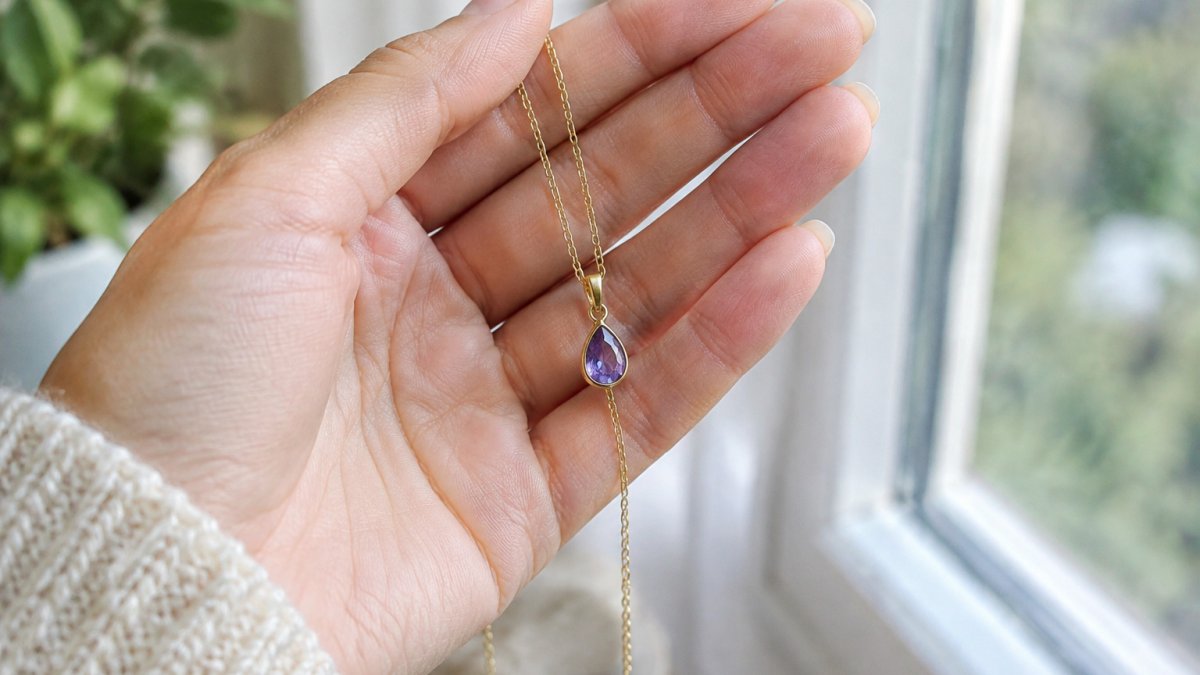
- January (Garnet): Often associated with protection and loyalty, and in older folklore with safe travel. Garnet is not one mineral but a family; the deep red pyrope and almandine varieties are the classic birthstone look, while rhodolite leans purple-red and tsavorite is a rare green garnet. It is durable enough for everyday rings.
- February (Amethyst): Traditionally linked to calm, clarity and sober judgment, a association old enough that some traditions called it the stone of clear thinking. It is a purple variety of quartz, and its color ranges from pale lilac to deep violet; most of the saturated purple on the market is heat-treated, which is an accepted and permanent practice.
- March (Aquamarine or Bloodstone): Aquamarine is linked to courage and tranquility, with a pale blue to blue-green color that ranges from nearly colorless to a saturated "Santa Maria" blue. Bloodstone, a dark green stone flecked with red, is the traditional alternative and was historically tied to endurance and healing.
Watch out: Many shoppers assume all birthstones are equally hard. They are not.
Here is a quick reference of each month's birthstone and the meaning attached to it, drawn from the sections above.
| Month | Birthstone | Traditional meaning |
|---|---|---|
| January | Garnet | Protection and loyalty |
| February | Amethyst | Calm, clarity and sober judgment |
| March | Aquamarine or Bloodstone | Courage and tranquility |
| April | Diamond | Strength and lasting value |
| May | Emerald | Renewal, growth and rebirth |
| June | Pearl, Moonstone or Alexandrite | Purity and intuition |
| July | Ruby | Passion, vitality and protection |
| August | Peridot or Spinel | Good fortune |
Modern vs Traditional Birthstones: Which List Should You Follow?
Choosing Between Traditional and Modern Lists
The traditional list is the one most older jewelry sellers still use. The modern list, promoted by trade groups in the United States, adds alternative stones for each month, often including more durable or more affordable options.
Traditional birthstones suit anyone who wants the classic association and the stone their family or a gift-giver is likely to expect. Modern birthstones suit shoppers who want a specific color or who need a more durable stone for daily wear.
The Science Behind Birthstones: Hardness, Clarity and Mineral Properties
Most birthstone guides stop at folklore. This section takes the opposite approach: it treats each stone as a material with measurable properties, because those properties decide whether a birthstone ring survives daily wear and whether the price you are quoted makes sense.
Hardness: The Mohs Scale in Practice
Gemstones are rated for scratch resistance on the Mohs scale, which runs from 1 (talc) to 10 (diamond) (gia.edu). The scale is ordinal, not linear, diamond at 10 is dramatically harder than corundum at 9, and the gap between 9 and 8 is larger than the gap between 8 and 7. For a birthstone buyer, the practical bands are:
- 10: Diamond (April). Resists scratching from almost anything it will meet in normal wear.
- 9: Corundum, ruby (July) and sapphire (September). Excellent for daily rings.
- 7.5-8: Emerald (May, 7.5-8), spinel (August, 8), topaz (November, 8), zircon (December, 6.5-7.5), tourmaline (October, 7-7.5), garnet (January, 6.5-7.5), quartz-family stones including amethyst (February) and citrine (November) at 7.
- 6-6.5: Tanzanite (December, 6-7), moonstone (June, 6-6.5), peridot (August, 6.5-7).
A useful rule of thumb: a stone rated 7 or above is generally reasonable for an everyday ring; below 7, choose a pendant, earring, or a protective bezel setting.
Chemical Composition and Why It Matters
Mineral family explains many of the differences above. Quartz (silicon dioxide) covers amethyst and citrine, which is why both share a hardness of 7. Beryl covers emerald and aquamarine. Corundum covers ruby and sapphire. Pearl is organic, layers of calcium carbonate (aragonite) held by conchiolin, which is why it behaves nothing like a mineral gem. Opal is hydrated silica with a variable water content, and that water is part of why it can craze or crack with sudden temperature change.
Clarity, Cut and Treatments
Clarity and cut affect how a stone looks, and a faceted stone reflects light differently than a smooth cabochon. To learn how to tell natural stones from synthetic ones, see how to tell if a gemstone is natural or synthetic. Translucency and refractive index shape appearance, which is why two stones of the same type can look very different. Treatments are routine and legal when disclosed: emerald is commonly oiled or resin-filled, sapphire and ruby are commonly heat-treated, blue topaz is irradiated, and opal may be treated with sugar or smoke.
Natural, Lab-Grown and Simulated
Real gemstones and lab-grown stones share the same chemistry and crystal structure; a lab-grown ruby is corundum, and a lab-grown diamond is carbon.
Watch out: A high Mohs rating does not mean a stone is tough. Diamond is the hardest natural material but has perfect cleavage and can chip from a sharp blow, while jade, softer on the scale, is far tougher.
How to Choose Birthstone Jewelry You Will Actually Wear
Practical Factors to Weigh
Start with how you plan to wear the piece. A ring worn daily needs a stone with a high Mohs rating and a secure setting.
Consider the setting as well. Prong settings protect the stone, while bezel settings shield its edges.
Think about color and size next.
Finally, check how the jeweler describes the stone. Ask whether it is natural, lab-grown or simulated, and ask for the carat weight.
Caring for Birthstone Pieces and Ethical Sourcing Considerations
Cleaning, Storage and Responsible Buying
Most birthstone jewelry is cleaned with warm water, mild soap and a soft brush. To understand why metal and stones dull over time, see what causes jewelry to tarnish quickly. For durable everyday options, read our quality gold chains for daily wear guide.
Ethical sourcing matters to many buyers.
Watch out: Ultrasonic cleaners can crack stones with internal fractures or damage softer materials, so avoid them for most birthstone pieces unless the jeweler confirms the stone is safe for that method.
Choosing Your Birthstone Piece at Carlotta
Carlotta offers a curated collection of chains, bracelets and cross-themed accessories. Pricing depends on the piece, quantity, dates and delivery, so check our website for current prices and seasonal offers.
If you are unsure which stone to pick, start with the month, then decide between traditional and modern stones, and finally weigh hardness and setting against how often you plan to wear the piece.
Frequently Asked Questions
What do different birthstones symbolize?
Most birthstones carry symbolic meanings tied to their color and the traditions attached to them. Garnet is associated with protection and devotion, amethyst with calm and clear thinking, and emerald with growth and renewal. Diamond is widely linked to strength and enduring love. Meanings vary by culture and era, so treat them as traditions rather than proven effects. Many shoppers choose the stone whose meaning matches the wearer's personal story, which is often the most meaningful reason to pick one.
What is the rarest birthstone?
Among the traditional birthstones, alexandrite (June's alternative) and red beryl are among the rarest gem materials found in commercial quantities, and fine examples of both are scarce. Other stones, such as jadeite and some colored diamonds, are also uncommon at high quality. Rarity is not the same as value, though. Price depends on size, color, clarity and treatment, so compare individual stones on those factors rather than relying on rarity alone.
What is the weakest birthstone?
Opal and pearl are among the softest traditional birthstones, which makes them more prone to scratches and damage. Opal rates roughly 5.5 to 6.5 on the Mohs hardness scale, and pearl is softer still. Harder stones such as sapphire and diamond, rated 9 and 10, resist wear far better. Softer stones are still wearable in jewelry, but store them separately and remove them for heavy activity, cleaning and sports.
What is the difference between modern and traditional birthstones?
Traditional birthstone lists date back to early religious and biblical associations and were standardized in the United States in 1912 by the National Association of Jewelers, now Jewelers of America. Modern lists, updated in 2002, added or substituted stones to broaden choice and include gems that are more available and affordable. Both are valid. Many people pick the modern stone for variety and the traditional one for historical meaning, so choose whichever list reflects what matters to you.
How do I choose birthstone jewelry I can wear every day?
Start with hardness, since stones rated 7 or higher on the Mohs scale handle daily wear best. Choose a setting that protects the stone, such as a bezel or a secure prong setting, and pick a gold or plated finish that suits your skin and budget. Simple, versatile designs work well for everyday pieces, while more delicate stones suit occasional wear.
How do I care for birthstone jewelry?
Clean most birthstone jewelry with warm water, a drop of mild dish soap and a soft brush, then dry it gently with a soft cloth. Avoid harsh chemicals, chlorine and ultrasonic cleaners for softer or treated stones such as opal, pearl and emerald. Store pieces separately to prevent scratching, and remove jewelry before swimming, exercising or cleaning.
Are birthstones ethically sourced?
Sourcing varies widely by stone. Some gems, including diamonds, have documented concerns that the Kimberley Process addresses only partially, while colored stones often come from artisanal mining with limited oversight. Lab-grown alternatives are chemically identical and avoid mining concerns, though they are a different product.
Can I buy a birthstone necklace or bracelet for someone as a gift?
Yes. A birthstone chain or bracelet is a common gift for friends and family, and choosing a stone that matches the recipient's birth month adds personal meaning. Pricing depends on design, materials, quantity and delivery timing, so check the current options on the Carlotta website for specific prices or to request a quote.
