

What Causes Jewelry to Tarnish Quickly: 7 Common Reasons
Table of Contents
- What Is Jewelry Tarnish and Why It Happens Fast
- 7 Common Causes of Rapid Jewelry Tarnish
- Does Gold Plated Jewelry Tarnish?
- How to Prevent Jewelry from Turning Skin Green
- How to Clean Tarnished Jewelry Safely at Home
- Proper Storage and Preventative Maintenance Tips
- Frequently Asked Questions
Last Updated: September 16, 2026
What Is Jewelry Tarnish and Why It Happens Fast
Jewelry tarnish is a surface-level chemical reaction that darkens or dulls metal, and what causes jewelry to tarnish quickly comes down to one thing: exposure. At Carlotta, customers often ask why a piece they love turned dark within weeks, usually sulfur, moisture, and skin chemistry.
7 Common Causes of Rapid Jewelry Tarnish
Rapid tarnish almost always traces back to one of seven triggers, and most people deal with two or three at once.
- Sulfur and airborne pollutants
- Humidity and moisture exposure
- Body chemistry and pH balance
- Cosmetics, lotions, and perfumes
- Household chemicals and cleaning products
- Material reactivity and base metals
- Poor storage and atmospheric exposure
1. Sulfur and Airborne Pollutants
Sulfur is the single biggest chemical culprit behind tarnish. It exists in the air as hydrogen sulfide and sulfur dioxide, both of which bond readily with silver and copper, and urban or industrial areas raise sulfur levels enough to accelerate discoloration.
2. Humidity and Moisture Exposure
Moisture speeds up every chemical reaction that causes tarnish. High humidity leaves a thin film of water on metal surfaces, giving sulfur compounds an easier path to bond, bathrooms, kitchens, and coastal climates are the worst offenders. Storing jewelry in a bathroom cabinet is a common mistake, since shower steam drives rapid discoloration.
3. Body Chemistry and pH Balance
Your skin's pH balance and natural body oils affect how fast your jewelry tarnishes. Acidic skin reacts aggressively with base metals, and sweat contains sulfur compounds that bond with metal on contact. If a chain darkens within days, your body chemistry is often the reason, not a flaw in the jewelry, but a chemical mismatch.
4. Cosmetics, Lotions, and Perfumes
Cosmetics, lotions, perfumes, and hairspray are loaded with sulfur, acids, or alcohol that strip protective layers and leave metal exposed. Applying perfume directly onto a necklace is one of the fastest ways to dull it, so let skincare products absorb fully first.
5. Household Chemicals and Cleaning Products
Cleaning products, bleach, and chlorine are brutal on jewelry: they corrode the surface layer and can permanently pit metal, and even brief bleach contact can discolor a piece beyond simple polishing. Always remove jewelry before cleaning, swimming, or handling harsh chemicals.
6. Material Reactivity and Base Metals
Not all metals react at the same rate. Sterling silver, copper, and brass tarnish quickly because they contain reactive metals, and gold plating over brass or copper tarnishes once the plating wears thin. Tarnish speed depends less on price tag than on what's underneath the finish.
7. Poor Storage and Atmospheric Exposure
Leaving jewelry out in the open invites tarnish: airborne pollutants, humidity, and sulfur gases reach exposed metal continuously, so a piece left on a dresser for a month darkens faster than one sealed in an airtight container. Proper storage is preventative maintenance, and the easiest cause to control.
Does Gold Plated Jewelry Tarnish?
Yes, gold plated jewelry can tarnish. Pure gold is one of the least reactive jewelry metals, it doesn't bond readily with sulfur or oxygen, which is why solid gold can sit in a drawer for decades and stay bright. Gold plating, however, is a micron-thin layer of gold over a base metal, and the base metal is what tarnishes.
Why the base metal is the real story
Gold plating is measured in microns (one-thousandth of a millimeter), with consumer plating ranging from about 0.5 microns (flash) to 2.5 microns or more (heavy). The thicker the layer, the longer the base metal stays sealed off from air and skin; once friction, sweat, or cleaning chemicals wear through the gold, the underlying brass, copper, or nickel alloy reacts with sulfur and moisture almost immediately.
How the common jewelry materials compare
| Material | Tarnishes? | Why |
|---|---|---|
| Fine silver (99.9%) | Yes, slowly | Pure silver is reactive but has no alloyed base metals to accelerate discoloration |
| Sterling silver (92.5%) | Yes, quickly | The 7.5% copper alloy is the reactive component; copper sulfides form the dark layer |
| Gold plated over brass or copper | Yes, once plating wears | Gold resists tarnish; the exposed brass or copper underneath does not |
| Gold filled | Slowly | A thicker bonded gold layer (legally required to be at least 5% gold by weight in the U.S.) outlasts plating by years |
| Solid gold (10K-24K) | Essentially no | Gold itself is inert to sulfur; lower karats contain alloy metals that can discolor slightly over long periods |
| Stainless steel (304, 316L) | Rarely | Chromium in the alloy forms a passive oxide layer that resists sulfur and moisture |
| Titanium, tungsten | No | Naturally passive oxide surface; not reactive with sulfur |
A useful rule: the more copper in the alloy, the faster the piece tarnishes. Sterling silver, brass, and copper-based plating all share copper as the reactive weak point.
How long plating actually lasts
There's no universal number, but under daily-wear conditions:
- Flash plating (under 1 micron): weeks to a few months before visible wear
- Standard plating (1-2.5 microns): several months to a year with careful wear
- Heavy plating (2.5+ microns) or gold filled: years
Wear frequency, skin pH, and exposure to perfume, sunscreen, and chlorine shorten those windows. Removing jewelry before showering, swimming, and applying lotions, and storing pieces in airtight containers with an anti-tarnish strip, extends the bright finish.
What to do when plating wears through
Once the base metal is exposed, home polishing can't restore the gold layer, it only removes tarnish on the exposed metal, brightening the piece temporarily but leaving it vulnerable within days. Replating by a jeweler is the only real fix, usually worth it only on pieces with sentimental or high material value.
How to Prevent Jewelry from Turning Skin Green
The green stain on skin comes from a reaction between your sweat and the base metals in jewelry, not from dirt: copper and other base metals form compounds when they meet sweat and skin acids, leaving a green mark. Prevention comes down to a few habits:
- Apply lotions, sunscreen, and perfume before putting jewelry on, and let them dry fully
- Remove pieces before workouts, showers, and swimming
- Wipe jewelry with a soft cloth after wearing to remove sweat and oils
- Choose pieces with thicker plating or solid metals when you have sensitive skin
- Seal the back of a pendant or ring with clear nail polish as a temporary barrier
How to Clean Tarnished Jewelry Safely at Home
You can clean most tarnished jewelry at home with mild soap, warm water, and a soft cloth. Skip harsh abrasives and ultrasonic cleaners unless you know the piece can handle them.
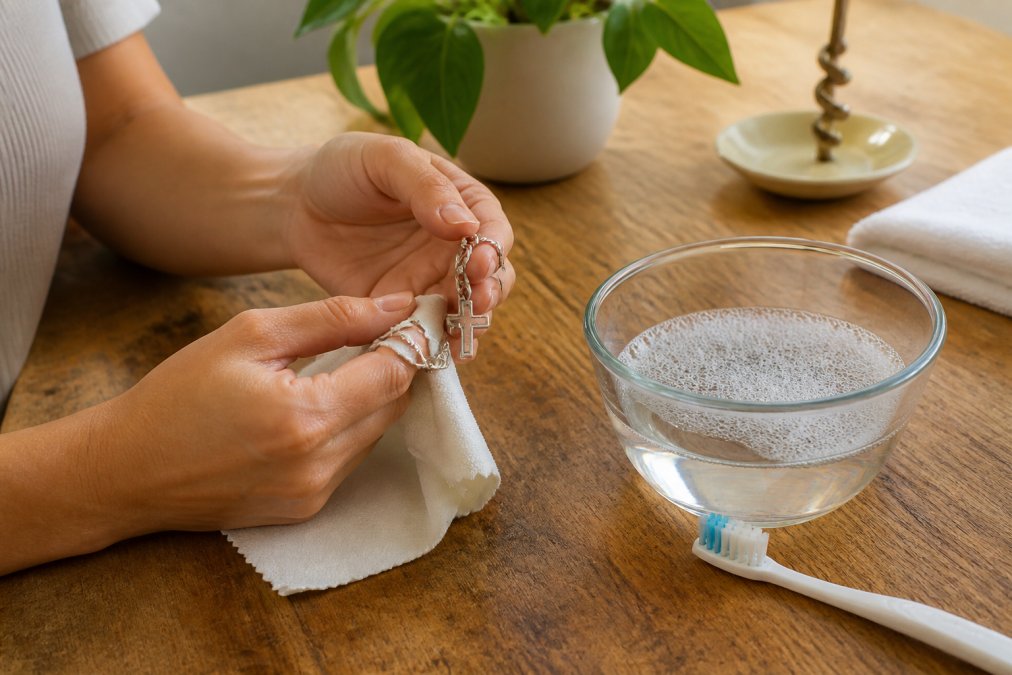
Follow these steps:
- Line a small bowl with aluminum foil, shiny side up
- Add warm water and a spoonful of baking soda
- Soak the piece for a few minutes
- Gently scrub crevices with a soft toothbrush
- Rinse with clean water and pat dry
- Buff with a polishing cloth to restore shine
DIY Methods vs. Professional Cleaning
DIY cleaning handles light tarnish well, fast, cheap, and safe for most pieces with gentle methods, but falls short on heavy corrosion, deep crevices, and delicate stones. Professional cleaning makes sense for significant tarnish, loose settings, or gemstones that can't handle water, since a jeweler can clean without damaging plating or settings.
Proper Storage and Preventative Maintenance Tips
Good storage is the cheapest tarnish prevention you'll ever use. The goal is to block air, moisture, and sulfur-bearing gases from reaching the metal, and since silica gel and anti-tarnish strips do different jobs, it helps to know which tool blocks which threat.
Silica gel vs. anti-tarnish strips: what each one actually does
Silica gel is a desiccant: porous silicon dioxide beads with an enormous internal surface area that pull water vapor out of the air inside a sealed container through adsorption. It does nothing about sulfur gases, it only controls moisture. That matters because moisture is the accelerant, not the fuel; dry air with sulfur in it will still tarnish silver, just more slowly.
In practice, the two products are complementary, not redundant:
- Silica gel handles humidity. Best for bathrooms-adjacent storage, coastal climates, and rainy seasons.
- Anti-tarnish strips handle sulfur. Best for urban areas, homes near industrial zones, and any sealed box where jewelry sits for weeks.
- Together in one airtight container, they cover both attack routes.
Replacement cadence and signs they've stopped working
Both products saturate over time and stop absorbing, and neither has a gauge, so use these signals:
- Silica gel: replace when the beads shift from indicating color (many consumer packets contain orange-to-green or blue-to-pink indicating beads) or every 1-2 months in a humid space. Rechargeable tins can be dried in an oven per the manufacturer's instructions.
- Anti-tarnish strips: replace every 2-3 months in a sealed container, sooner in a high-sulfur environment. If silver starts darkening again inside a sealed box that previously stayed bright, the strip has likely exhausted its capacity.
Storage setup that actually works
- Store each piece in an airtight bag or a lined jewelry box with a gasket seal. A zip-top bag beats open air; a hard case with a rubber gasket beats a bag.
- Add one silica packet and one anti-tarnish strip per container, not per piece. They treat the air, not the jewelry directly.
- Keep jewelry away from bathrooms and kitchens. Steam and cooking fumes raise local humidity and sulfur exposure.
- Separate pieces so they don't scratch each other's plating. Scratches expose base metal, which tarnishes far faster than the finish.
- Don't store jewelry on open dressers or hooks. Airborne sulfur reaches exposed metal continuously, and dust holds moisture against the surface.
| Cause | Quick Fix | How Often |
|---|---|---|
| Sulfur and pollutants | Airtight storage, anti-tarnish strips | Replace strips every 2-3 months |
| Humidity and moisture | Silica gel packets, dry location | Replace or recharge monthly |
| Body chemistry | Wipe after wear, choose better plating | Every wear |
| Cosmetics and perfumes | Apply products first, let dry | Every use |
| Household chemicals | Remove before cleaning | Every task |
| Base metal reactivity | Choose solid or thick-plated pieces | At purchase |
| Poor storage | Airtight containers, separate pieces | Daily |
A quick weekly wipe-down with a polishing cloth removes oils and moisture before they cause damage. Pair that with the right desiccant-plus-strip combination, and most pieces stay bright for months.
Frequently Asked Questions
Why is my jewelry tarnishing all of a sudden?
Sudden tarnishing often points to a change in environment or routine. Increased humidity, a new lotion or perfume, or switching to a different cleaning product can accelerate the chemical reaction. If you recently started wearing a piece daily without removing it for showers or workouts, moisture and body oils build up faster. Sulfur-containing gases in the air also play a role, especially if you live near industrial areas or use wool storage.
Does humidity cause jewelry to tarnish faster?
Yes. High humidity speeds up oxidation on sterling silver and base metals. Moisture in the air acts as an electrolyte that helps sulfur compounds reach the metal surface. Storing jewelry in a bathroom or wearing it in a sauna will make tarnish appear quicker. Using silica gel packets in an airtight container helps control moisture and slows the process.
Can perfume and lotions damage gold plated jewelry?
They can. Perfumes, lotions, and hairspray contain chemicals that break down the thin gold plating on costume jewelry. Once the plating wears away, the base metal underneath reacts with air and your skin, causing discoloration. Apply cosmetics first, let them dry, then put on your jewelry. Wipe pieces with a soft cloth after wearing to remove residue.
How can I fix tarnished jewelry at home?
For sterling silver, a polishing cloth or a paste of baking soda and water works well. Gently rub the tarnished area, rinse, and dry completely. For gold plated pieces, avoid abrasive methods; use a mild soap solution and a soft brush instead. Always dry thoroughly before storing. If the tarnish is heavy or the plating is flaking, a professional jeweler can assess whether cleaning is safe.
Tarnish is a chemical problem, not a mystery, and once you know the triggers, you can slow it down dramatically. Carlotta builds chains, bracelets, and cross-themed accessories for people who want timeless pieces they can actually wear every day. With airtight storage habits, a polishing cloth, and pieces designed to hold their finish, you get jewelry that stays sharp instead of turning dull in a drawer. Shop the full collection and take up to 30% off your favorites during seasonal offers.