

How to Tell if a Gemstone is Natural or Synthetic
Last Updated: October 23, 2026
Quick Summary
How to tell if a gemstone is natural or synthetic involves examining inclusions, growth patterns, and color uniformity under magnification, since natural stones show irregular patterns from geological processes while synthetics display more uniform characteristics from controlled laboratory conditions. Natural gemstones typically contain more inclusions than synthetics, and professional gemological testing with specialized equipment provides definitive authentication.
- Natural gemstones form over millions of years through geological processes, while synthetic gemstones are laboratory-created in weeks or months with identical chemical composition
- Synthetic gemstones typically cost 30-40% less than natural equivalents of the same type
- Air bubbles visible under magnification indicate imitation gemstones, as real gems exclude air during formation
- A loupe magnifying glass reveals inclusion patterns, growth lines, and manufacturing marks that distinguish stone origins
- Professional gemological reports from certified laboratories provide definitive authentication and cost typically $50-$200
Table of Contents
- Understanding Gemstone Types: Natural, Synthetic, and Imitation
- How to Tell if a Gemstone is Real: Visual Inspection Basics
- Synthetic vs. Imitation Gemstones: Key Differences Explained
- Synthetic Gemstone Inclusions and What They Tell You
- Gemstone Identification Tests You Can Perform at Home
- Professional Gemological Testing and Reports
- Gemstone Treatments and Disclosure: What You Need to Know
- Frequently Asked Questions
Understanding Gemstone Types: Natural, Synthetic, and Imitation
Natural gemstones are formed in the earth over millions of years through geological processes.
Learning how to tell if a gemstone is natural or synthetic matters because it affects value, durability, and authenticity. A natural diamond costs significantly more than a synthetic one, and a simulant may look beautiful but won't last under daily wear.
What Makes a Gemstone Natural
Natural gemstones form through geological processes deep in the earth, where heat and pressure transform mineral deposits over centuries.
Natural gemstones are rare because they require specific conditions to develop. Diamond, ruby, sapphire, and emerald are prized partly because finding high-quality examples takes time and resources, which drives their value.
Synthetic Gemstones and Lab-Created Stones
Synthetic gemstones are real gems made in laboratories with the same chemical composition and physical properties as natural stones. The key difference is origin: they're created in weeks or months rather than millions of years.
Lab-created gemstones are chemically identical to natural stones, not fake or imitation materials. A synthetic diamond is still a real diamond, just made in a lab.
Imitation Gemstones and Simulants
Imitation gemstones look like real gems but have different chemical makeup.
Simulants serve a purpose for affordable jewelry and fashion pieces and aren't deceptive if properly labeled. The problem arises when sellers misrepresent them as natural or synthetic gems.
Natural, synthetic, and imitation gemstones differ fundamentally in origin, composition, and cost.
| Gemstone Type | Origin | Chemical Composition | Typical Cost vs Natural |
|---|---|---|---|
| Natural | Earth over millions of years | Same as synthetic of same type | Baseline (higher) |
| Synthetic | Laboratory in weeks or months | Identical to natural equivalent | 30-40% less than natural |
| Imitation | Manufactured material | Different from real gem | Lowest cost |
| Glass simulant | Manufactured | Silicon dioxide | Lowest cost |
| Cubic zirconia | Manufactured | Zirconium dioxide | Lowest cost |
How to Tell if a Gemstone is Real: Visual Inspection Basics
The first step in determining authenticity is careful visual inspection of a stone's surface, color, and clarity. It won't give a definitive answer, but it provides valuable clues about whether a gemstone is natural, synthetic, or imitation.
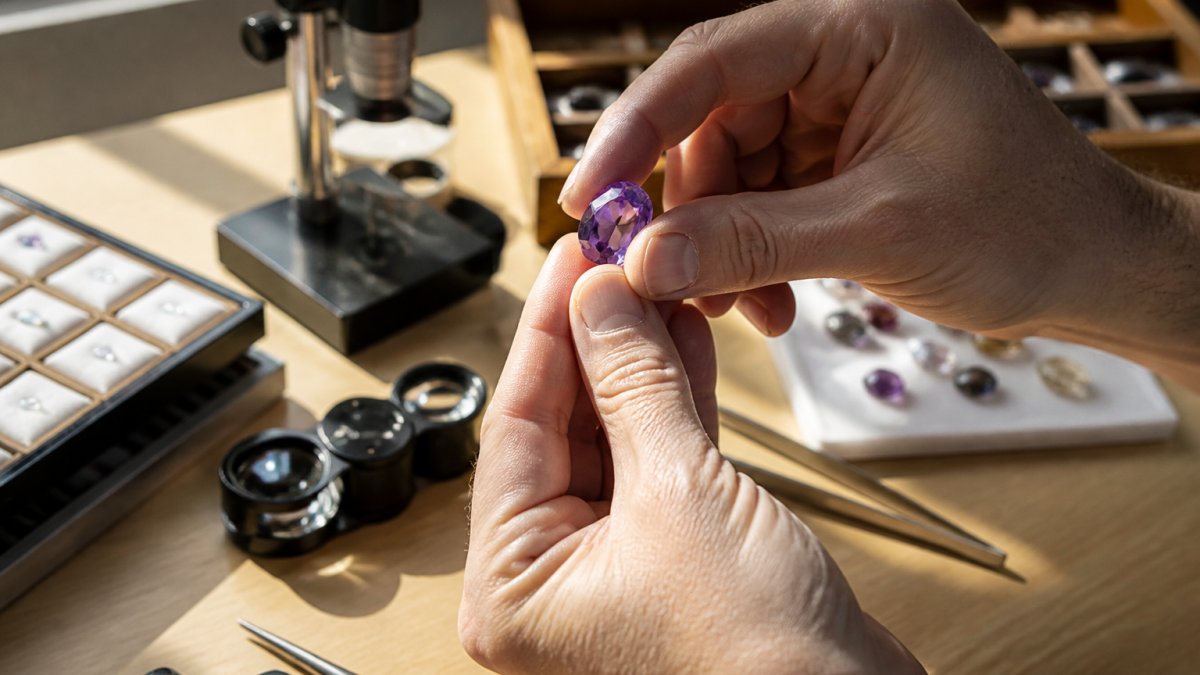
What to Look for With the Naked Eye
Examine the gemstone in good natural light.
Check for visible inclusions, the tiny materials trapped inside the stone during formation.
Examine the surface for scratches, polish marks, and wear patterns, which reveal the stone's age and handling.
Look at the light reflection. Natural gemstones refract light in specific ways based on their crystal structure, and simulants often reflect light differently than real gems.
Using a Loupe for Closer Examination
A loupe is a small magnifying glass that reveals details invisible to the naked eye.
Magnification reveals inclusion patterns clearly. Natural gemstones show characteristic inclusion types.
Look for growth lines and color banding under magnification.
Examine the facet edges where the stone was cut. Chipping or wear patterns provide clues about durability.
Synthetic vs. Imitation Gemstones: Key Differences Explained
Synthetic and imitation gemstones are both lab-made or manufactured, but they're fundamentally different materials.
Synthetic gemstones have the same chemical composition as natural stones. A synthetic ruby is still ruby, aluminum oxide with chromium impurities.
Imitation gemstones are different materials designed to look like valuable gems. Cubic zirconia imitates diamond but is softer and less durable.
Chemical Composition and Physical Properties
The chemical makeup of a gemstone determines its physical properties.
Imitation gemstones have completely different chemical compositions: cubic zirconia is zirconium dioxide, glass is silicon dioxide.
Natural and synthetic gemstones share identical hardness, density, and refractive index. Imitation gemstones have different properties that reveal their nature under professional testing.
How Growth Patterns Reveal Origin
Growth patterns form during the creation process and are visible under magnification.
Natural gemstones develop complex, irregular growth patterns over millions of years in varying conditions, while synthetics develop more regular, predictable patterns in controlled laboratory environments.
Imitation gemstones show manufacturing patterns. Glass shows cooling and molding patterns. Cubic zirconia shows manufacturing marks from the synthetic process.
Synthetic Gemstone Inclusions and What They Tell You
Inclusions are materials trapped inside a gemstone during formation, and like fingerprints, each stone's pattern is unique. Understanding them helps you determine whether a gemstone is natural, synthetic, or imitation.
Natural Inclusions vs. Lab-Created Markers
Natural gemstones contain inclusions formed during geological development, including other minerals, gases, and organic materials. Gemologists use these well-documented patterns to identify stones and their origins.
Synthetic gemstones contain fewer inclusions because they're created in controlled conditions, and when inclusions do appear, they follow laboratory patterns that differ from natural ones in recognizable ways.
Some synthetic gemstones are created inclusion-free, which actually signals their synthetic nature.
Air Bubbles and Other Signs of Imitation Materials
Air bubbles are the most obvious sign of imitation gemstones. Glass and other imitation materials often trap air during manufacturing.
Natural and synthetic gemstones don't contain air bubbles. The crystalline structure of real gems excludes air. Finding air bubbles means you're looking at an imitation material.
Other manufacturing signs include:
- Uneven color distribution from poor mixing
- Surface cracks from cooling too quickly
- Visible mold lines from manufacturing processes
These signs appear under loupe examination and confirm imitation status.
Gemstone Identification Tests You Can Perform at Home
Home testing provides useful information but has limitations. Learn how to tell if a diamond is real with a flashlight as a practical example of at-home testing methods. No single test definitively proves a gemstone's origin. Multiple tests together create a clearer picture. Professional testing remains the gold standard for authentication.
The Weight and Density Test
Different gemstone materials have different densities. A stone's weight compared to its size reveals clues about its composition.
To perform a density test, you need a scale that measures in grams and calipers to measure dimensions.
This test works best for common gemstones where density is well-documented.
Light Performance and Refractive Properties
How light travels through a gemstone reveals information about its composition.
Observe the light reflection and refraction in the stone. Natural and synthetic gemstones of the same type refract light identically.
Look at the "fire" in the stone, the colorful light sparkles. Diamond shows distinctive fire patterns.
Limitations and Risks of At-Home Testing
Home testing has real constraints. Visual inspection and basic tests provide clues but not certainty.
The biggest risk is misidentification. A stone that appears natural might be synthetic.
Some home tests can damage jewelry.
Home tests work best as preliminary screening. They help you narrow possibilities before professional testing.
Professional Gemological Testing and Reports
Professional gemological laboratories provide definitive gemstone authentication. Learn what to look for when buying vintage jewelry to understand authentication considerations across different jewelry sources. Certified gemologists use specialized equipment and trained expertise. A gemological report documents the stone's characteristics and origin.
What a Gemological Laboratory Examines
Professional gemologists examine gemstones using equipment unavailable to consumers. A microscope reveals inclusion patterns and growth characteristics.
Gemologists look for specific markers that indicate natural, synthetic, or imitation status. They examine inclusion patterns under high magnification.
Professional examination takes time. A thorough analysis might take 30 minutes to several hours depending on complexity.
Reading and Understanding Your Gemological Report
A gemological report documents the gemstone's characteristics and authentication.
The report notes any treatments or enhancements. Heat treatment, clarity enhancement, and color treatment are disclosed. These treatments affect value and durability.
The report includes a description of inclusions and growth patterns. These details explain how the gemologist reached their conclusions about origin.
Look for the gemologist's credentials. The laboratory should be recognized by industry standards. The American Gem Society maintains standards for gemological testing and reporting.
Gemstone Treatments and Disclosure: What You Need to Know
Many gemstones receive treatments to enhance appearance or durability. These treatments are legal and common, but they must be disclosed. Treated gemstones cost less than untreated ones. Understanding treatments helps you make informed purchasing decisions.
Heat Treatment and Clarity Enhancement
Heat treatment is the most common gemstone enhancement. Heating a gemstone can improve color, clarity, or both.
Clarity enhancement removes or fills inclusions. Fracture filling uses oils or resins to fill surface cracks.
Other treatments include irradiation to change color, coating to enhance appearance, and diffusion to add color.
Professional gemological reports disclose all treatments.
Why Disclosure Matters for Value and Authenticity
Disclosure protects consumers from overpaying for treated stones. Knowing the treatment status helps you understand fair pricing. The Federal Trade Commission provides guidance on gemstone disclosure to protect consumers from misleading claims.
Disclosure also affects durability expectations. Some treatments are permanent.
Reputable sellers disclose treatments clearly. If a seller won't discuss treatments, that's a red flag.
Authenticity includes honest disclosure. A treated gemstone is authentic when properly labeled.
Determining whether a gemstone is natural or synthetic matters for value, durability, and authenticity.
Frequently Asked Questions
What can I use to test if my gemstones are real at home?
You can perform basic visual inspections using a 10x loupe to examine inclusions and growth patterns, check the stone's weight relative to its size, and observe how light passes through it. However, at-home tests have limitations and cannot definitively prove authenticity. A density test using water displacement or a specific gravity scale can provide clues, but these methods work best when combined with professional examination. For valuable pieces, professional gemological testing is the most reliable approach to confirm whether a gemstone is natural or synthetic.
What is the difference between a synthetic gemstone and an imitation gemstone?
Synthetic gemstones are lab-created stones with the same chemical composition and crystal structure as natural gemstones, they are genuine gemstones made in a laboratory. Imitation gemstones, or simulants, are materials that look like gemstones but have completely different chemical compositions and physical properties. A synthetic diamond and a natural diamond are chemically identical; a cubic zirconia imitating a diamond is chemically different. Synthetic gemstones are more durable and valuable than imitations because they possess the authentic physical properties of the genuine mineral.
Are home gemstone tests reliable for identifying natural vs. synthetic stones?
Home tests provide useful initial clues but are not fully reliable on their own. Visual inspection with a loupe can reveal growth patterns and inclusions that suggest origin, and basic density tests offer supporting evidence. However, modern synthetic gemstones are increasingly difficult to distinguish from natural stones without specialized equipment like spectroscopes and microscopes. Professional gemological laboratories use multiple testing methods, including advanced spectroscopy, thermal imaging, and microscopic analysis, to provide definitive identification. For significant purchases or valuable pieces, professional examination is essential.
How can I tell if a gemstone has been treated or enhanced?
Many gemstones undergo treatments like heat treatment or clarity enhancement to improve their appearance. A gemological report will disclose any treatments applied. At home, some signs include unusual color saturation, visible fractures filled with foreign material, or clarity that seems too perfect for the gemstone type. However, many treatments are invisible to the naked eye. Always request disclosure from sellers about any treatments, this information affects both value and durability. A gemological certificate will specify exactly what treatments, if any, have been applied to the stone.
