

7 Infant Bracelet Checks Before You Buy Smooth Edges
Last Updated: November 20, 2026
Quick Summary
Infant bracelets with smooth edges are the first thing to check before a baby wears any jewelry, because a small wrist gives a sharp edge little room. Smooth, rounded edges reduce friction against soft skin and lower the chance of scratches, and a polished finish makes flaws easier to spot.
- Run a fingertip over every join and clasp before purchase and again before each wear.
- Remove bracelets during sleep, crawling, meals and car seat use.
- Measure the wrist just below the wrist bone and add about half an inch.
- Slide one fingertip under the band; two fingers fitting easily means it is too loose.
- Store removed bracelets out of the sleep area and out of baby's reach.
Table of Contents
- When Not to Put Jewelry on an Infant
- Baby Bracelet Size Guide: Measuring for a Comfortable Fit
- Infant Bracelet Safety and Fit Checks
- Step-by-Step Edge and Finish Inspection
- Infant Bracelets with Smooth Edges in Silver
- Infant Bracelets with Smooth Edges in Gold
- Your Next Step: Choosing a Bracelet You Can Check in Person
- Frequently Asked Questions
Infant bracelets with smooth edges are the first thing to check before a baby wears any jewelry. A small wrist gives a sharp edge very little room. A bracelet that looks gentle on the shelf can still snag skin or catch on clothing once it is on a moving baby.
Smooth, rounded edges reduce friction against soft skin. They also lower the chance of scratches when a baby's hand moves against a crib rail, a car seat strap or a parent's sleeve. A polished finish is easier to inspect than a textured one, so flaws show up before the bracelet is worn.
Watch out: a bracelet that looked smooth in product photos can still have a burr at a clasp or join. Run a fingertip over every join and clasp before purchase and again before each wear.
Best for: families who want a keepsake that feels safe against delicate skin. Skip if: the piece has any loose beads, small charms or exposed clasps that could come off.
When Not to Put Jewelry on an Infant
Some situations call for no jewelry at all, and the reasons differ by age. A newborn spends most of the day lying down, sleeping, and being carried, while an older infant is rolling, sitting, crawling, and mouthing everything within reach. Match the decision to the stage, not just to the bracelet.
Newborns and young infants (roughly 0 to 6 months)
- Skip bracelets during sleep, tummy time, and any period when the baby is not directly watched. A bracelet can press against the wrist under body weight, and a loose band can slip over the hand.
- Leave jewelry off during feeding, bathing, and diaper changes, when hands are moving and the bracelet is most likely to catch.
- Do not put a bracelet on a baby who is swaddled or in a sleep sack. Fabric can trap the bracelet against the skin and hide a tight fit.
Older infants and crawlers (roughly 6 to 12 months)
- Remove bracelets during crawling, pulling up, and floor play. A bracelet can catch on carpet, toy edges, or furniture and pull against the wrist.
- Take jewelry off before meals and messy play, when food and saliva collect under the band and irritate skin.
- Keep bracelets off during car seat use. Straps and buckles can press a bracelet into the wrist, and a small part can interfere with the harness fit.
Toddlers (roughly 12 to 36 months)
- Expect the child to pull, chew, and try to remove the bracelet. Small charms, beads, and clasps are choking hazards at this age, and a bracelet that comes off in the mouth is a serious risk.
- Remove jewelry during active play, climbing, and any time the child is out of direct sight.
Skin and health reasons to skip jewelry
Leave the bracelet off if the skin is irritated, eczema-prone, broken, or red where the band would sit. Stop wearing a piece immediately if the skin reacts, and check with a pediatrician about any persistent rash. Remove jewelry before a medical appointment or procedure unless a clinician says otherwise.
Non-wearable keepsake alternatives
When jewelry is unsuitable, the keepsake can live somewhere other than the wrist. Common options include a small keepsake box, a framed shadow box with the bracelet displayed, a fabric pouch kept out of reach, or a bracelet sized for a parent to wear until the child is older. These keep the meaning without the daily wear risk.
For general product-safety context on children's jewelry, see Consumer Product Safety Commission guidance on children's jewelry. For skin sensitivity concerns, parents can review American Academy of Pediatrics information on infant skin care.
Watch out: a bracelet removed for sleep can be left within a baby's reach on a crib or changing table. Store it out of the sleep area and out of reach every time it comes off.
Baby Bracelet Size Guide: Measuring for a Comfortable Fit
A bracelet that fits well is easier to keep safe, because it stays where you put it and does not slide over the hand. Instead of guessing, measure the wrist and then check the fit on the baby with a simple routine.
How to measure a baby's wrist at home
- Use a soft cloth tape measure, or cut a strip of paper about 6 inches long and mark it with a pen.
- Wrap the tape or paper around the wrist just below the wrist bone, over the skin, not over a sleeve.
- Keep the tape flat and snug against the skin without pressing in. Read the measurement where the end meets the mark, to the nearest quarter inch.
- Write down the wrist measurement and the date. Babies grow quickly, so a measurement from two months ago may no longer be accurate.
- Add about half an inch to the wrist measurement for a bracelet that allows movement and a little room for growth. For a very young infant, a quarter to half an inch of ease is a common starting point; for an older infant who is crawling or pulling up, closer to half an inch is easier to check.
How to check the fit once the bracelet is on
- Slide one fingertip, not two, under the band. If you can fit two adult fingers under it easily, the bracelet is likely loose enough to slide off.
- Turn the bracelet gently around the wrist. It should rotate without dragging or leaving a red mark.
- Ask the baby to flex the hand and bend the wrist. The band should not press into the skin or gap open at the clasp.
- Check the skin after 10 to 15 minutes of wear. A faint temporary mark that fades within a few minutes is common; a raised red line, dent, or broken skin means the fit is too tight.
- Recheck the fit every two to four weeks for a newborn and every one to two months for an older infant, and always after a growth spurt or a change in feeding routine.
Adjustable sizing and what to verify
Adjustable closures, extension chains, and sliding knots can extend the usable range, but each adds a part to inspect. Confirm that the extension chain has no open links, that the sliding knot cannot loosen on its own, and that the clasp cannot pinch skin when the wrist bends. A bracelet that adjusts across a wide range may fit for several months, but the fit still needs the same fingertip and skin checks each time it is worn.
Watch out: a bracelet that passes the fingertip check can still be too long if the clasp slides around to the palm side of the wrist, where it can catch on clothing or bedding. Mark the clasp position before wear and confirm it stays on the outer wrist.
Infant Bracelet Safety and Fit Checks
Before each wear, inspect the bracelet for loose links, bent clasps and any part that could detach. Confirm the closure holds firmly and that no edge rubs the skin when the wrist bends. Lightweight construction reduces strain on delicate skin, which is another reason to favor simple designs.
For further safety guidance, see Consumer Product Safety Commission guidance on children's jewelry. Parents can also review American Academy of Pediatrics information on infant skin care for skin sensitivity concerns.
Step-by-Step Edge and Finish Inspection
Work through this checklist under good light before buying or wearing:
- Run a fingertip along every edge, looking for roughness or sharp spots.
- Inspect each link join for gaps, burrs or exposed wire.
- Test the clasp by opening and closing it several times.
- Check that the finish is even, with no flaking or thin plating worn through.
- Confirm no beads, charms or spacers can come loose.
Parent's hands checking a small polished bracelet with a fingertip under soft natural light, folded cotton cloth nearby.
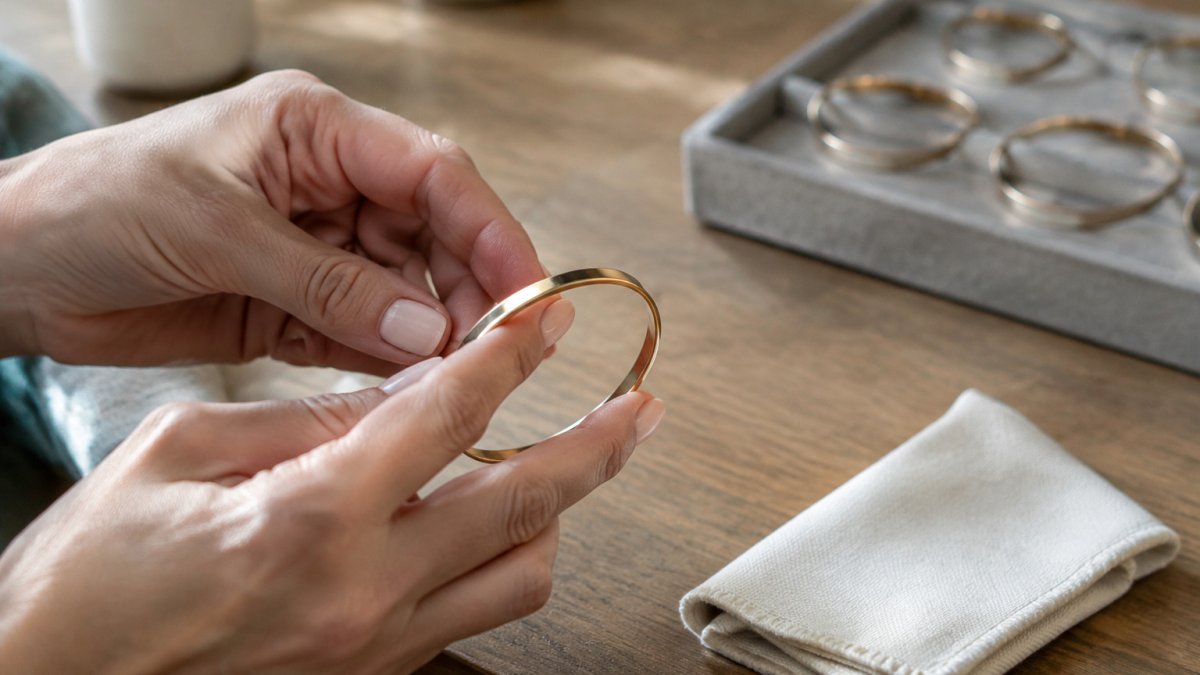
Use this checklist under good light before buying or wearing an infant bracelet.
| Step | What to do | Time or frequency |
|---|---|---|
| Edge check | Run a fingertip along every edge for roughness or sharp spots | Before purchase and each wear |
| Join check | Inspect each link join for gaps, burrs or exposed wire | Before purchase and each wear |
| Clasp test | Open and close the clasp several times | Before purchase and each wear |
| Finish check | Look for flaking or thin plating worn through | Before purchase and each wear |
| Loose parts check | Confirm no beads, charms or spacers can come loose | Before purchase and each wear |
Infant Bracelets with Smooth Edges in Silver
Sterling silver is a popular choice for infant bracelets with smooth edges. It polishes to a bright finish and is often chosen for christenings and keepsakes. Silver can tarnish over time, so store it dry and polish gently. Anyone with metal sensitivities should check materials before buying, since silver alloys vary.
Infant Bracelets with Smooth Edges in Gold
Gold-tone and gold-plated bracelets offer a warm look for gifts. Plating can wear thin with friction, so inspect the finish regularly and retire a piece once the base metal shows. Hypoallergenic materials can reduce irritation, but confirm the metal composition with the seller before purchase.
Your Next Step: Choosing a Bracelet You Can Check in Person
Choose a bracelet you can inspect closely, with clear photos of the edges and clasp. Start with the edge and finish checklist above, then shop with confidence.
Frequently Asked Questions
How do you choose a safe bracelet for an infant?
Start with a piece that has no loose charms, small detachable parts or sharp edges, and check that the clasp closes securely without pinching. Smooth, rounded links and a polished finish reduce snagging on skin and clothing. Choose a bracelet that is sized for an infant's wrist and inspect it before every wear. Supervise your baby closely, and remove the bracelet if it shows signs of irritation, wear or loosening. When in doubt, skip the jewelry altogether until your child is older and can be supervised safely.
How should an infant bracelet fit?
A good fit lets you slip one finger easily between the bracelet and the wrist, with the piece sitting snugly without pressing into the skin. Measure your baby's wrist with a soft tape and use the size guide to pick a bracelet slightly larger than that measurement. Check the fit regularly, because wrists grow quickly during the first year. An adjustable closure helps, but still confirm the bracelet does not slide over the hand.
Are gold or silver bracelets better for babies?
Both can work, but the choice depends on the metal's finish and your baby's skin sensitivity. Whichever metal you choose, look for smooth, well-finished edges and stop use if redness or rash appears.
What should you check before buying a bracelet for a baby?
Check the edges by running a fingertip along every link, clasp and join to confirm there are no burrs or rough spots. Confirm the size against a wrist measurement, and make sure the clasp locks firmly and cannot open easily. Ask the seller about the metal type, plating and any allergy-related materials.
