

Hypoallergenic Jewelry for Infants: A Complete Safety Guide
Table of Contents
- What Hypoallergenic Jewelry Means for Infants
- Hypoallergenic Earrings for Babies: Materials That Work
- Nickel-Free Earrings for Infants: Why It Matters
- When Can Babies Wear Earrings: Age and Readiness
- Baby Jewelry Safety: Design Features and Standards
- Reducing Irritation and Allergic Reactions
- Care, Cleaning, and Wear Guidance for Infant Jewelry
- Frequently Asked Questions
Last Updated: October 16, 2026
What Hypoallergenic Jewelry Means for Infants
Hypoallergenic jewelry infants need is designed to minimize allergic reactions and skin irritation by using materials that are unlikely to cause sensitivity or adverse reactions in delicate, developing skin.
The term "hypoallergenic" doesn't mean a material is completely allergen-free, no material is truly 100% hypoallergenic for every person. Rather, it means the material has been selected and tested to reduce the likelihood of triggering allergic responses in most people, particularly those with sensitive skin.
According to the American Academy of Pediatrics guidance on infant safety, materials matter significantly when jewelry comes into contact with developing skin. Infants cannot communicate discomfort the way older children can, so prevention through material selection is your primary defense against irritation and allergic reactions.
The real challenge isn't finding jewelry labeled "hypoallergenic", it's understanding which materials actually deliver on that promise and which ones don't. Mystery alloys, unclear labeling, and marketing claims that sound reassuring but lack substance are common pitfalls.
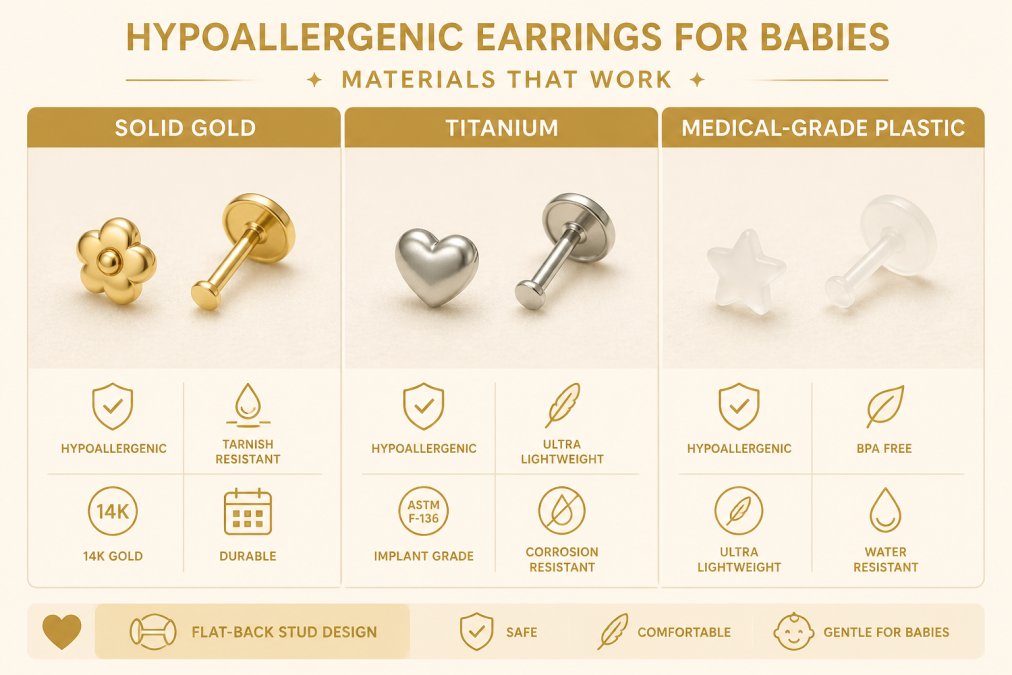
Hypoallergenic Earrings for Babies: Materials That Work
When it comes to choosing earrings for infants, the material is everything. Not all metals are created equal, and some that sound safe can still cause problems over time. Here's what actually works for sensitive infant skin.
Solid Gold and 14-Karat Gold
Solid gold remains one of the safest choices for infant jewelry because pure gold is hypoallergenic and doesn't oxidize or corrode.
The advantage of gold is longevity. Gold earrings won't tarnish, won't turn your child's skin green, and can be worn continuously without degradation. The drawback is cost, solid gold pieces carry a higher price tag than alternatives.
When shopping for gold earrings, verify the karat stamp on the post itself. Reputable sellers clearly mark 14K or 18K. If the marking is unclear or missing, the gold content is likely lower than advertised.
Titanium and Implant-Grade Titanium
Titanium has become increasingly popular for infant jewelry because it's lightweight, durable, and biocompatible, meaning it integrates well with human tissue without triggering reactions. Implant-grade titanium, specifically ASTM F136 titanium, is the medical standard used in surgical implants and is the gold standard for sensitive skin.
The difference between regular titanium and implant-grade titanium matters. Regular titanium can contain trace elements and impurities that may cause sensitivity. Implant-grade titanium (ASTM F136) is manufactured to strict standards that eliminate these impurities, making it safer for prolonged contact with infant skin.
Titanium earrings are typically less expensive than solid gold while offering comparable safety. They're also extremely durable and won't break easily if your child pulls or tugs at them.
Surgical Stainless Steel
Surgical stainless steel, when it meets ASTM F138 standards, is another reliable option for infant earrings. This grade of stainless steel is corrosion-resistant and doesn't leach metals into the skin under normal wear conditions. It's affordable, durable, and widely available.
The catch: not all stainless steel is created equal. Lower grades of stainless steel can contain nickel and other reactive elements. When selecting surgical stainless steel earrings, confirm they meet ASTM F138 specifications. This standard ensures the material has been tested and verified to resist corrosion and minimize nickel release.
Surgical stainless steel won't last as long as gold or titanium in terms of shine and finish, but it's a solid budget-friendly option when you're confident in the material certification.
Medical-Grade Plastic
Medical-grade plastic, sometimes called acrylic or PMMA (polymethyl methacrylate), offers a lightweight, hypoallergenic alternative for infants with extreme sensitivities or those who haven't yet healed from a recent piercing. Plastic earrings pose no risk of metal allergies and are gentle on delicate skin.
The trade-off is durability. Plastic can scratch, cloud, or become brittle over time, and it's not suitable for long-term daily wear. Many parents use plastic earrings as a temporary solution during the healing phase after piercing, then transition to metal once the earlobe has fully stabilized.
Nickel-Free Earrings for Infants: Why It Matters
Nickel is the most common metal allergen, affecting roughly 10-15% of the population, with even higher rates in children (pubmed.ncbi.nlm.nih.gov).
For infants, the problem is compounded. Their skin barrier is still developing, and if you pierce their ears, the wound is a direct pathway for nickel ions to penetrate and trigger a reaction.
Nickel often hides in mystery alloys, mixed metals that aren't clearly labeled or disclosed. It appears in "white gold" that contains less than 75% gold, in some grades of stainless steel, and in plated jewelry where the base metal is nickel.
The safest approach is to choose jewelry with transparent labeling: solid gold (14K or higher), implant-grade titanium (ASTM F136), or surgical stainless steel (ASTM F138).
When Can Babies Wear Earrings: Age and Readiness
The question of when to pierce an infant's ears is ultimately a family decision, but there are medical and practical considerations worth understanding.
From a medical standpoint, most pediatricians suggest waiting until a child is at least 4-6 months old, when the immune system is more developed and can better handle the minor trauma of piercing and the healing process.
The practical reality is that infants and young toddlers will pull at earrings, which can lead to torn earlobes if the jewelry isn't secured properly.
If you do choose to pierce your infant's ears, expect the healing process to take 6-12 weeks. During this time, the earring must remain in place continuously, and you'll need to clean the piercing site regularly to prevent infection.
Baby Jewelry Safety: Design Features and Standards
Beyond material selection, the physical design of the jewelry matters enormously for infant safety. Jewelry for babies must meet specific criteria to prevent injury, infection, and choking hazards.
Flat-Back Studs and Secure Closures
Flat-back studs are the only appropriate earring style for infants. These studs have a small, smooth backing that sits flush against the earlobe rather than protruding. This design prevents the earring from being grabbed, pulled, or caught on clothing or hair.
The closure mechanism is equally important. Secure closures, whether screw-backs, push-fits, or locking mechanisms, keep the earring firmly in place even if your child tugs at it. Avoid butterfly backs, which are easy to dislodge, and never use traditional hook-style earrings for infants.
When selecting a closure, test it yourself. The earring should require deliberate effort to remove, not come loose with gentle pulling. A properly secured earring is your first line of defense against accidental removal and loss.
Smooth Edges and Small, Lightweight Designs
Any jewelry touching infant skin must have completely smooth edges with no sharp corners, rough spots, or pointed designs. Infants explore their world by putting things in their mouths, and if an earring is removed (intentionally or accidentally), it becomes a choking hazard if it's small enough to fit in a child's mouth.
For this reason, earrings should be larger than a standard choking-hazard size (roughly the size of a toilet paper tube opening) or, if smaller, should be secured so firmly that removal is virtually impossible without adult assistance.
Weight matters too. Heavy earrings can strain the earlobe, cause discomfort, and increase the risk of the post tearing through the skin. Titanium and medical-grade plastic are advantageous here because they're naturally lightweight. Gold earrings should be kept small and delicate for infant wear.
ASTM Standards and Material Labeling
ASTM International sets standards for jewelry materials to ensure safety and biocompatibility. When shopping for infant jewelry, look for these key certifications:
- ASTM F136: The standard for implant-grade titanium. This is the material used in surgical implants and represents the highest level of purity and biocompatibility.
- ASTM F138: The standard for surgical stainless steel. This ensures the material is corrosion-resistant and tested for nickel release.
- ASTM F417: The standard for precious metal content in gold jewelry. This confirms karat weight and purity.
Reputable sellers will clearly indicate which standards their jewelry meets. If you see vague language like "hypoallergenic" or "nickel-free" without specific material grades or ASTM certifications, that's a red flag. Ask for documentation or avoid the piece.
Reducing Irritation and Allergic Reactions
Even with careful material selection, some infants will experience mild irritation or allergic reactions. Knowing how to recognize and respond to these signs is essential.
Common signs of irritation include redness around the earring post, mild swelling, or slight crusting. These symptoms often resolve with improved cleaning and can be managed without removing the earring.
Prevention is far more effective than treatment. Keep the piercing clean by gently wiping the earring post and surrounding skin with a saline solution or as directed by your piercing professional. Avoid over-cleaning, which can irritate the site.
If your child does develop an allergic reaction, remove the earring immediately and switch to a different material, typically implant-grade titanium if the previous material was gold, or vice versa.
Care, Cleaning, and Wear Guidance for Infant Jewelry
Proper care extends the life of the jewelry and reduces the risk of irritation or infection.
After the initial healing phase (typically 6-12 weeks) for hypoallergenic jewelry infants wear, you can reduce cleaning to a few times per week.
For gold and titanium earrings, occasional gentle cleaning with a soft cloth keeps them shiny and free of buildup. Avoid harsh chemicals or abrasive materials that can scratch the surface.
Never force an earring in or out. If you're having difficulty inserting or removing the earring, stop and try again later when the earlobe is relaxed.
Store earrings in a clean, dry place away from moisture and direct sunlight.
Choosing the right hypoallergenic jewelry for your infant is about understanding materials, recognizing safety standards, and making informed decisions based on your child's specific needs.
Frequently Asked Questions
Are hypoallergenic earrings safe for babies?
Yes, when chosen correctly. Hypoallergenic earrings made from solid gold, implant-grade titanium, or medical-grade plastic minimize allergic reactions and skin irritation. Look for flat-back studs with secure closures, smooth edges, and small, lightweight designs. Verify material labeling and avoid mystery alloys or nickel-containing metals. Always consult your pediatrician before piercing and monitor for signs of infection or irritation during the healing period.
Which metals are least likely to irritate an infant's skin?
Solid 14-karat or 18-karat gold, implant-grade titanium (ASTM F136), and surgical stainless steel (ASTM F138) are the safest choices for sensitive infant skin. These materials resist corrosion and tarnish, reducing the risk of allergic reactions. Medical-grade plastic is also hypoallergenic and lightweight, making it ideal for very young children. Avoid nickel-containing alloys, mystery alloys, and low-karat gold plating, which can trigger irritation and discoloration.
What age can babies start wearing earrings?
Most pediatricians recommend waiting until an infant is at least 6 months old and has received basic vaccinations before piercing. Some suggest waiting until 12 months or older for better immune function and faster healing. Never pierce a baby's ears yourself; use a licensed professional with sterile equipment. Once pierced, keep earrings in continuously for 6-12 weeks to allow the earlobe to heal fully. Remove jewelry immediately if you notice redness, swelling, discharge, or signs of infection.
How can parents tell whether baby jewelry contains nickel?
Check the product label for material composition and look for terms like 'nickel-free' or 'hypoallergenic.' Reputable sellers provide ASTM certification numbers (F136 for titanium, F138 for stainless steel) that verify material standards. Avoid items labeled as 'mystery alloys' or with vague descriptions like 'mixed metals.' Request material documentation from the seller before purchasing. If your infant develops a green or black discoloration around the earlobe or shows signs of allergic reaction, remove the jewelry immediately and consult your pediatrician.
What safety features should parents look for in infant earrings?
Prioritize flat-back studs over dangling designs to reduce choking and strangulation hazards. Choose secure closures like screw-backs or push-backs that cannot fall out easily. Look for small, lightweight designs with smooth edges and no sharp corners or pointed details. Avoid oversized or dangling jewelry. Verify the earrings meet ASTM standards and are made from hypoallergenic materials. Always supervise wear and remove earrings during sleep, playtime, or when your infant is unsupervised.
When should a baby's jewelry be removed?
Remove earrings during sleep, active play, swimming, and bathing to prevent loss, damage, and infection. Take them off if your infant shows signs of irritation, allergic reaction, or infection such as redness, swelling, discharge, or pain. Remove jewelry immediately if it becomes caught on clothing or toys. During the initial 6-12 week healing period, earrings should be left in continuously except during cleaning. Once healed, you can remove them occasionally, but frequent removal may cause the piercing to close.