

How to Size Baby Bracelets for Baptism
Quick Summary
To size baby bracelets for a baptism, measure your baby's bare wrist with a soft tape just above the wrist bone, then add about 0.5 to 1 inch for growth. Match that number to a size chart, choosing an adjustable or stretch style for the first year. Measure when your baby is calm, since babies' wrist sizes change quickly.
- Measure bare skin with a soft, flexible tape placed just above the wrist bone.
- Add about 0.5 to 1 inch to your measurement so the bracelet can grow with your child.
- Use a stretch or adjustable style for babies from newborn to 6 months.
- Measure twice to confirm the number before ordering.
- Avoid measuring over a sleeve or onesie, which gives a false reading.
Table of Contents
- Why Sizing Matters for a Baptism Bracelet
- How to Measure Baby Wrist for Jewelry
- Baptism Bracelet Size Chart by Age
- Tips for a Comfortable, Secure Fit
- Safety Tips for Baby Jewelry
- Choosing a Bracelet That Grows With Your Child
- Book Your Baptism Bracelet Order Now
- Frequently Asked Questions
Before measuring a baby for a baptism bracelet, it helps to know that wrist size changes fast in the first year, so a baby bracelets fit chosen today may not last. A bracelet that fits well at a christening can be too snug within months, so getting the size right the first time matters. For more on keeping infant skin comfortable, see our hypoallergenic jewelry safety guide.
Here is the short answer: measure your baby's wrist with a soft tape, add a small growth allowance, and match the result to a size chart. The steps below show you exactly how.
Why Sizing Matters for a Baptism Bracelet
A bracelet that is too tight can pinch the skin, leave marks, or press against a baby's delicate wrist. One that is too loose can slide over the hand and become a safety concern. Because babies grow quickly, sizing is less about a single measurement and more about choosing a fit that stays comfortable for the next several months.
A good baptism bracelet should sit snug enough to stay put but loose enough to slip over the tip of one finger. Keep that rule in mind as you work through the measuring steps below.
How to Measure Baby Wrist for Jewelry
Measuring a baby is easier when the baby is calm. Try to measure after a feeding or nap, when your little one is relaxed and still. A quick measurement will save you a return later.
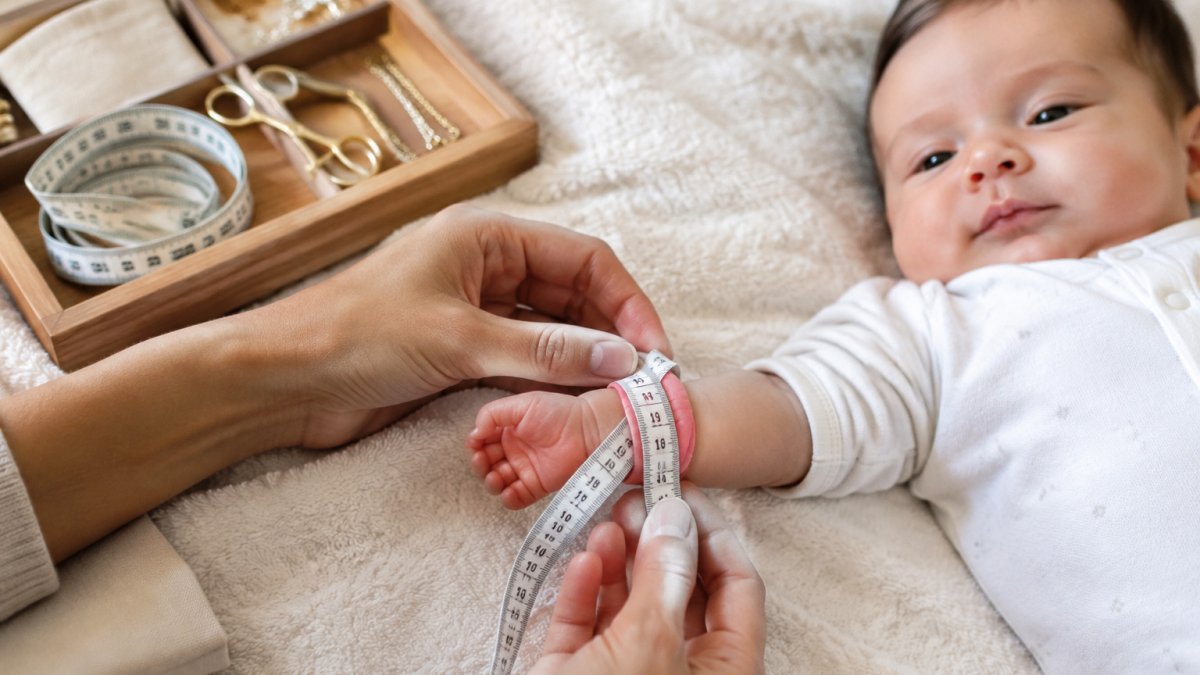
What You Need Before You Start
Gather these simple tools before you begin:
- A soft, flexible measuring tape (a sewing tape works well)
- A pen or pencil to mark the measurement
- A piece of paper to write down the number
- An existing bracelet your baby already wears, if you have one
A soft tape gives a more accurate reading than a stiff ruler because it follows the curve of the wrist, which is why it is the best tool for sizing baby bracelets.
Step-by-Step Measuring Method
- Sit your baby comfortably. Rest your baby on a lap or a soft blanket with the arm relaxed.
- Wrap the tape around the wrist. Place the tape just above the wrist bone, where a bracelet would sit.
- Keep it snug, not tight. The tape should lie flat against the skin without pressing in.
- Read the measurement. Note the number where the tape meets the zero mark.
- Add a growth allowance. Add about 0.5 to 1 inch to your reading so the bracelet can grow with your child.
- Repeat the measurement. Measure twice to confirm the number.
Watch out: measuring over a bulky sleeve or onesie gives a false reading. Always measure bare skin.
Baptism Bracelet Size Chart by Age
Use your measurement as the starting point, but age can help you estimate growth. Babies gain wrist size quickly during the first year, so a bracelet bought for a newborn may need resizing by the first birthday.
| Age Range | Typical Wrist Size | Recommended Fit |
|---|---|---|
| Newborn to 3 months | About 4 to 4.5 inches | Adjustable or stretch style |
| 3 to 6 months | About 4.5 to 5 inches | Adjustable or stretch style |
| 6 to 12 months | About 5 to 5.5 inches | Small clasp, with growth room |
| 12 months and up | About 5.5 to 6 inches | Standard child size |
These ranges are general estimates. Always trust your own tape measurement over a chart.
Tips for a Comfortable, Secure Fit
A bracelet that looks right can still feel wrong on a baby. Keep these points in mind:
- Choose a clasp that closes securely but opens easily for adults.
- Pick a lightweight design so the bracelet does not pull on the wrist.
- Check that no sharp edges or loose charms touch the skin.
- Look at the bracelet every few weeks, since a fit that worked last month may now be too tight.
Many parents find that a stretch or adjustable style works best for the first year, because it moves with the wrist as the baby grows.
Safety Tips for Baby Jewelry
Safety should come first with any jewelry worn by an infant, and the details that matter most are the ones you can inspect with your own hands: the clasp, the connections, and the metal itself. Small parts can become a choking hazard if they break loose, so inspect the bracelet before each wear and know what to look for.
Clasp Types and What to Avoid
The clasp is the single most important safety feature on a baby bracelet. Avoid magnetic closures entirely for infants: a small magnet can detach and is a known ingestion hazard, and magnets that attract each other across a baby's skin or fingers can cause serious injury. A screw-back or threaded closure is the most secure option for a keepsake piece, but it requires an adult to open, so it is best for a bracelet worn only on special occasions rather than daily.
Break-Away and Adjustable Features
For everyday wear on an infant, look for a bracelet designed to release under tension rather than hold fast. A break-away clasp or an elastic cord with a safety release gives way if the bracelet catches on a crib rail, a car seat strap, or a sibling's hand, which reduces the risk of the bracelet tightening around the wrist. Adjustable sliding knots and extension chains are useful for fit, but check that any sliding bead or knot cannot be pulled loose and swallowed. If the bracelet has a charm, confirm the charm is soldered or threaded onto the chain rather than hung from a small split ring that can open.
Metal and Skin Sensitivity
Nickel is the most common cause of contact dermatitis from jewelry, and it is frequently present in plated and costume pieces. For a baby with sensitive skin, choose nickel-free sterling silver (look for the 925 stamp), 14k or higher gold, or surgical stainless steel. Gold-filled jewelry contains a thick layer of gold bonded to a base metal and wears far longer than gold-plated, which is a thin wash that can flake off with repeated handling and expose the base metal underneath. Avoid plated pieces for anything worn against the skin for long periods.
Inspection and Wear Rules
- Remove the bracelet during sleep, bath time, and any active play, and never let a baby wear it unsupervised.
- Check the clasp and links before each wear for wear, stretching, or loose parts, and tug gently on the charm to confirm it is secure.
- Avoid charms with small removable pieces, and skip bracelets with beads smaller than a choke-test cylinder.
- Store the bracelet out of reach when not in use, and inspect the skin underneath for redness or marks after each wearing.
Watch out: a bracelet that leaves a mark on the skin after ten minutes is too tight, even if it slipped on easily, and a clasp that opens with a light pull is too loose for an infant. If a piece ever breaks, take it out of reach right away and replace it rather than repairing it at home.
Choosing a Bracelet That Grows With Your Child
Many parents want a bracelet they can keep long after the christening, and the design you choose determines whether it can be worn from infancy into the toddler years or saved as a keepsake. The two goals pull in different directions: a piece built to adjust and survive daily wear is not always the piece you want to preserve for a future generation, so decide early which job the bracelet needs to do.
Adjustable and Extension Designs
A stretch bracelet with a strong elastic core is the most forgiving option for the first year because it moves with the wrist and slips over the hand without a clasp. The trade-off is that elastic weakens over time, so check the cord every few weeks and replace the bracelet at the first sign of fraying. An adjustable bracelet with a sliding knot or a chain-and-bead slider lets you tighten or loosen the fit as the wrist grows, but confirm the slider holds firmly and cannot be pulled apart by a curious baby.
Material Durability vs. Skin Sensitivity
The metal you choose affects both how long the bracelet lasts and how it treats a baby's skin. Sterling silver (925) is soft enough to engrave and resize but tarnishes with exposure to air and moisture, so it needs polishing and careful storage. Gold-filled jewelry bonds a thick layer of gold to a base metal and outlasts gold-plated pieces many times over, which makes it a practical middle ground for a bracelet meant to be worn often. Solid 14k gold is the most durable and the most hypoallergenic, but it is also the most expensive and the hardest to resize without a jeweler.
Heirloom Preservation
A baptism bracelet kept as an heirloom needs different care than one worn daily. Store silver in a tarnish-preventing bag or a lined jewelry box away from humidity, and keep gold and gold-filled pieces in separate soft pouches so they do not scratch. Have the bracelet cleaned professionally before storing it long-term, and keep a written record of the date, the occasion, and any engraving so the story travels with the piece.
Watch out: an adjustable bracelet that fits a newborn by sliding to its shortest setting may not have enough chain left to reach a toddler wrist, so measure the maximum extension length before you buy rather than assuming it will grow with your child.
Book Your Baptism Bracelet Order Now
You now have what you need to size a baptism bracelet with confidence: measure bare skin with a soft tape, add a growth allowance, and check the fit against an age-based chart. Carlotta offers a Cross Bracelet (S925) at $37.00 that you can explore in our bracelets collection, including the Handmade Unisex Stainless Steel Cross option. Shop All to find a size that matches your measurement and enjoy up to 30% off select pieces during our seasonal offers.
Frequently Asked Questions
How big should a baby bracelet be?
For most babies, a baptism bracelet should measure about 4 to 5 inches around the wrist, with a little room for growth. Measure the baby's wrist with a soft tape, add roughly half an inch to a full inch for comfort and movement, and choose the closest size up. Bracelets for newborns are often sold in the 4 to 4.5 inch range, while toddler sizes run larger. If the baby is between sizes, pick the larger option so the bracelet does not pinch or slide over the hand.
Should a baptism bracelet be loose or snug?
A baptism bracelet should be snug enough that it cannot slip over the hand, but loose enough that you can fit one finger comfortably between the bracelet and the skin. A bracelet that is too tight can leave marks or irritate delicate skin, while one that is too loose can slide off or become a hazard. Check the fit each time you dress the baby, especially after bath time or in warm weather when the wrist may swell slightly.
At what age can a baby wear a baptism bracelet?
A baby can wear a baptism bracelet from the day of the christening, including as a newborn, as long as the piece is sized correctly and has no small parts that could come loose. Many families choose a stretchy or adjustable style for infants because it grows with the child. Always supervise the baby while wearing jewelry and remove it during sleep, naps in a crib, or any time the bracelet could catch on bedding or clothing.
How do I know if a bracelet will fit a growing baby?
Choose a bracelet with a bit of growth allowance, or pick an adjustable or stretchy style that can be resized later. Measure the baby's wrist every few months and compare it with the bracelet's inside circumference. If the bracelet fits well at the first wear but feels tight within a few weeks, have a jeweler resize it or move to the next size. Keeping the original measurement and purchase date makes future sizing easier.
