

What to Look for When Buying Vintage Jewelry
Last Updated: October 22, 2026
Quick Summary
When buying vintage jewelry, examine hallmarks and maker's marks to verify authenticity, inspect gemstone cuts and settings to confirm they match the claimed era, and run a six-step condition check covering closures, prongs, solder joints, surface wear, weight, and function before committing to purchase.
- Victorian pieces feature ornate heavy designs in gold with dark gemstones, while Art Deco emphasizes geometric shapes with platinum and onyx.
- Authentic vintage jewelry carries hallmarks like 10K, 14K, 18K for gold or Sterling for silver inside rings, on brooch backs, or along clasps.
- Test every clasp and moving part at least five times; a weak or sticky clasp is a common repair waiting to happen.
- Use a 10x jeweler's loupe to check that prongs touch stones and no tips are worn flat or bent outward.
- Request a written return policy of 14-30 days before purchase and pay by credit card or protected payment service for buyer protection.
Table of Contents
- Understanding Vintage Jewelry Eras and Styles
- How to Authenticate Vintage Jewelry Before Purchase
- Vintage Jewelry Condition Checklist: What to Inspect
- Questions to Ask When Buying Vintage Jewelry
- Verifying Sellers and Safe Purchase Channels
- Repair Risks and Replacement-Part Detection
- Getting Independent Appraisal and Documentation
- Frequently Asked Questions
Understanding Vintage Jewelry Eras and Styles
When buying vintage jewelry, knowing the era matters: each period's design, materials, and construction help you spot authentic pieces and avoid overpaying for reproductions.
Key Design Characteristics by Period
Each era has recognizable design elements:
Victorian Era (1837-1901): Heavy, ornate designs dominate. Gold is the primary metal, often paired with dark gemstones like garnet or jet. Nature motifs are common; clasps are simple hook-and-eye styles.
Edwardian Era (1901-1915): Lighter, delicate designs.
Art Deco Era (1920-1935): Geometric shapes define this era. Bold, angular designs with strong lines replace earlier curves.
Retro/Forties Era (1939-1950): Wartime constraints influenced design.
Mid-Century Modern (1950-1965): Clean lines and minimalism emerge.
These era markers help you recognize authentic pieces and assess value when buying vintage jewelry.
How to Authenticate Vintage Jewelry Before Purchase
Authentication separates genuine vintage pieces from modern reproductions. Before committing, examine several key indicators.
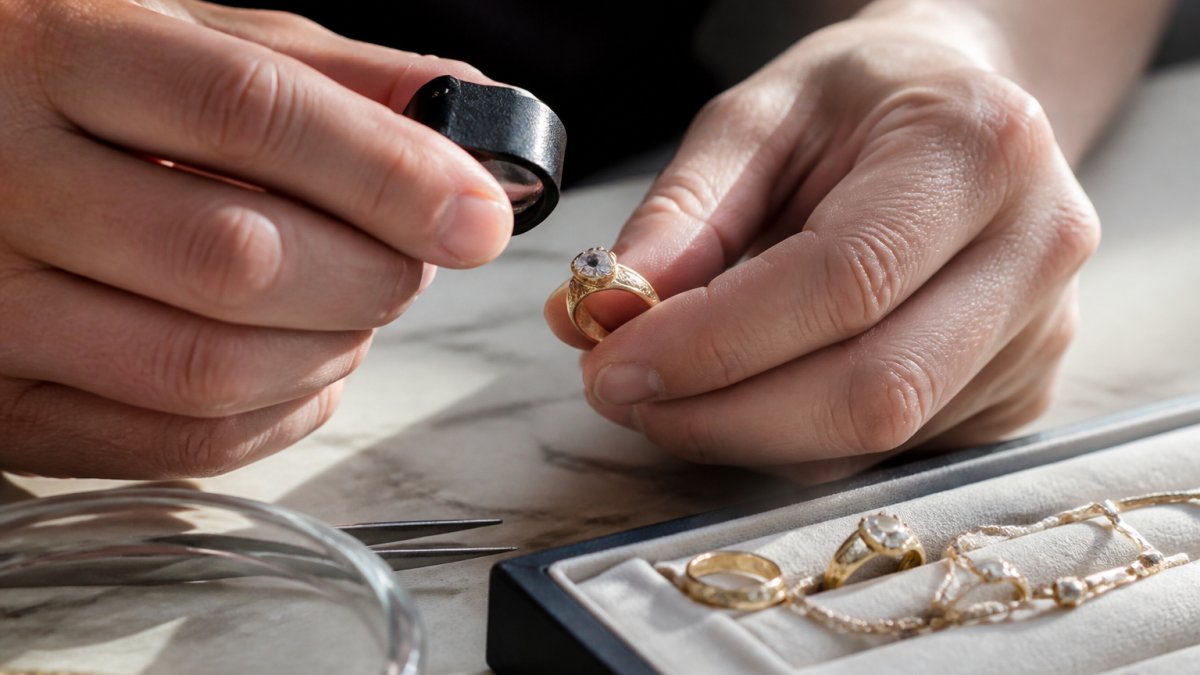
Hallmarks, Maker's Marks, and Metal Stamps
Authentic vintage jewelry carries marks identifying metal content, maker, and sometimes country of origin.
Look for hallmarks inside rings, on the backs of brooches, or along necklace clasps. Common hallmarks include:
- Gold stamps: "10K," "14K," "18K," or "750" (for 18K gold)
- Silver stamps: "Sterling," "925," or "Ster"
- Platinum stamps: "Plat," "Pt," or "950"
Hallmarks vary by country and era; American pieces typically show clearer stamps than European ones.
Research the hallmark you find; many reference guides document maker's marks by country and period. A hallmark that doesn't match the claimed era is a red flag.
Gemstone Cuts and Period-Appropriate Settings
Gemstone cuts evolved across eras; recognizing period-appropriate cuts helps verify authenticity when buying vintage jewelry.
Victorian pieces typically feature older cuts like cushion or rose cuts, which appear less brilliant than modern diamonds because the faceting differs.
Mismatched cuts and settings raise concerns. A piece claiming to be Victorian but featuring a modern brilliant-cut diamond likely isn't authentic, reproductions often pair old-looking settings with modern gemstones.
Vintage Jewelry Condition Checklist: What to Inspect
Most buying guides say to "check the condition" without explaining how. Here is an ordered inspection sequence you can run in five to ten minutes at a dealer's counter or against high-resolution seller photos.
Step 1: Test Every Closure and Moving Part
Start with the parts that fail first. Open and close every clasp, hinge, and box catch at least five times: a lobster claw should spring back cleanly, a box clasp should click without wiggle, a barrel clasp should thread smoothly.
A clasp that sticks, springs weakly, or needs jiggling is a repair waiting to happen. Clasp replacement is one of the most common vintage repairs, and a replaced clasp makes an otherwise original piece partially modern.
Step 2: Check Prongs and Stone Security
Look at each stone under magnification (a 10x jeweler's loupe costs $10-$20 and is the best tool a vintage buyer can own). Check that every prong touches the stone and no tip is worn flat or bent outward.
Run a fingernail along the girdle of the center stone; a stone set too high or with worn prongs will catch.
Never wiggle a stone hard or pry at a setting to "test" it. Ask the seller to demonstrate stone security, or have a jeweler check it before you pay. Damage you cause during inspection is usually your liability.
Step 3: Inspect Solder Joints and Metal Integrity
Solder joints are where vintage pieces fail structurally. Check where shanks meet ring heads, chain links meet clasps, and brooch pins attach. Original solder is smooth and matches the surrounding metal; repair solder often shows as a different color, a lumpy bead, or a visible seam.
Check for cracks at stress points: the bottom of a ring shank, the hinge area of a bracelet, and the loop of a pendant bail.
Step 4: Assess Surface Wear and Patina
Scratches, dings, and patina are normal and often part of the charm. What matters is depth and location: fine surface scratches on the back of a brooch are cosmetic, while deep gouges on a ring shank, flattened engraving, or worn-away milgrain indicate heavy wear and reduce value.
Patina is a judgment call. Dark oxidation in the recesses of silver is desirable to many collectors; heavy black tarnish on the high points suggests decades unworn and uncleaned. Neither is a dealbreaker, but both are negotiating points.
Step 5: Check Weight, Balance, and Flexibility
Hold the piece. Solid gold or platinum should feel denser than its size suggests; hollow or plated pieces feel light for their bulk.
Gently flex rings and bracelets. They should move slightly but feel solid. Excessive flexibility in a ring shank means the metal is thin from wear. A bracelet that flops loosely at the hinges has worn hinge pins.
Step 6: Confirm Function End to End
Put the piece on if you can. A necklace should sit flat without flipping, earrings should hang evenly with straight posts, and a ring should not spin. Minor-seeming function problems, a flipping pendant, a spinning ring, often mean the piece needs work before it is comfortably wearable.
Run the six steps in order: closures, prongs, solder, surface, weight and flex, then function. Any failure in steps 1-3 is a structural red flag; failures in steps 4-6 are usually negotiating points rather than dealbreakers.
What Each Finding Means for Price
A loose stone, a weak clasp, or a worn shank is a repair cost you should subtract from the asking price before you negotiate. Ask the seller for a repair estimate in writing, or get one from a jeweler before you commit. A piece priced as "excellent condition" that needs a $150-$300 repair is not priced as excellent condition.
Questions to Ask When Buying Vintage Jewelry
Smart buyers ask specific questions before purchasing; the answers reveal whether the seller understands their inventory and whether the piece is genuine.
Ask about provenance: where did the seller obtain it, an estate, an auction, a collection?
Inquire about repairs or restoration: has it been professionally cleaned, or has anything been replaced?
Ask about metal composition and gemstones: can the seller provide specifics on gold purity, gemstone type, or weight?
Verifying Sellers and Safe Purchase Channels
Where you buy matters as much as what you buy, but "buy from reputable sellers" is not advice, it is a conclusion. This section gives you a verification process you can run before you send money, plus the channel-by-channel trade-offs that determine how much recourse you have if the piece is not as described.
A Seller Verification Sequence
Run these checks in order. Each one is cheap; the cost of skipping them is not.
- Confirm a real business identity. Ask for the legal business name, a physical address, and a phone number. Cross-check the name against state business registration records (most states offer a free online search) and against the address on the seller's own website. A seller who will not provide a verifiable business identity is a pass.
- Read reviews across multiple platforms. Check Google reviews, the Better Business Bureau, and any marketplace-specific feedback (eBay, Etsy, 1stDibs). Look for patterns, not single complaints. Repeated complaints about misrepresented condition, undisclosed repairs, or slow refunds are the pattern that matters.
- Ask for the return policy in writing before you buy. A reasonable window for vintage jewelry is 14-30 days from delivery, with the buyer paying return shipping. Get the policy in the listing, an email, or a message, not a verbal assurance.
- Ask what documentation comes with the piece. At minimum, ask for a written description of the piece's era, metal content, gemstone identification, and any known repairs. For pieces above roughly $1,000, ask whether an independent appraisal or gemological report exists.
- Confirm payment method before checkout. Pay by credit card or a payment service that offers buyer protection. Avoid wire transfers, money orders, and cryptocurrency for any purchase you cannot inspect in person, none of them give you a dispute mechanism.
Save every message, listing screenshot, and receipt. If a dispute arises, the paper trail is what determines the outcome, not what was said on the phone.
Channel-by-Channel Trade-Offs
Established auction houses. Major houses publish detailed condition reports, provenance, and high-resolution images, and their catalogs are generally reliable.
Antique malls and physical vintage shops. You can inspect in person, which is the single biggest advantage.
Estate sales. Estate sales run by licensed auctioneers or estate-sale companies often include jewelry with documented provenance.
Private sellers and social media. The highest risk channel.
Payment Protection in Practice
Credit cards and major payment services give you a dispute process if the item is materially different from the description. That protection usually has a time limit, commonly 60-120 days from the transaction, so inspect and raise any issue promptly after delivery. Wire transfers, money orders, and cryptocurrency generally offer no dispute mechanism; once the money is gone, it is gone.
A seller who pressures you to pay by wire transfer, asks you to move the conversation off-platform, or refuses to put the return policy in writing is showing you the risk before you buy. Treat those behaviors as disqualifying, not as negotiating friction.
What to Get in Writing Before You Pay
For any piece above a few hundred dollars, request a written summary that includes: the era the seller attributes the piece to, the metal content and any hallmarks, the gemstone identification as the seller understands it, a description of any repairs or replacements, and the return policy. This document is your baseline if the piece arrives and does not match.
Repair Risks and Replacement-Part Detection
Vintage jewelry often requires repair or restoration.
Some repairs are straightforward. Cleaning, polishing, and minor adjustments don't affect value significantly.
Other repairs are problematic.
Ask about replacement parts specifically. Has the clasp been replaced? Are the earring posts original?
Gemstone replacement is particularly concerning.
Be cautious of pieces described as "mostly original" or "original except for..." These qualifications suggest substantial work.
Getting Independent Appraisal and Documentation
Before finalizing any significant purchase, obtain an independent appraisal.
Find a certified appraiser through the American Society of Appraisers (The ASA Appraiser-The Right Choice for the Insurance Professional).
An appraisal includes detailed descriptions of the piece, its condition, its era, and its estimated replacement value.
Request a written appraisal with photographs. The appraiser should examine the piece in person.
Keep your appraisal safe.
For pieces under $500, a detailed appraisal may cost $75-150.
Buying vintage jewelry requires patience and attention to detail.
Frequently Asked Questions
How do you know jewelry is vintage?
Vintage jewelry is typically at least 20 years old and reflects the design, materials, and craftsmanship of its era. Look for hallmarks indicating the metal type and purity, design motifs specific to periods like Art Deco or Victorian, and signs of age such as patina or wear patterns. Gemstone cuts and setting styles also reveal authenticity, modern cuts and settings would indicate reproduction jewelry rather than genuine vintage pieces.
What should you check before buying vintage jewelry?
Inspect the metal for hallmarks and maker's marks, check gemstone cuts and settings for period accuracy, examine the clasp or fastening for function and wear, look for discoloration or damage, and assess overall condition. Verify the seller's credibility, request documentation or provenance if available, and consider getting an independent appraisal. Ask about repair history and whether any parts have been replaced, replacements can affect authenticity and value.
How can you tell what era vintage jewelry is from?
Each jewelry era has distinct design characteristics: Victorian jewelry (1837-1901) features ornate metalwork and sentimental motifs; Art Nouveau (1890-1910) emphasizes flowing, organic designs; Art Deco (1920-1930) showcases geometric patterns and bold color; mid-century modern (1940-1960) uses streamlined forms and mixed metals. Research the specific design elements, metal types used during that period, and gemstone cuts popular at the time. Hallmarks and maker's marks also indicate production date and country of origin.
What are the risks of buying vintage jewelry online?
Online purchases carry risks including misrepresented condition, inaccurate photos, unclear authenticity, and potential damage in transit. Minimize risk by buying from reputable sellers with verified reviews and return policies, requesting detailed photos from multiple angles, asking specific questions about repairs and alterations, and using secure payment methods. Request a certificate of authenticity or independent appraisal for high-value pieces, and verify the seller's contact information and customer support responsiveness before committing to a purchase.
