

How to Tell if a Diamond Is Real With a Flashlight
Table of Contents
- Why a Flashlight Can (and Can't) Reveal a Real Diamond
- How to Test a Diamond With a Phone Flashlight: Step by Step
- How to Tell a Real Diamond From Cubic Zirconia
- Distinguishing a Real Diamond From Moissanite Using Light
- Diamond Tester: How It Works and Where It Falls Short
- Natural, Lab-Grown, and Imitation Stones: What Light Tests Can and Can't Tell You
- Reliability, False Positives, and When to See a Jeweler
- Frequently Asked Questions
Last Updated: October 18, 2026
Why a Flashlight Can (and Can't) Reveal a Real Diamond
Knowing how to tell if a diamond is real with a flashlight can reveal how a stone handles light, but it cannot confirm a diamond on its own. At Carlotta, we sell jewelry, not gem grading, so we want you to understand exactly what a home test proves. Learning how to tell if a diamond is real with a flashlight starts with one fact: light behavior separates diamonds from most simulants, but not from every one. A flashlight test is a screening tool, not a verdict. It tells you whether a stone is worth a closer look. It cannot certify authenticity, and it will not distinguish a natural diamond from a lab-grown one, because both are diamond.
How Diamonds Reflect and Refract Light
A diamond is a crystal of carbon with an extremely high refractive index, meaning it bends light sharply as light enters and exits the stone. Cutters shape facets to exploit this. Light that enters the top of the stone bounces off the bottom facets and reflects back out toward your eye instead of leaking out the sides. That internal reflection is why a well-cut diamond looks bright even in dim light. A flashlight gives you a controlled, bright light source to watch this happen.
Brilliance, Fire, and Scintillation Explained
Three light effects matter when you inspect a stone:
- Brilliance: the white light returned to your eye from the stone's interior
- Fire: flashes of spectral color, the rainbow effect caused by light dispersion
- Scintillation: the sparkle pattern that shifts as you move the stone
Diamond scores high on all three, but so do good simulants. The differences show up in how the effects behave, not just whether they appear.
How to Test a Diamond With a Phone Flashlight: Step by Step
A phone flashlight is a convenient, consistent light source, but the test only means something if you control the conditions. The goal is not to make the stone sparkle, almost any faceted stone will sparkle under a bright light. The goal is to observe how light enters, bounces, and exits the stone, and to compare that behavior against a known reference. Follow these steps in order and repeat them the same way every time.
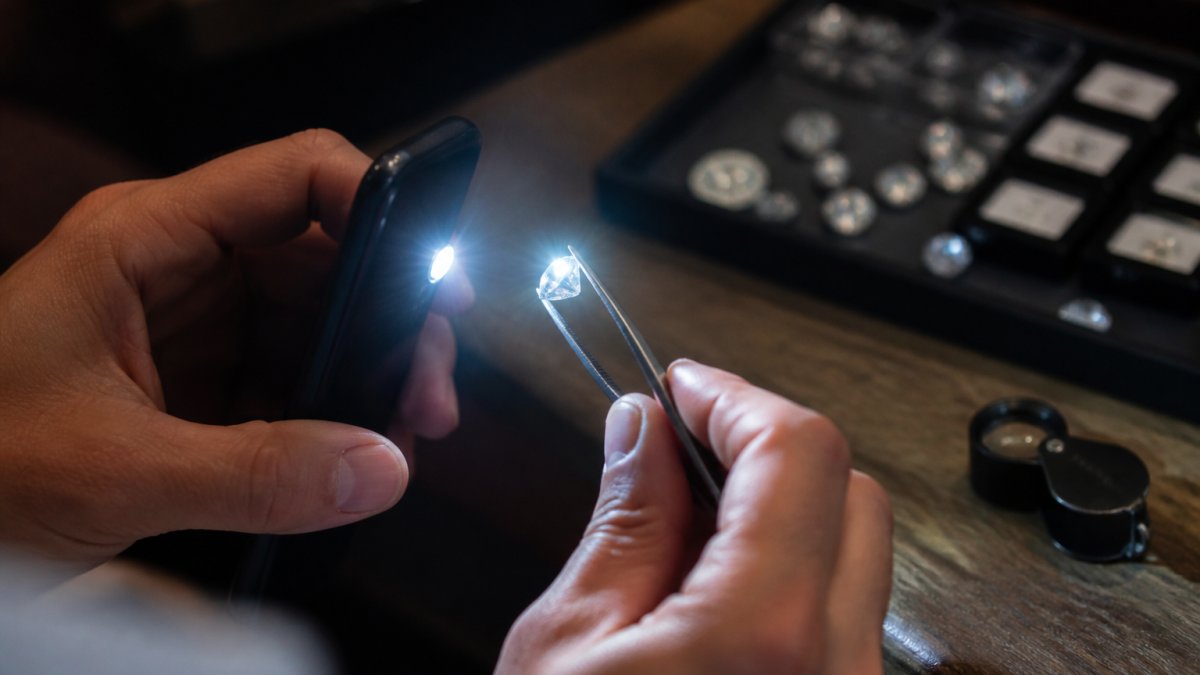
- Work in a dim room with one light source. Turn off overhead lights and close blinds. The phone flashlight should be the only light hitting the stone. Ambient light washes out fire and makes faint differences invisible.
- Clean the stone and your hands. Wipe the stone with a lint-free cloth. Skin oils, lotion, and dust dull the surface and scatter light, which can make a real diamond look hazy. Clean the phone lens too.
- Handle a loose stone with tweezers, never fingers. Hold it at the girdle (the widest edge) so your fingers do not block light or deposit oil. For a mounted stone, leave it in the setting and angle the flashlight at the side of the stone rather than straight into the table.
- Set a dark, non-reflective background. A black cloth or a matte dark surface works. A white background reflects light back into the stone and flattens fire; a black background lets you see the light return from inside the stone.
- Position the flashlight at a shallow angle, about 2-5 centimeters away. Aim the beam at the side of the stone, roughly 30-45 degrees off the table, not straight down. Straight-down light mostly reflects off the top facets and tells you little about internal reflection.
- Rotate the stone slowly through a full turn. Watch for three things: white light returning from inside the stone (brilliance), sharp flashes of spectral color (fire), and the shifting sparkle pattern as facets move (scintillation). Note whether the light seems to come from inside the stone or sit on the surface.
- Repeat with a known reference stone if you have one. Alternate the unknown stone and the reference under identical distance, angle, and background. Side-by-side comparison under the same light is far more reliable than testing one stone, then the other, in different conditions.
Setting Up Controlled Conditions
Consistency is what most home tests get wrong. Use the same distance, the same angle, and the same background every time. A white background washes out fire; a black background makes it easier to see. Test one stone at a time. If you are comparing two stones, alternate them under identical conditions rather than testing one, then the other, in different spots. Keep the phone at full brightness and do not use a case that diffuses the beam.
Reading the Results: What a Real Diamond Looks Like Under a Flashlight
A real diamond returns bright white light from its interior and throws sharp, distinct flashes of color as you rotate it. The sparkle should look crisp, not soft. Light should appear to come from inside the stone rather than sitting on the surface. If the stone looks glassy, dull, or the light seems to pool on top without depth, treat that as a reason to look closer, not proof of a fake. A well-cut cubic zirconia can also return bright light, so the flashlight alone cannot confirm a diamond.
How to Tell a Real Diamond From Cubic Zirconia
Cubic zirconia is the most common diamond simulant, and light gives it away. Under a flashlight, CZ tends to show a warmer, almost orange-tinted flash, and its fire looks broader and softer than a diamond's. CZ also shows more color fringing at the edges of facets. A diamond's flashes are sharper and more white-dominated. One more clue: CZ is softer, so older stones pick up surface scratches and a slightly hazy look that a diamond resists. If you are learning how to tell a real diamond from cubic zirconia, the flashlight is a useful first filter, but a jeweler's loupe and a professional check remain the reliable answer.
Distinguishing a Real Diamond From Moissanite Using Light
Moissanite is the trickiest simulant because it is genuinely brilliant, and in some lights it can fool an untrained eye. The tell is fire. Moissanite throws more rainbow color than diamond, and the flashes look almost exaggerated, with a slightly greenish or yellowish tint in some stones. Diamond fire is more restrained and more balanced across colors. Under a phone flashlight, rotate both stones side by side if you can. Moissanite's color flashes come faster and louder. That difference is subtle, and it is exactly why a flashlight test should never be your final word.
Why Light Alone Cannot Reliably Separate Diamond From Moissanite
Both stones are cut to maximize brilliance and fire, and both return white light and spectral flashes under a phone flashlight. The difference in fire is real but small, and it shifts with the cut, the stone's size, the light angle, and how clean the stone is. A well-cut moissanite can look more restrained than a poorly cut diamond, and a diamond with a shallow cut can throw more color than a moissanite. That overlap is why a flashlight observation is suggestive, not conclusive. The test can raise or lower your suspicion, but it cannot settle the question.
What Follow-Up Testing Is Appropriate
If a flashlight comparison leaves you unsure, the next step is a thermal or electrical conductivity tester. Diamond conducts heat unusually well, and a basic thermal tester will react to diamond, but moissanite also conducts heat well, so a thermal tester alone can flag moissanite as diamond (Synthetic Moissanite: A New Diamond Substitute). Better testers add electrical conductivity, which separates the two materials more reliably. Even then, a tester confirms the material, not the origin. It will not tell you whether a diamond is natural or lab-grown. For any stone with real value, the reliable answer is a jeweler or gemologist using a loupe, magnification, and gemological instruments.
Diamond Tester: How It Works and Where It Falls Short
A diamond tester measures thermal or electrical conductivity, and diamond conducts heat unusually well. The pen touches the stone, and the meter reacts. Here is the catch: moissanite also conducts heat well, so basic thermal testers can flag it as diamond. Better testers add electrical conductivity to separate the two. Even then, a tester confirms the material, not the origin. It will not tell you whether a diamond is natural or lab-grown. Treat a tester as one more data point, not a certificate.
Natural, Lab-Grown, and Imitation Stones: What Light Tests Can and Can't Tell You
Light tests separate diamond from imitations. They cannot separate natural from lab-grown, because lab-grown diamonds are diamonds, with the same optical properties. Only a gemologist with specialized equipment can determine origin. This is the part most guides skip. If origin matters to you, a flashlight will not answer the question, and no home method will.
Reliability, False Positives, and When to See a Jeweler
A flashlight test can produce false positives. A well-cut CZ in bright light can look convincing, and a dirty real diamond can look dull. Lighting, angle, and stone condition all shift results. Use the test to decide whether a stone deserves professional attention, not to declare it real.
A loose stone, an unclear listing, or a gift with no paperwork all raise the same question: is this real? A flashlight gives you a fast first read, but certainty comes from a professional. At Carlotta, we focus on what we do well: stylish, affordable chains, bracelets, and cross-themed pieces designed to finish your look.
Frequently Asked Questions
Can a flashlight tell the difference between a real diamond and cubic zirconia?
A flashlight can flag obvious differences but cannot confirm authenticity. Cubic zirconia throws a wider spread of rainbow color and looks brighter and more glassy under direct light, while a real diamond shows tighter, sharper white sparkle with smaller flashes of color. Because cut quality and lighting vary, treat the flashlight test as a screening step. A jeweler using a loupe or a professional diamond tester gives you a definitive answer.
Can you use a phone flashlight to test a diamond?
Yes. A phone flashlight is enough for a basic light test. Work in a dim room, hold the stone with tweezers or place it table-down on a white surface, and shine the light from a few inches away at different angles. Watch how white light bounces back and whether you see sharp rainbow flashes. The phone light is weaker than a jeweler's lamp, so results are less clear on smaller stones, but the test still separates most obvious fakes.
Can a fake diamond pass a diamond tester?
Some can. Basic thermal testers measure heat conductivity, which moissanite also passes, and some coated or treated simulants can confuse lower-end devices. Multi-tester units that check thermal and electrical conductivity catch more fakes, but no handheld tester replaces a gemologist. If a stone matters to you financially or emotionally, get it checked by a jeweler with proper equipment before you rely on the result.
What is the most reliable way to confirm a diamond is real?
Professional verification. A jeweler or gemologist examines the stone under magnification for inclusions and facet sharpness, runs thermal and electrical tests, and can send it to a gem lab for a grading report. Home light tests, including the flashlight method, are useful for spotting obvious simulants like cubic zirconia, but they cannot separate natural from lab-grown diamonds or confirm treatments. Use them as a first pass, then book an appointment.