

How to Build a Luxury Jewelry Collection on a Budget
Table of Contents
- Step 1: Start With Essential Jewelry Pieces for Every Woman
- Step 2: Set a Budget Allocation That Works
- Step 3: How to Spot High-Quality Jewelry Before You Buy
- Step 4: Best Alternatives to Expensive Jewelry Brands
- Step 5: Build a Capsule Jewelry Collection With Versatile Pieces
- Step 6: Care, Storage, and Resale Value
- Frequently Asked Questions
Last Updated: September 17, 2026
Step 1: Start With Essential Jewelry Pieces for Every Woman
Building a luxury jewelry collection on a budget starts with a simple truth: you need the right pieces, not many. A chain, a bracelet, and one meaningful pendant beat a drawer of cheap trend pieces.
The essential jewelry pieces for every woman are fewer than you think:
- One everyday chain or pendant you never take off
- One bracelet that works with both casual and dressy outfits
- One pair of simple studs or small hoops
- One statement piece for occasions
That is it. Everything else is optional.
Most guides say buy "the basics" without defining one. A basic is a piece you wear at least twice a week. If you would not, skip it.
Carlotta builds its catalog around this exact idea: a curated set of chains, bracelets, and cross-themed accessories designed to be worn daily, not saved for special occasions.
Step 2: Set a Budget Allocation That Works
A budget only works if you split it on purpose. Most people blow it on one impulse buy and have nothing left for what they actually need.
A common approach is to divide your jewelry budget into three buckets:
| Bucket | Share of Budget | What It Covers |
|---|---|---|
| Everyday staples | 50% | Chain, pendant, daily bracelet |
| Occasion pieces | 30% | Statement necklace, dressier earrings |
| Maintenance and storage | 20% | Polishing cloth, jewelry box, repairs |
This split prevents overspending in one category and forces you to budget for care before you buy.
Set a total number first, then work backward. If your yearly budget is a few hundred dollars, everyday staples get the biggest slice because they get the most wear.
How do you decide what to spend on one piece?
Judge by cost-per-wear, not sticker price. A $64 necklace worn 200 times a year costs about 32 cents per wear; a $15 trend piece worn twice costs $7.50. The cheaper item is often the worse deal.
That math pushes you toward durable, tarnish-resistant pieces instead of disposable ones.
Step 3: How to Spot High-Quality Jewelry Before You Buy
Learning how to spot high-quality jewelry comes down to four checks: hallmarks, materials, construction, and weight. Run all four before you pay. Most guides stop at "look for a stamp"; the useful version explains what the stamp actually promises.
Hallmarks and quality marks. These are tiny stamps that tell you what a piece is made of. The common ones you will see:
-
925orSterling, 92.5% silver, the standard for solid sterling silver -
14K,18K,585,750, karat gold, where 585 and 750 are the decimal equivalents of 14K and 18K -
GFor14K GF, gold-filled, meaning a layer of gold mechanically bonded to a base metal -
GEP,HGE,GP, or1/20, gold electroplate or heavy gold electroplate, which is a thin electroplated layer
A missing mark is not automatically fraud, but it means the seller is not making a legal claim about metal content. Under the Jewelers Vigilance Committee guidance on quality marks, a quality mark is a representation that the metal meets a recognized standard, if it is stamped, it has to be true. That is why a missing stamp makes returns and resale harder: there is nothing to hold anyone to.
Materials: vermeil vs. gold-filled vs. plated. This is where most budget buyers get burned, because the three terms sound interchangeable and are not:
- Gold plated is a microscopic layer of gold electroplated over a base metal. The layer is typically measured in microns, and it wears through at friction points, clasps, ring bands, the back of a pendant, within months of daily wear.
- Gold vermeil (pronounced ver-may) is a thicker gold layer, by the widely used industry standard, at least 2.5 microns, over sterling silver, not a base metal. The sterling core is what makes vermeil hold up; the gold layer is what makes it look like fine jewelry.
-
Gold-filled is not plated at all. A layer of gold is bonded to a brass or copper core under heat and pressure, and by convention the gold content must be at least 5% of the total weight (often stamped
1/20 14K GF). Because the gold is bonded rather than deposited, it does not flake off the way plating does.
The takeaway: plated is a trend purchase, vermeil and gold-filled are daily-wear purchases, and solid sterling or gold are decade-plus purchases. If a listing says "gold" without a qualifier, ask which one it is.
Construction. Check the clasp, jump rings, and pendant attachment. A lobster clasp with a soldered ring outlasts a spring-ring clasp with an open loop. On chains, soldered links outlast bent ones, which stretch and open. On earrings, friction backs are fine for studs; anything heavier wants a screw-back or locking back.
Weight. Real precious metals feel denser than plastic or hollow base metals.
For a deeper look at metal standards, the Jewelers Vigilance Committee guidance on quality marks explains what those stamps legally mean.
Step 4: Best Alternatives to Expensive Jewelry Brands
The best alternatives to expensive jewelry brands are not knockoffs but honest pieces made from real materials at fair prices. You trade a logo for substance, and that usually works in your favor.
Here is how the tiers compare:
| Option | Material | Typical Lifespan | Best For |
|---|---|---|---|
| Gold vermeil | Gold over sterling silver | Years with care | Daily wear on a budget |
| Gold-filled | Bonded gold layer | Years, heavy wear | Bracelets and chains |
| Sterling silver | Solid 925 silver | Decades | Timeless, resale-friendly |
| Plated fashion jewelry | Thin gold flash | Months | Short-term trends |
Step 5: Build a Capsule Jewelry Collection With Versatile Pieces
Then add layers:
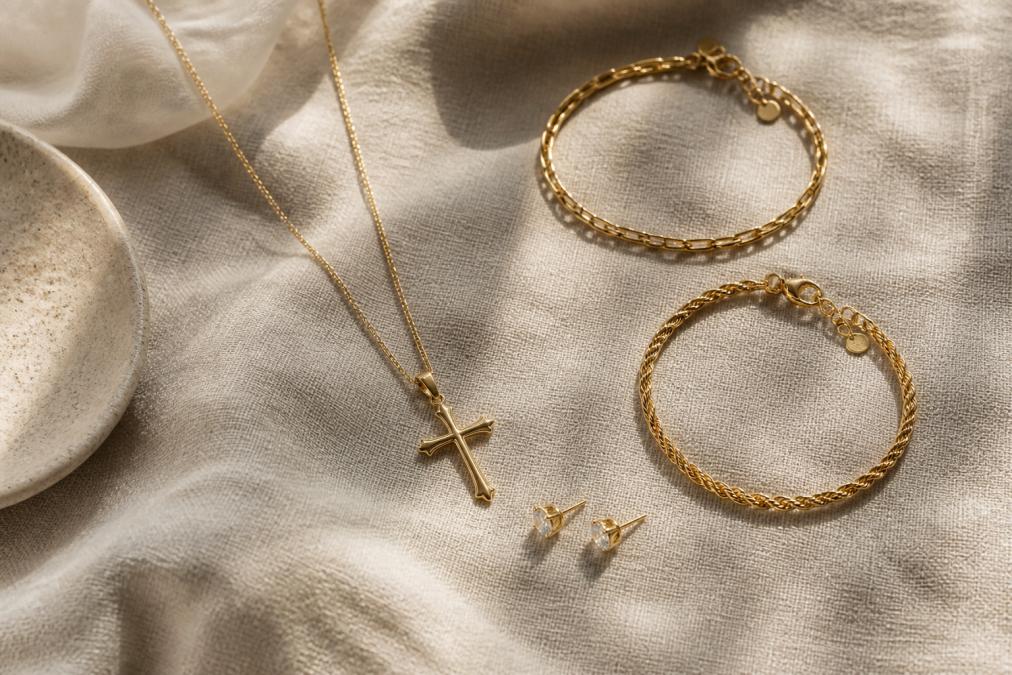
- A short chain with a pendant as your anchor
- A longer chain for layering necklaces
- A thin bracelet you can stack
- Stackable rings in the same finish
- One statement piece for events
Carlotta's cross-themed pieces fit this model well. The Zirconia Cross Necklace and the S925 Cross Bracelet share a clean, timeless design that layers easily with a basic chain setup.
Step 6: Care, Storage, and Resale Value
Care separates a collection that lasts from one that tarnishes in a drawer. Three habits do most of the work, each targeting a specific failure mode.
Does jewelry hold resale value?
Some does, some does not, and the difference is mechanical, not sentimental. Resale value comes from either the intrinsic value of the metal or stone, or demand for a specific designer or vintage piece. Budget buyers should focus on the first.
What holds value:
- Solid gold, value tracks the spot price of gold, so a 14K or 18K piece always has a floor. A buyer can always melt it, which means you can always sell it.
- Sterling silver, same logic at a lower price point. The metal has a floor, though the spread between what you pay and what a refiner pays is wider than with gold.
- Certified diamonds and colored stones, value depends on the 4Cs and on certification. A stone with a grading report from a recognized lab is far easier to resell than an ungraded one, because the buyer is not guessing.
What does not:
- Plated fashion jewelry, there is no recoverable metal value, and the finish is the only thing that made it desirable. Once it wears, it is worth nothing.
- Trend-driven designs, a piece that was everywhere two seasons ago is worth what someone will pay for it now, which is usually a fraction of retail.
Frequently Asked Questions
What are the essential pieces for a luxury jewelry collection on a budget?
Start with five to seven versatile staples: a cross pendant or simple pendant necklace, a pair of stud earrings, a chain bracelet, stackable rings, and one statement piece. Choose neutral tones like gold or silver so each item works with multiple outfits. A capsule approach means fewer pieces that get worn constantly, which lowers your cost-per-wear and keeps spending controlled.
How do I know if gold-plated jewelry is high quality?
Check the base metal and coating thickness. Pieces built on 316L stainless steel with a solid 14k gold coating and an anti-tarnish finish resist fading far better than thin electroplating over brass. Look for hallmarks or material details on the product page. A clear description of the base metal, coating, and finish is a strong sign the piece is built to last.
What is the 2:1:1 rule for jewelry?
The 2:1:1 rule suggests owning two everyday pieces, one statement piece, and one sentimental or meaningful item. For a budget collection, this keeps spending focused on items you actually wear. It also prevents impulse buys that sit unworn. Adjust the ratio to your lifestyle, but the principle holds: prioritize versatility and personal meaning over quantity.
How do I maintain the longevity of my jewelry collection?
Store pieces separately in a dry, lined box to prevent scratching and tarnishing. Put jewelry on last when getting dressed and take it off first at night. Wipe pieces with a soft cloth after wearing to remove oils. Avoid perfume, lotion, and chlorinated water. Pieces with an anti-tarnish coating and a stainless steel core need less upkeep but still benefit from consistent care.