

Durable Jewelry for Sensitive Skin Types: A 2026 Guide
Table of Contents
- Why Durable Jewelry for Sensitive Skin Types Matters
- Signs of Jewelry Allergy You Should Not Ignore
- Hypoallergenic Metals for Jewelry: What Actually Works
- How to Clean Sensitive Skin Jewelry Without Causing Reactions
- Spotting Metal Degradation Before It Irritates Your Skin
- Layering, Stacking, and Daily Wear Without Redness or Itching
- Budget-Friendly vs. Investment-Grade Durability
- Frequently Asked Questions
Last Updated: September 28, 2026
Why Durable Jewelry for Sensitive Skin Types Matters
Durable jewelry for sensitive skin types is the practical solution for anyone whose skin reacts to ordinary costume pieces within days. The problem is rarely the design. It is the metal underneath.
Signs of Jewelry Allergy You Should Not Ignore
The most common sign of a jewelry allergy is contact dermatitis: a red, itchy, sometimes bumpy rash that appears exactly where the metal touches your skin, typically within hours to a few days of wearing a new piece, and clears when you stop wearing it.
Watch for these signals:
- Redness, itching, or a burning sensation under the jewelry
- Small bumps, blisters, or dry, scaly patches
- A rash that fades after you remove the piece and returns when you put it back on
- Discoloration on the skin, often green or black, especially on the neck and fingers
Contact Dermatitis vs. Simple Irritation
Contact dermatitis is an immune reaction to a metal, most often nickel, and worsens with repeated exposure. Simple irritation is mechanical, soap trapped under a ring, friction from a tight clasp, or sweat against the skin, and resolves once you clean the area and adjust the fit. If a rash spreads, blisters, or does not improve after you stop wearing the piece, see a dermatologist.
Hypoallergenic Metals for Jewelry: What Actually Works
The best metals for sensitive skin resist corrosion and release almost nothing onto your skin: implant-grade titanium, surgical-grade stainless steel, and high-karat solid gold. "Hypoallergenic" is not a regulated term, so treat it as a starting point, not a guarantee.
Titanium, Surgical-Grade Steel, and Gold Karat Purity
Titanium is lightweight, strong, and effectively non-reactive for most people. Implant-grade titanium is used in surgical hardware precisely because the body tolerates it.
| Metal | Nickel Risk | Durability | Best For |
|---|---|---|---|
| Implant-grade titanium | Very low | Excellent | Sensitive ears, everyday wear |
| 316L stainless steel | Low | Very good | Bracelets, chains, daily use |
| 14k-18k solid gold | Low | Excellent | Investment pieces, heirlooms |
| Gold-plated over brass | Higher over time | Moderate | Budget buys, occasional wear |
| Sterling silver | Low | Good, tarnishes | Cooler tones, lighter wear |
How to Clean Sensitive Skin Jewelry Without Causing Reactions
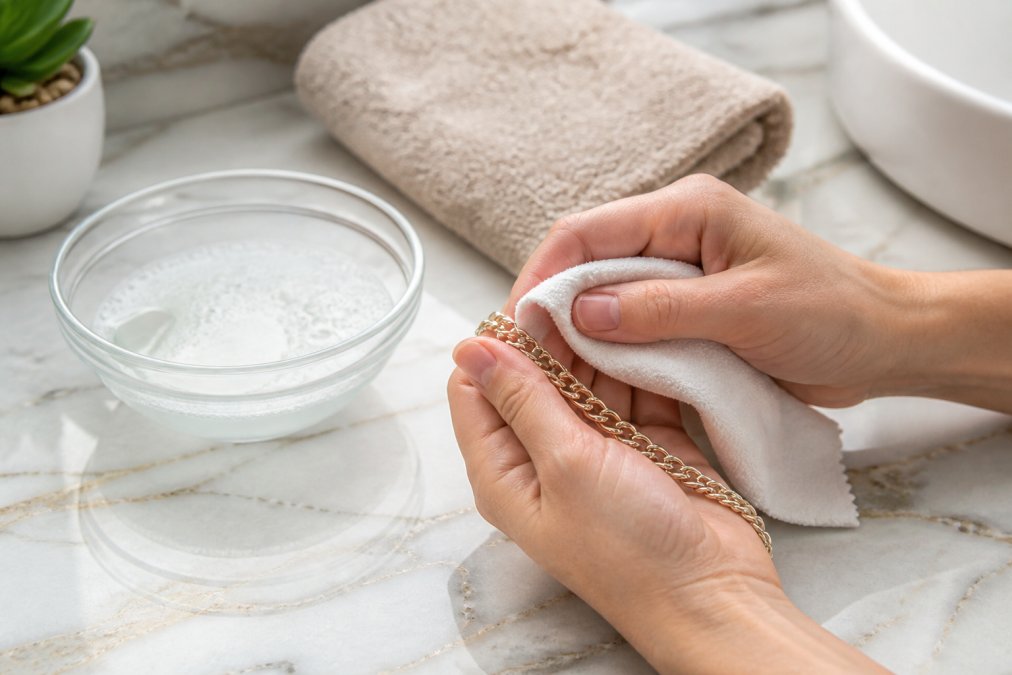
Most guides tell you to use mild soap and water and stop there, skipping the part that matters for reactive skin: what you leave behind on the metal. Cleaning is about not introducing a new irritant and not stripping the coating that stands between your skin and the base metal.
What You Are Actually Trying to Remove
Residue builds up in layers, each behaving differently against metal:
- Sebum and sweat. Sweat is salty and slightly acidic; left on metal it accelerates tarnish on silver and attacks thin plating on costume pieces, the main driver of the green or black mark some people see.
- Sunscreen and lotion. These leave a film that traps moisture against the metal, and chemical sunscreens can react with copper and brass alloys, which is why a piece that was fine in winter suddenly irritates in summer.
- Perfume and hair products. Alcohol and fragrance compounds dull a finish and provoke reactions on already-sensitized skin.
- Dead skin and soap scum. These collect in crevices around clasps and stone settings, holding moisture against the metal longer than anywhere else on the piece.
A Cleaning Routine That Respects the Coating
- Mix a drop of mild, fragrance-free soap into lukewarm water. Dish soap formulated for sensitive skin works; avoid anything labeled antibacterial or with added fragrance.
- Dip a soft cloth or soft-bristle brush and wipe the piece gently. Do not press hard on plated items.
- Rinse with clean water and pat dry immediately. Do not let pieces air-dry on a counter where water can pool in a clasp.
- Let the piece air-dry fully before wearing it again.
Solid Metal vs. Plated: Two Different Jobs
This is the distinction most cleaning advice skips. A solid 14k gold or implant-grade titanium piece has no coating, so a brief soak in warm soapy water and a soft brush can reach buildup in links and settings. A plated piece is the opposite: every scrub removes a little plating, and once it is gone the base metal is exposed.
How Often, and When to Clean More
Wipe pieces after each wear and do a full clean weekly, more often in hot weather or after exercise. If itching starts within an hour of putting a piece on, clean it before wearing it again, a reaction that fast usually means something is sitting on the surface, not that the metal has changed.
What Not to Use
- Jewelry dips and tarnish removers, which often contain acids or ammonia that can pit plated surfaces
- Toothpaste, which is abrasive enough to scratch gold and strip plating
- Baking soda pastes on anything plated or set with softer stones
- Ultrasonic cleaners on plated, glued, or pearl-set pieces
For solid gold, platinum, and titanium, a jeweler can deep clean once or twice a year and check clasps and settings, a loose clasp that snags and bends is one of the fastest ways a durable piece becomes unwearable.
Spotting Metal Degradation Before It Irritates Your Skin
Metal degradation usually announces itself before your skin reacts. Learning the early signs lets you retire or repair a piece before it causes a flare-up.
Look for:
- A dull, cloudy, or uneven finish where the shine used to be
- Color change, such as gold turning brassy or silver going dark
- Flaking or peeling along edges and clasps, a clear sign of electroplating wearing thin
- A green or black mark on your skin after wearing
- Pitting or a rough texture you can feel with a fingertip
Layering, Stacking, and Daily Wear Without Redness or Itching
Layering is safe for sensitive skin when each piece is a compatible, low-risk metal. Trouble starts when you stack a plated chain against a solid one: friction rubs the coating off the cheaper piece, and the exposed base metal sits against your skin all day.
Keep these habits:
- Stack pieces of the same or similar metal so they wear evenly
- Avoid tight clasps and heavy pendants that pull and rub
- Take jewelry off before showering, swimming, and sleeping
- Rotate pieces so no single item takes daily abuse
- Give skin a break: a day off now and then prevents cumulative irritation
Budget-Friendly vs. Investment-Grade Durability
Budget-friendly pieces win on price and variety; investment-grade pieces win on longevity and skin safety, and over a few years the math often flips. The useful version of this comparison is cost-per-wear, which depends on how often you actually put the piece on.
The Cost-Per-Wear Framework
Cost-per-wear is simple: divide what you paid by the number of times you wear the piece before it fails or stops being skin-safe. What matters is not the sticker price but how many wears you get before it breaks, loses its plating, or starts irritating your skin.
Matching the Tier to Your Wear Pattern
- Occasional wear (a few times a month, special occasions). A well-cared-for plated piece can last long enough to be worth it. Store it dry, put it on last, and it will hold up for its limited lifespan.
- Regular wear (several times a week). Plating wears through faster than most people expect under this pattern. Solid 316L stainless steel or a mid-karat solid gold piece is usually the better buy.
- Daily wear (shower-adjacent, sleep-adjacent, never taken off). This is where solid metal stops being a luxury and becomes the practical choice. A piece that never leaves your skin is exposed to sweat, friction, and cleaning products continuously, which is the worst possible environment for a coating.
The Hidden Cost of Replacement
There is a second cost that does not show up in the price tag: every replacement is a new chance for a reaction. A plated piece that has worn through exposes base metal, and if it contains nickel, the reaction can appear even if the same style never bothered you before. The budget path is not just more expensive over time, it is less predictable for sensitive skin.
Where the Middle Tier Fits
316L stainless steel is the pragmatic compromise: it resists corrosion, holds up to daily wear, and costs far less than solid gold. It still contains trace nickel bound inside the alloy, so it is not right for a confirmed nickel allergy, but for most reactive skin it is a durable, affordable everyday option. Implant-grade titanium sits a step up in skin safety, costing more than steel but less than solid gold.
Frequently Asked Questions
What jewelry material is best for sensitive skin?
Implant-grade titanium, 316L surgical-grade stainless steel, and solid gold at 14k or higher are the safest choices because they contain little to no nickel. Platinum and sterling silver also work for many people, though sterling silver contains copper that some react to. If you want a durable piece for daily wear, look for nickel-free labels and avoid base metals with electroplating that can wear away.
Is gold-plated jewelry safe for sensitive skin?
Gold-plated jewelry can be safe if the base metal is nickel-free and the plating is thick, but thin plating wears down over time and exposes the alloy underneath. A PVD coating adds a harder, more corrosion-resistant layer that lasts longer than traditional electroplating. Check the alloy composition before buying, and replace any piece once you see the base metal showing through.
How can I tell if jewelry will cause an allergic reaction?
Look for terms like nickel-free, hypoallergenic, and surgical-grade on the label. Ask about the alloy composition, since metals like cobalt and chromium can also trigger contact dermatitis. When trying a new piece, wear it for a few hours on the first day and watch for redness, itching, or a rash. If symptoms appear, remove the jewelry and clean the area with mild soap and water.
How do I maintain the durability of sensitive-skin-friendly jewelry?
Clean your pieces every one to two weeks with warm water and a drop of mild dish soap, then dry them with a soft cloth. Keep jewelry away from lotions, perfume, and hair products, since residue can trap irritants against your skin. Store each piece separately in a dry pouch to prevent scratches. For gold-plated items, avoid wearing them in the shower or pool, because chlorine and salt water speed up plating wear.
Sensitive skin and durability are not competing goals, and you should not have to choose between a piece that looks good and one your skin tolerates. At Carlotta, we design chains, bracelets, and cross-themed accessories for everyday wear, with a specialized cross collection and up to 30% off during seasonal offers. Shop All and find a piece built to last on your skin, not just in the photo.