

Anti-Tarnish Strips for Jewelry Storage: A Buyer's Guide
Table of Contents
- What Anti-Tarnish Strips Are and How They Work
- Which Jewelry Metals Benefit Most from Anti-Tarnish Protection
- Anti-Tarnish Strips for Jewelry Boxes: Placement and Setup
- How to Store Jewelry to Prevent Tarnishing Effectively
- Anti-Tarnish Strip Replacement Frequency and Lifespan
- Safety Considerations for Different Jewelry Types
- Common Mistakes to Avoid When Using Anti-Tarnish Strips
- Frequently Asked Questions
Last Updated: October 6, 2026
What Anti-Tarnish Strips Are and How They Work
Anti-tarnish strips for jewelry are small, flat materials that absorb tarnish-causing gases during storage, neutralizing the reactive compounds that oxidize silver, copper, brass, and other susceptible metals.
Tarnish forms when metals react with sulfur-containing gases, moisture, and oxygen. Anti-tarnish strips jewelry uses chemically bind those gases before they reach your jewelry; some use activated carbon or specialized compounds to trap sulfur and other corrosive elements, creating a protective microclimate inside a box or bag.
Paper-thin and lightweight, strips are easy to place in jewelry boxes, storage bags, or display cases. They're especially effective for sterling silver, which oxidizes readily, but also protect gold-plated jewelry, brass, bronze, and other reactive materials. Protection typically lasts several months to a year, depending on storage conditions and composition.
Their value is simplicity: unlike polishing cloths or chemical solutions, strips work passively, protecting continuously without maintenance. That matters most for jewelry worn occasionally or stored seasonally, which would otherwise tarnish while sitting unused.
Which Jewelry Metals Benefit Most from Anti-Tarnish Protection
Not all metals tarnish the same way, and strips are not a universal fix. Knowing which metals benefit and how finishes change the equation helps you place strips where they actually work.
Sterling silver is the primary candidate. This alloy is 92.5% pure silver mixed with copper for durability, and that copper reacts with airborne sulfur to form silver sulfide, the dark film called tarnish.
Gold-plated jewelry benefits because the base metal underneath, often copper or brass, can tarnish and show through the gold layer. Protecting it extends the piece's life and prevents discoloration at edges and clasps.
Copper and brass tarnish readily: unprotected copper develops a green or dark patina within weeks, and brass turns dark brown or black. Strips slow this dramatically. Bronze behaves similarly and benefits from the same protection.
Solid gold (including 18k and 24k) resists tarnish naturally and does not require strips. However, if gold jewelry has gemstone settings with metal prongs or mixed-metal components, strips still protect those reactive elements.
Mixed-metal jewelry is where strips earn their keep. A piece combining sterling silver with copper accents, or gold plating over brass with silver findings, has multiple reactive surfaces.
Stainless steel, titanium, and platinum do not tarnish conventionally. They may corrode in extreme conditions, but strips aren't designed for that. Stored alongside reactive metals, strips still help the reactive pieces without harming the inert ones.
A key distinction: strips target sulfur-based tarnish on silver, copper, brass, and bronze, not general corrosion. For rust on iron-based findings or corrosion on base-metal costume jewelry exposed to moisture, you need moisture control first, then strips for tarnish-prone metals.
For mixed collections, group by reactivity: sterling silver and copper together, gold and platinum together, and mixed-metal pieces in their own sealed container with a strip.
Anti-Tarnish Strips for Jewelry Boxes: Placement and Setup
Effective placement of anti-tarnish strips jewelry determines how well they protect your collection. Distribute them throughout the storage space so they neutralize tarnish-causing gases evenly.
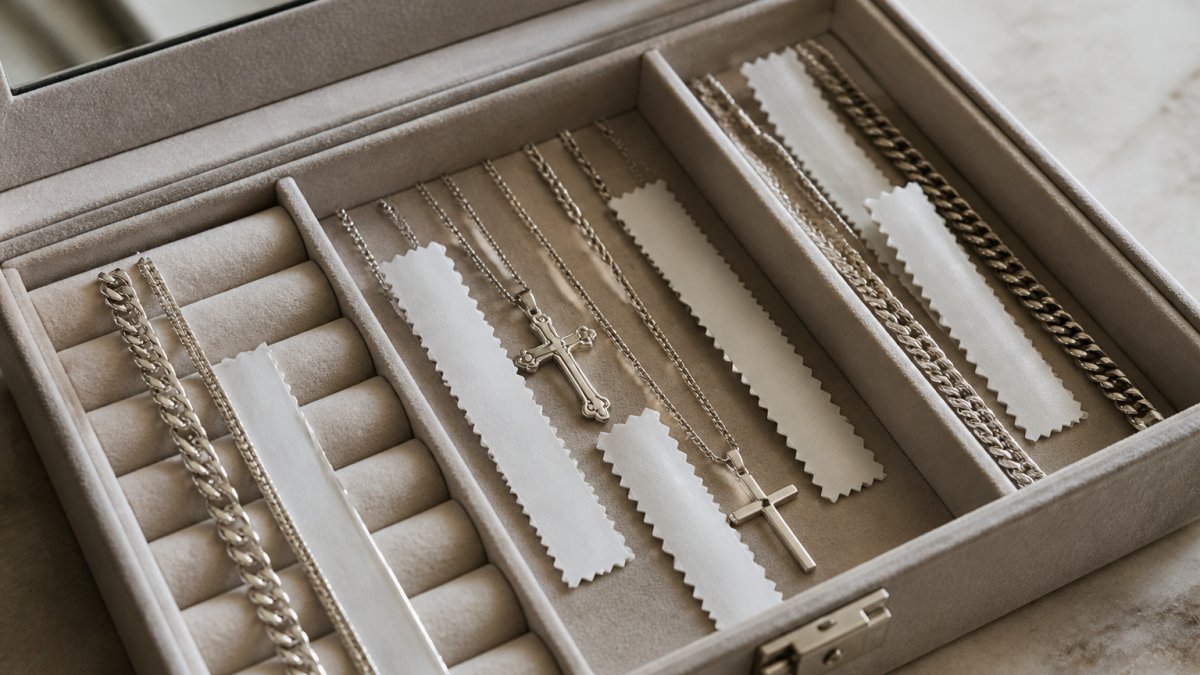
In a standard jewelry box, place one strip in each corner and one in the center for a balanced protective zone. If the box has compartments or dividers, place a strip in each section. Strips don't need to touch your jewelry; they work through the air in the enclosed space.
In storage bags, drop one strip in before sealing. For larger bags holding multiple pieces, use one strip per piece or small group. A sealed bag concentrates the protective effect, so one strip often covers more area than you'd expect.
When storing stacked items, place strips between layers rather than only at the bottom, so protection reaches all pieces, not just those closest to a single strip.
Keep strips away from direct contact with gemstones, especially porous stones like pearls, opals, or turquoise; moisture trapped between a strip and a delicate stone can cause problems. Solid metal pieces without stones can touch strips directly.
Strips are less effective in display cases or open shelving because the space isn't sealed, though placing them nearby still helps somewhat. If you display pieces regularly but store them sealed between wearings, strips in the storage container matter more than those in the display area.
How to Store Jewelry to Prevent Tarnishing Effectively
Storage conditions amplify or diminish what anti-tarnish strips can do, so combine strips with smart storage practices.
Keep jewelry in sealed containers. Airtight boxes, ziplock bags, or specialized cases minimize air exposure and tarnish-causing gases. The tighter the seal, the longer strips remain effective; a loosely closed box lets fresh air in, forcing strips to work harder and wear out faster.
Humidity control matters significantly: high moisture accelerates tarnishing and can cause corrosion even with strips present. Store jewelry in a cool, dry location; basements and bathrooms are poor choices. A bedroom closet or dresser drawer in a climate-controlled room is ideal. In humid climates, add silica packs alongside anti-tarnish strips.
Avoid direct sunlight and heat sources. UV light and heat don't cause tarnish directly, but they degrade the strips themselves. A dark, cool storage space keeps both jewelry and strips in optimal condition.
Separate different metals when possible: storing sterling silver away from copper or brass prevents cross-contamination of tarnish-causing compounds. If space is limited, use separate compartments or bags within the same container.
Keep jewelry clean before storage; dirt and oils trap moisture and accelerate tarnishing. A soft cloth wipe is sufficient, aggressive polishing isn't necessary.
Anti-Tarnish Strip Replacement Frequency and Lifespan
Most anti-tarnish strips remain effective for 6 to 12 months under normal storage conditions, depending on composition, container tightness, and humidity.
A strip nearing the end of its life darkens or discolors: many are white or light gray when new and turn dark brown or black as they absorb tarnish-causing compounds. That visual cue means it has done its job and should be replaced.
Don't wait for visible darkening in high-value collections. For pieces worn rarely and meant to be preserved perfectly, replace strips annually regardless of appearance; the cost is minimal next to the value of protected jewelry.
Sealed storage extends strip lifespan because fewer new tarnish-causing gases enter the space. In sealed conditions a strip might last 12-18 months; in loosely sealed storage, expect 6-9 months.
For jewelry worn regularly and stored only between wearings, replace strips every 6-12 months. For seasonal pieces stored for months at a time, replace them before each storage season to ensure maximum protection when pieces are vulnerable.
Keep replacement strips on hand and swap a spent one immediately. A few weeks without protection can allow visible tarnish to develop, especially on highly reactive metals like sterling silver.
Safety Considerations for Different Jewelry Types
Anti-tarnish strips are safe for most jewelry, but certain pieces require specific handling.
Porous gemstones and organic materials. Pearls, opals, turquoise, coral, amber, and emeralds can absorb moisture or chemicals trapped between a strip and the stone.
Plated jewelry. Strips prevent tarnish of the base metal, extending the plating's visible life, but they do not prevent wear from friction or repeated wearing.
Children's jewelry. Store children's jewelry in sealed containers with strips, never loose strips that could be handled or ingested, and keep storage boxes out of reach. Strips are not toys.
Vintage or antique jewelry with unknown composition. If a piece has sentimental value and its materials are uncertain, a sealed bag with a strip is safer than leaving it unprotected; the strip will not damage it.
Jewelry with leather components. Leather straps, leather-lined boxes, and leather accents work fine with strips, which absorb gases, not moisture. However, if the container traps excess humidity, leather can develop mold or deteriorate, so ensure air circulation or add silica packs alongside strips in humid environments.
Delicate pieces with intricate designs. Intricate filigree, loose components, or pieces with multiple small parts benefit from strips in padded boxes, where the sealed environment also reduces vibration and dust. Place the strip in a corner or under a padded insert rather than against the piece.
Manufacturer instructions. Always check the care instructions that came with your jewelry or storage container; some manufacturers specify storage methods or warn against certain materials. If a manufacturer advises against anti-tarnish strips for a piece, follow that guidance.
A practical safety protocol. For a mixed collection, use separate sealed containers: one for sterling silver and copper, one for gold and platinum, one for gemstone pieces with strips away from stones, and one for children's jewelry stored out of reach. Label each and replace strips per the lifespan schedule.
Common Mistakes to Avoid When Using Anti-Tarnish Strips
The most frequent error is placing strips in unsealed or loosely sealed storage. A strip in an open box or on a shelf does minimal work because tarnish-causing gases continuously enter from the air.
Another mistake is overestimating strip lifespan. Many people place a strip in storage and forget it for years; it loses effectiveness long before that and jewelry begins tarnishing again. Set a reminder to replace strips annually.
Storing too many pieces in one small space overwhelms the strip; a large collection crammed into a tiny box with a single strip can't be protected effectively. Use appropriately sized containers or add strips for larger collections.
Placing strips directly against delicate gemstones or soft metals risks damage; moisture or chemical reactions can occur if a strip sits pressed against a porous stone for months. Maintain small gaps between strips and vulnerable pieces.
Mixing sealed and unsealed storage defeats the purpose. If some pieces sit in sealed bags with strips and others in open boxes within the same larger container, the open boxes become humidity sources affecting the sealed ones.
Assuming strips work without supporting storage conditions is a critical error.
Not monitoring strip condition leaves you unaware when protection ends. Check stored jewelry periodically; if tarnish is developing, your strips are spent and need replacement.
Protecting your jewelry from tarnish doesn't require complex systems. Anti-tarnish strips for jewelry storage offer a simple, effective solution when placed correctly in sealed containers and replaced regularly.
At Carlotta, we understand that your jewelry deserves care that matches its value to you. Pair your pieces with proper storage using anti-tarnish protection, and you'll preserve their beauty between wearings. Learn more about jewelry care best practices from the Smithsonian Institution for additional preservation guidance.
Frequently Asked Questions
How do anti-tarnish strips prevent tarnish on jewelry?
Anti-tarnish strips contain activated charcoal or other reactive materials that neutralize tarnish-causing gases in the air, such as hydrogen sulfide and sulfur dioxide. By absorbing these corrosive gases before they can react with silver, copper, or brass surfaces, the strips create a protective barrier around your jewelry. This oxidation prevention works best in sealed storage environments like jewelry boxes and storage bags where air circulation is limited.
Are anti-tarnish strips safe for gold-plated jewelry and gemstones?
Yes, anti-tarnish strips are safe for gold-plated jewelry and most gemstones when used correctly. The strips work passively through gas absorption and do not release chemicals that damage plating or stone settings. However, avoid direct contact between strips and delicate gemstones or porous stones like pearls or opals. Keep strips separated from these pieces using small compartments or cloth dividers to prevent any potential moisture transfer.
How often should I replace anti-tarnish strips?
Most anti-tarnish strips remain effective for up to one year in typical storage conditions. Replacement frequency depends on humidity levels, storage container seal quality, and how often the box is opened. In humid environments or frequently accessed storage, replace strips every 6-8 months. Monitor strips for discoloration or odor changes, which signal saturation. Always replace strips when moving jewelry to new storage or when you notice tarnish reappearing on previously protected pieces.
Where should I place anti-tarnish strips in a jewelry box or drawer?
Position strips on the bottom, sides, or top of your jewelry box, away from direct contact with jewelry pieces. For boxes with compartments, place one strip in a corner or along an edge where it won't interfere with storage. In larger drawers, distribute multiple strips evenly to maximize coverage. Ensure the storage container closes tightly to trap protective gases around your pieces.