

Tips for Buying Jewelry Online Safely: 2026 Guide
Table of Contents
- 1. Start with Seller Reputation and Reviews
- 2. How to Spot Fake Jewelry Websites
- 3. How to Verify Jewelry Authenticity Online
- 4. Secure Payment Methods and Checkout Safety
- 5. Online Jewelry Return Policy Best Practices
- 6. Shipping, Insurance, and Post-Purchase Verification
- 7. Cybersecurity Hygiene for Jewelry Shoppers
- Conclusion
- Frequently Asked Questions
Last Updated: September 26, 2026
1. Start with Seller Reputation and Reviews
The safest jewelry purchase you'll ever make starts with a seller you can trace. Tips for buying jewelry online safely begin with one rule: vet the seller before you fall in love with the piece. According to the FTC's consumer guidance on online shopping, buyers should research a seller's history and read reviews before handing over payment details. At Carlotta, we've watched too many shoppers skip this step and pay for it later.
A seller's reputation is built from three signals:
- Verified reviews on independent platforms, not just testimonials hosted on the seller's own site
- A real return address and phone number, not a contact form that loops back to itself
- Consistent product photos across listings, which suggests a genuine inventory rather than stolen images
How to Read Customer Feedback Effectively
Sort reviews by newest first, not by "most helpful." Recent feedback reflects how the seller operates now. Look for patterns: one complaint about slow shipping is noise, but five complaints about clasps breaking within a month is a signal. Check whether the seller replies to negative reviews with a solution or with excuses. A seller who resolves problems publicly earns more trust than one with a flawless five-star wall.
2. How to Spot Fake Jewelry Websites
Fake jewelry websites share a recognizable fingerprint. Learning how to spot fake jewelry websites takes about two minutes per seller once you know what to check.
Start with the domain. A site registered three months ago, with a name that misspells a known brand, is a counterfeit operation. Check the About page: if it has no company name, no physical address, and no staff photos, treat it as unverified. Then look at the product copy. Legitimate sellers describe materials precisely, such as "14K gold-plated brass" or "sterling silver." Fake sites lean on vague phrases like "gold tone" with no composition details.
Red Flags in Online Listings
- Prices far below what the materials could possibly cost
- Only one payment option, usually a wire transfer or gift card
- No sizing chart, no weight listed, no material composition
- Stock photos used across multiple unrelated "brands"
- Countdown timers pressuring you to buy within minutes
3. How to Verify Jewelry Authenticity Online
Verifying jewelry authenticity online means matching the seller's claims against independent evidence. Three checks do most of the work.
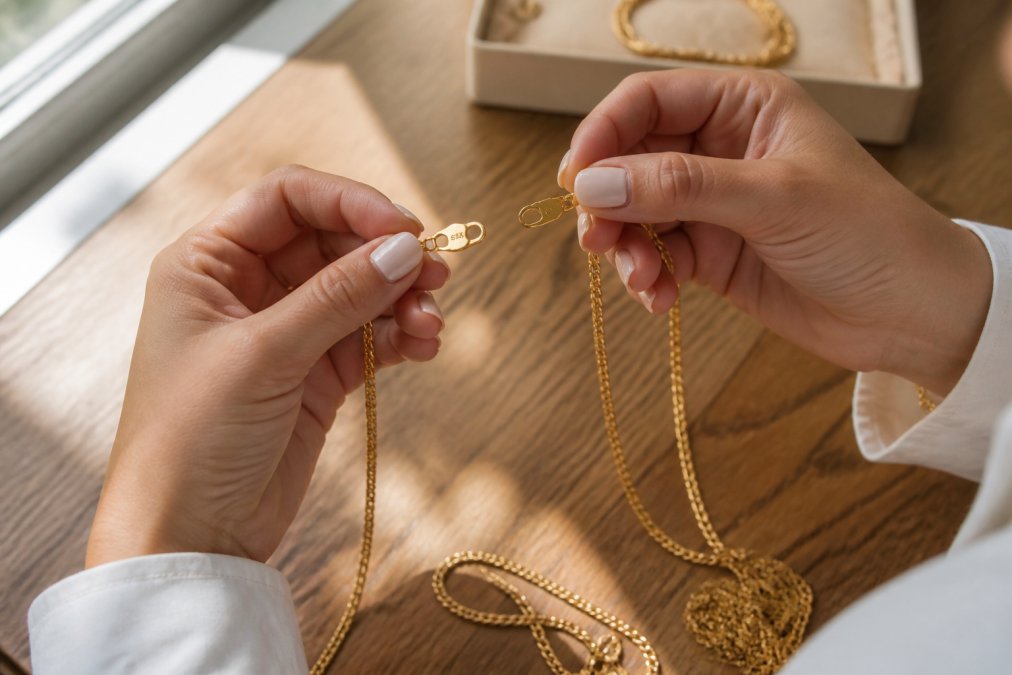
First, the hallmark. In the United States, precious metal items are typically stamped with a quality mark, such as "14K," "585," or "925" for sterling silver. The FTC's Jewelry Guides set the rules for how these marks may be used in advertising, which means a seller making a karat claim is making a legally binding statement.
Second, certification. For diamonds and gemstones, ask for a grading report from an independent laboratory. A certificate issued by the seller itself is not third-party verification.
Third, digital authentication tools. Some sellers now provide blockchain-based traceability records or scannable certificates that link a specific piece to its origin. These tools are still uneven in adoption, but when a seller offers one, it's a meaningful signal of confidence in their supply chain.
Digital Authentication Tools and Hallmark Checks
4. Secure Payment Methods and Checkout Safety
Secure checkout is non-negotiable. Pay with a credit card or a recognized secure payment gateway, both of which give you dispute rights if the item never arrives or arrives misdescribed. Debit cards offer weaker protection, and peer-to-peer transfers offer almost none.
Look for the padlock and "https" in the address bar, but don't stop there. Encryption protects the transmission, not the seller's honesty. Before you enter card details, confirm the checkout page is on the seller's own domain, not a third-party redirect you don't recognize.
| Payment Method | Dispute Protection | Best For |
|---|---|---|
| Credit card | Strong | Most online jewelry purchases |
| Secure payment gateway | Strong | Sellers without direct card processing |
| Debit card | Limited | Small purchases only |
| Wire transfer | None | Never for online jewelry |
5. Online Jewelry Return Policy Best Practices
Online jewelry return policy best practices come down to reading the fine print before you buy, not after. A fair policy gives you at least 14 to 30 days, covers unworn items in original packaging, and states clearly who pays return shipping.
Watch for these traps:
- Restocking fees that eat a meaningful share of the refund
- "Final sale" labels buried in the product description
- Return windows that start at the order date rather than the delivery date
- Exclusions for engraved or customized pieces, which are common and worth confirming upfront
If the policy isn't visible on the product page, email the seller and ask. A slow or evasive answer tells you what the return process will feel like.
6. Shipping, Insurance, and Post-Purchase Verification
Require tracking and shipping insurance on anything valuable. Insurance covers loss and damage in transit, and tracking gives you proof of delivery if a package goes missing. For higher-value pieces, signature confirmation closes the "left on the porch" gap.
Post-purchase verification is the step most buyers skip. When your piece arrives, inspect it under good light before removing tags. Check the hallmark, weigh the item against the listing's stated weight, and compare the finish to the product photos. If anything is off, document it with photos and contact the seller within the return window.
7. Cybersecurity Hygiene for Jewelry Shoppers
Cybersecurity hygiene protects you after checkout, when your card details and address are already in a seller's system. Use a unique password for every jewelry account, enable two-factor authentication where offered, and avoid saving card details on smaller sites.
Be skeptical of post-purchase emails asking you to "confirm" payment information. Phishing campaigns often mimic order confirmations from retailers. Instead of clicking the link, log into your account directly through the seller's website and check the order status there.
Check your card statements for small unfamiliar charges. Fraudsters frequently test stolen cards with minor transactions before attempting larger ones.
Conclusion
Buying jewelry online safely is a process, not a single decision. Vet the seller, verify the materials, pay through a protected method, and inspect what arrives. Carlotta builds its collection of chains, bracelets, and cross-themed accessories for shoppers who want timeless pieces without the guesswork, and our seasonal offers take up to 30% off favorites. Shop All at Carlotta and find a piece worth keeping.
Frequently Asked Questions
Is buying jewelry online safe?
Buying jewelry online is safe when you take a few precautions. Check that the retailer has a verified seller reputation and real customer feedback, pay through secure checkout with encryption, and confirm the return policy before ordering. Make sure the product description lists material composition, karat, and weight. If a deal looks too good to be true, it probably is.
What are the red flags when buying jewelry online?
Watch for prices far below market value, missing hallmark or certification details, blurry or stolen high-resolution imagery, and sellers who only accept wire transfers or cryptocurrency. Other red flags include no physical address, no return policy, pressure to buy immediately, and reviews that all sound identical. If the site has no secure payment gateway or asks for unnecessary personal data, leave. These are common signs of counterfeit or dupe operations.
How can I verify the authenticity of online jewelry?
Check for a hallmark stamp indicating karat and precious metal content. Request macro photography of the hallmark, clasp, and any engraving. Digital authentication tools and traceability reports are increasingly common.
What should I look for in an online jewelry store's return policy?
Look for a clear return window, typically 14 to 30 days, and whether returns are free or require a restocking fee. Confirm that customized or engraved items are excluded, and check if the policy covers damaged or counterfeit items. A good policy states who pays return shipping and how refunds are issued. Save screenshots of the policy at checkout. If the policy is vague or hidden, that is a warning sign.