

Are Online Jewelry Return Policies Usually Reliable?
Table of Contents
- Return Windows: What's Standard and What's a Warning Sign
- Restocking Fees and Hidden Costs in Jewelry Return Policies
- How to Verify Online Jewelry Store Authenticity Before You Buy
- Common Jewelry Return Policy Red Flags to Watch For
- Hygiene Policies, Tamper Tags, and Condition Requirements
- Store Credit vs. Full Refund: What You're Actually Getting Back
- Return Fraud, International Orders, and the Scenarios Nobody Warns You About
- Frequently Asked Questions
Last Updated: September 15, 2026
Return Windows: What's Standard and What's a Warning Sign
Most reputable online jewelry sellers give you 30 days from the delivery date to return an item, and that window is the first thing to check before you buy. Anything shorter than 14 days deserves scrutiny, especially for higher-value pieces. The question of whether online jewelry return policies are usually reliable comes down to how clearly the window is stated and how easy it is to start a return. A reliable policy names the exact number of days, the date the clock starts, and whether weekends count. A vague one says "returns accepted" and leaves you guessing.
Watch for these warning signs:
- No stated return window at all
- A window that starts at the purchase date instead of the delivery date
- Different windows for different product categories buried in fine print
- Language like "returns considered on a case-by-case basis"
That last one is the biggest red flag. It means the seller keeps full discretion, and you have no guaranteed path to a refund. Reliable policies are specific, and specificity is what protects you.
Restocking Fees and Hidden Costs in Jewelry Return Policies
A restocking fee is a percentage deducted from your refund when you send an item back, and it is the most common hidden cost in jewelry returns (the FTC). Many sellers charge one on non-defective returns, and the fee often ranges from a small percentage to a fifth of the item's value, though the exact amount varies by seller and product type. Jewelry restocking fees explained simply: you get back less than you paid because the seller recovers the cost of processing and reselling the item.
Beyond restocking, watch for these costs:
- Return shipping you pay out of pocket
- A requirement to use the seller's pre-paid shipping label, with the cost deducted from your refund
- Shipping insurance requirements for high-value items
- Deductions for missing original packaging or appraisal certificate
How to Verify Online Jewelry Store Authenticity Before You Buy
Verifying a store's authenticity starts with three checks: a real business address, a working customer service channel, and a return policy written in plain language. How to verify online jewelry store authenticity goes beyond these basics, though. Look for a physical mailing address, not just a contact form. Check whether the site lists a phone number or live chat. Read the return policy in full before adding anything to your cart.
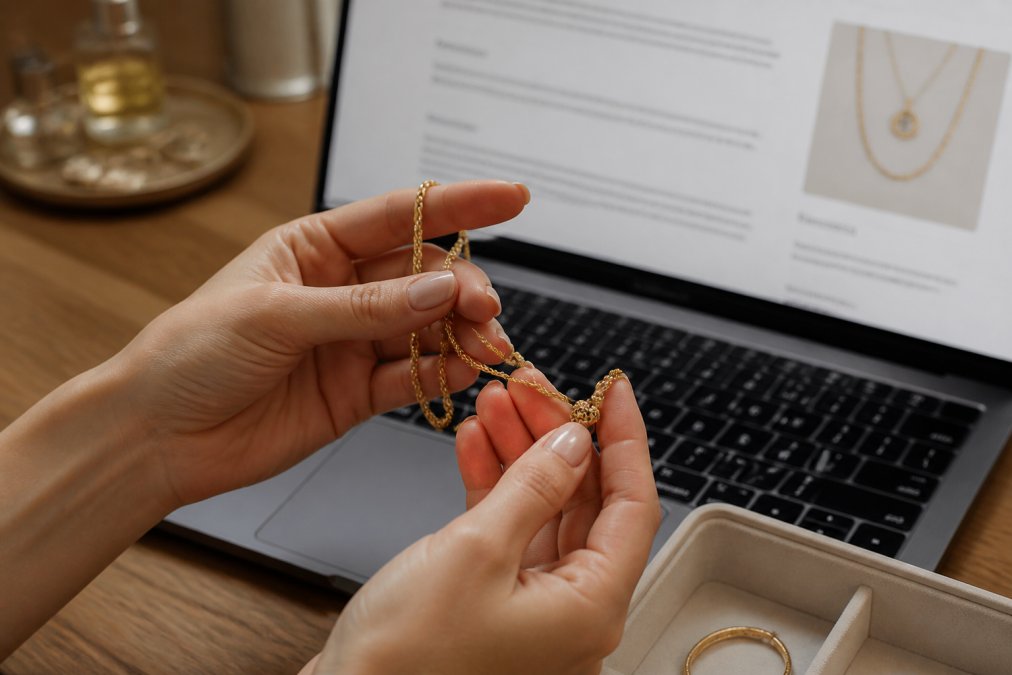
A legitimate seller will also provide documentation for precious metals and gemstone verification. For gold-plated pieces, that means a clear description of the base metal and plating thickness. For gemstones, it means an appraisal certificate or grading report from a recognized lab. If a store cannot tell you what its jewelry is made of, that is your answer.
Common Jewelry Return Policy Red Flags to Watch For
Common jewelry return policy red flags cluster around four areas: vague language, hidden fees, restrictive condition rules, and slow refund processing. Any one of these on its own might be manageable. Two or more together suggest a seller that makes returns deliberately difficult.
Here is what to watch for:
| Red Flag | What It Looks Like | Why It Matters |
|---|---|---|
| Vague window | "Returns accepted within a reasonable time" | No enforceable deadline |
| Hidden restocking fee | Fee disclosed only in FAQ, not at checkout | You lose money unexpectedly |
| No return authorization process | No way to get a return authorization number | Your package may be refused |
| Slow refunds | "Refunds processed within 30 business days" | Your money is tied up for weeks |
| Condition traps | "Item must be unworn and in original packaging" | Impossible to inspect without opening |
The condition trap is worth calling out specifically. If a policy requires an item to be unworn and in its original packaging, you cannot even try on a necklace to see how it looks. Many sellers handle this with a tamper-evident tag: you can inspect the piece, but removing the tag voids the return. That is a fair middle ground.
Hygiene Policies, Tamper Tags, and Condition Requirements
Hygiene policies exist for a legitimate reason: earrings and body jewelry cannot be resold once they have been worn (the FDA). That means many sellers mark pierced-ear items as non-refundable or final sale. The policy is reasonable. The problem is when sellers apply hygiene restrictions to items that have no hygiene concern, like a bracelet or a chain necklace.
A well-written policy separates these categories clearly:
- Pierced earrings and body jewelry: often final sale or exchange only
- Necklaces, bracelets, and rings: returnable if unworn and tagged
- Custom or personalized pieces: typically non-refundable
- Clearance items: frequently final sale
Tamper-evident tags are the mechanism that makes this work. The tag stays attached while you inspect the piece. If you remove it and then try to return the item, the seller can refuse. That is fair as long as the tag does not prevent you from actually seeing the jewelry. If a tag is attached in a way that hides the clasp or the stone setting, that is a problem.
Store Credit vs. Full Refund: What You're Actually Getting Back
Store credit is not a refund, and the difference is larger than most buyers realize. A full refund returns money to your original payment method. Store credit locks that money into a single retailer, frequently with an expiration date, and often at a value that assumes you will spend more than the credit to buy a replacement. Some sellers make store credit the default and a full refund available only on request, which quietly shifts the burden onto you.
The refund mechanics that decide what you actually get back
Before you buy, confirm these in writing:
- Refund type. Full refund to the original payment method, or store credit only? Some sellers offer a full refund within a short window and store credit after that.
- Refund processing time. A seller might receive your return in three days and take three weeks to process it. Reliable sellers state a specific number of business days. If the policy says "up to 30 business days," plan for the worst case.
- Deductions. Return shipping, a restocking fee, and the cost of a pre-paid label can all be subtracted from your refund. Ask whether the refund is calculated on the item price or the order total.
- Original payment method only. Refunds almost always go back to the card or account used for the purchase, not to a different one.
- Expiration on store credit. If credit expires, its real value is lower than the number on the certificate.
A pre-return inspection checklist
Documenting the item before you ship it is the single most effective way to protect a high-value return, and it is the step most buyers skip. Do this the day the item arrives, while the packaging is still intact:
- Photograph the item from multiple angles in good light, including the clasp, the stone setting, and any hallmark or stamp.
- Photograph the tamper tag and its attachment point before you remove anything.
- Photograph the packing slip, appraisal certificate, and grading report alongside the item.
- Note any pre-existing flaw (a scratch, a loose stone, a discolored plating edge) in a dated photo. This is what protects you if the seller claims you caused the damage.
- Keep the original box and packaging until you are certain you are keeping the piece. Missing original packaging is a common deduction.
- Save the order confirmation and a screenshot of the return policy as it read on the day you bought.
How to verify a policy before you commit
Return Fraud, International Orders, and the Scenarios Nobody Warns You About
Return fraud and the security measures you will encounter
Cross-border returns: customs, duties, and the costs that do not come back
The proposal-failure scenario
FTC guidance on online shopping and return policies
Frequently Asked Questions
What should I look for in an online jewelry return policy?
Check the return window (14-30 days is standard), whether you get a full refund or store credit, who pays return shipping, and whether restocking fees apply. Look for clear language about original packaging, tamper-evident tags, and appraisal certificates. A reliable jewelry return policy states all of this upfront, not buried in fine print.
Are restocking fees common for online jewelry purchases?
Restocking fees range from 10-25% at some retailers, especially for custom or engraved pieces. Not all stores charge them. Before buying, search the policy page for 'restocking fee' or 'return shipping costs.' If a store charges one, factor that into your total cost. Many reputable jewelers waive fees for exchanges or store credit.
Can a jeweler refuse a return on a custom-made piece?
Yes. Custom jewelry, engraved items, and resized rings are typically non-refundable because they cannot be resold. This is standard across the industry, not a red flag. What matters is whether the policy clearly states this before you order. If a store does not disclose custom-item restrictions upfront, treat that as a warning sign.
How do I verify if an online jewelry store is legitimate?
Check for a physical business address, a working customer service phone number, and reviews on independent sites. Look for secure checkout (HTTPS), clear terms and conditions, and gemstone verification or appraisal certificates for high-value pieces. A store that hides its return policy or has no contact information beyond a web form is a risk.