

How to Identify Durable Jewelry Clasps: 2026 Guide
Table of Contents
- Clasp Types and Their Durability at a Glance
- Key Signs of a Well-Made, Durable Jewelry Clasp
- Jewelry Clasp Material Guide: Precious Metals vs. Base Metal
- Most Secure Jewelry Clasps for Bracelets
- How to Repair Broken Jewelry Clasps
- Clasp Maintenance for Long-Term Wear
- Frequently Asked Questions
Last Updated: September 11, 2026
Clasp Types and Their Durability at a Glance
Learning how to identify durable jewelry clasps starts with knowing which mechanisms actually hold up to daily wear, and the same knowledge helps you spot durable jewelry clasps at a glance. A durable jewelry clasp is a closure engineered so its locking mechanism resists opening under repeated tension, sweat, and movement. A durable jewelry clasp is a closure engineered so its locking mechanism resists opening under repeated tension, sweat, and movement. Here is the short answer: lobster claws and box clasps outperform spring rings and magnetic closures for everyday pieces, and the metal matters as much as the mechanism.
The table below summarizes what each clasp type does well and where it fails.
| Clasp Type | Security Level | Best For | Main Weakness |
|---|---|---|---|
| Lobster claw | High | Bracelets, heavy chains | Spring can jam with grit |
| Box clasp | High | Bracelets, flat chains | Hinge wears over time |
| Spring ring | Moderate | Light necklaces | Thin spring loses tension |
| Toggle | Moderate | Statement necklaces | Can slip if chain is loose |
| Magnetic | Low | Accessibility needs | Releases under sudden pull |
| Barrel / bayonet | Moderate | Vintage-style pieces | Threads strip if forced |
Spring tension is the single biggest predictor of clasp failure. A lobster claw with a thick, well-seated spring will outlast three cheap spring rings. When you squeeze the trigger, it should snap back with authority, not feel spongy.
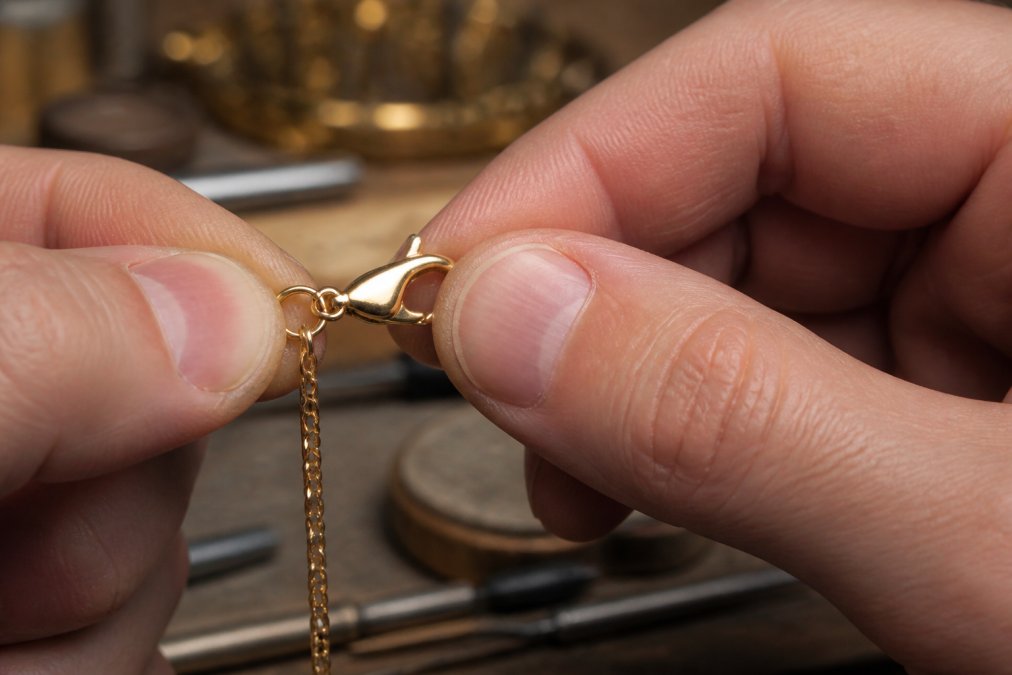
Key Signs of a Well-Made, Durable Jewelry Clasp
The clearest sign of a well-made clasp is uniform thickness in the metal and a mechanism that closes with a firm, audible click. Run your fingernail along the edges. Sharp seams or thin spots mean the piece was cast cheaply and will fatigue fast.
Look for these markers of quality:
- Weight in the hand. A solid clasp feels denser than it looks. Hollow stampings bend easily.
- Smooth hinge action. The hinge mechanism should move without grinding or wobbling.
- Clean solder marks. Sloppy, blobby solder around the jump ring usually signals rushed assembly.
- Even spring tension. Test the trigger several times; it should return to position every time.
A common mistake is judging a clasp by its shine alone. Plating hides base metal underneath, and that base metal is what determines whether the clasp survives a year of daily wear.
Jewelry Clasp Material Guide: Precious Metals vs. Base Metal
The jewelry clasp material guide comes down to one trade-off: precious metals resist corrosion and skin reactions, while base metals cost less but tarnish and weaken faster. What most guides skip is the mechanism behind that trade-off, hardness and how it interacts with the moving parts of a clasp.
On the Mohs hardness scale, pure gold sits around 2.5 and pure silver around 2.5 to 3, which is why both are almost always alloyed for jewelry (geology.com). Sterling silver is 92.5 percent silver alloyed with copper, landing near 2.5 to 3 on the scale but with far better ductility than brass. Platinum runs roughly 4 to 4.5 and resists deformation better than gold at the same thickness. Stainless steel, depending on grade, sits around 5.5 to 6.5 and is the reason it survives spring and hinge cycling that would fatigue a plated alloy.
That hardness number matters most at the two failure points inside any clasp: the spring and the hinge. A spring needs to flex thousands of times without taking a permanent set. A hinge needs to rotate without galling. Softer metals deform under both loads; harder metals resist but can become brittle if they are too hard for the mechanism.
| Material | Approx. Mohs Hardness | Corrosion Resistance | Typical Clasp Role |
|---|---|---|---|
| 14K-18K gold | 2.5-3.5 (alloy dependent) | High | Lobster claws, box clasps, toggles |
| Sterling silver (925) | 2.5-3 | Moderate (tarnishes) | Spring rings, lobster claws, hooks |
| Platinum | 4-4.5 | Very high | High-end box clasps, lobster claws |
| Stainless steel | 5.5-6.5 | Very high | Springs, magnetic housings, budget clasps |
| Brass / zinc alloy | 3-4 (varies) | Low | Plated fashion clasps |
| Titanium | ~6 | Very high | Hypoallergenic clasps, lightweight pieces |
Metal fatigue is the quiet killer here. Every time a clasp flexes, the metal weakens microscopically. Precious metals tolerate far more cycles before cracking. Base metal clasps on a chain you wear daily may fail within months, especially at the spring or hinge, because the plating wears through at the exact points that move.
Allergy-Friendly Materials for Sensitive Skin
For sensitive skin, stainless steel, sterling silver, and titanium are the safest clasp choices because they release minimal nickel. Nickel is the most common cause of jewelry reactions, and it hides in cheap base metal alloys and low-quality plating (the CDC). If a chain turns your neck green within weeks, the culprit is usually the clasp metal, not the chain itself, the clasp sits against skin longer and flexes more.
Two materials deserve more attention than they usually get:
- Titanium. Roughly 6 on the Mohs scale, naturally nickel-free in commercially pure grades, and about 40 percent lighter than steel at comparable strength. That lightness matters on earrings and lightweight necklaces where a heavy clasp drags the chain forward.
- Niobium. A softer, hypoallergenic metal often used in body jewelry and small findings. It is not as hard as titanium, so it suits hooks and small clasps rather than load-bearing lobster claws.
A practical rule: if a clasp is described only as "hypoallergenic" with no metal named, treat that as marketing. Ask what the clasp is made of specifically, not just the chain. Carlotta's S925 cross bracelet uses sterling silver, a material that works well for reactive skin.

Nickel directive and skin sensitization guidance
Most Secure Jewelry Clasps for Bracelets
The most secure jewelry clasps for bracelets are the lobster claw and the box clasp, because both lock positively and resist accidental release. Bracelets take more abuse than necklaces: they catch on sleeves, hit desks, and get tugged when you carry bags. That constant stress is why security matters more here than on any other piece.
Security is not just about the mechanism, though. It is about whether the clasp is rated for the weight it is holding. A lobster claw that is fine on a 4-gram chain will pop open on a 40-gram charm bracelet, because the spring was never sized for that load. A useful way to think about it is a weight-to-clasp ratio:
| Bracelet Weight | Chain Style | Minimum Clasp | Why |
|---|---|---|---|
| Under 10 g | Fine cable, box chain | Spring ring or small lobster claw | Light load, low stress |
| 10-25 g | Cable, rope, curb | Standard lobster claw | Handles daily tugging |
| 25-50 g | Curb, Figaro, flat links | Heavy lobster claw or box clasp | Spring must resist higher tension |
| 50 g+ | Charm, statement, multi-strand | Box clasp with safety catch, or oversized lobster claw | Single-point failure risk is high |
These ranges are practical guidance, not a standard, but the principle holds: as weight climbs, the clasp's spring wire diameter and the thickness of its body need to climb with it. A thin spring under a heavy load takes a permanent set and stops snapping closed.
Here is how the top options compare for bracelet use:
- Lobster claw: Best all-rounder. Strong spring, easy one-hand operation. Choose a heavier gauge for anything over about 25 grams.
- Box clasp: Ideal for flat chain bracelets; sits flush and looks clean. Look for one with a fold-over safety catch, which is the difference between a secure box clasp and a decorative one.
- Toggle clasp: Stylish but the least secure for active wear; best on loose bracelets where the bar cannot be pulled through the ring.
- Magnetic clasp: The accessibility favorite, but it pops open under a sharp pull. Strong neodymium magnets hold better than ceramic ones, but no magnet matches a mechanical lock under sudden tension.
Carlotta's GOD FIRST bracelets and cross bracelets pair secure closures with everyday styling.

Accessibility: Clasps for Limited Dexterity
Most clasp guides assume full hand strength and fine motor control. That leaves out a large group of wearers, people with arthritis, neuropathy, or reduced grip, who need a clasp they can actually operate independently.
The trade-off is real: the easiest clasps to open are usually the least secure, and the most secure are the hardest to work one-handed. A few options thread that needle:
- Magnetic clasps with a mechanical backup. Some designs pair a magnet for alignment with a small slide or hook that locks once closed. You get one-handed closing without the pop-open risk of a bare magnet.
- Oversized lobster claws. A larger trigger gives more surface for a thumb to press and requires less pinch strength than a small spring ring.
- Box clasps with a wide tab. The fold-over tab is easier to grip than a tiny trigger, though it still requires two hands on most bracelets.
- Magnetic clasp converters. These attach to an existing clasp and let you convert a hard-to-operate closure into a magnetic one without altering the piece. They are a common workaround for people who love a bracelet but cannot manage its original clasp.
If dexterity is the deciding factor, prioritize a clasp you can close one-handed and confirm it has a secondary lock. Security and accessibility are not mutually exclusive, but you have to look for the designs that address both.
How to Repair Broken Jewelry Clasps
Repairing a broken jewelry clasp depends on the failure point. If the spring has died, the clasp needs replacing. If a jump ring has opened, it can often be squeezed shut with pliers. If the hinge has cracked, professional repair is the only safe route. Learning to repair broken jewelry clasps saves you from discarding a piece you love over a small part.
Follow these steps to assess and fix common failures:
- Identify the exact failure point with a loupe or magnifying glass.
- Check whether the clasp or the jump ring broke; they need different fixes.
- For an open jump ring, use two flat-nose pliers to twist it closed, never pull it.
- For a dead spring, replace the entire clasp rather than bending the trigger.
- Test the repair under gentle tension before wearing the piece out.
DIY Fixes vs. Professional Repair
DIY works for jump rings, loose hooks, and reattaching a chain to an intact clasp. Professional repair is worth it when the clasp body is cracked, when solder is required, or when the piece is valuable. The rule of thumb: if the fix involves heat or the clasp's internal spring, hand it to a jeweler.
Clasp Maintenance for Long-Term Wear
Clasp maintenance is simple but most people skip it entirely. Wipe the clasp with a soft cloth after wear to remove sweat and oils, which are the main causes of corrosion and stiff springs. Once a month, work the mechanism open and closed a few times to keep the spring limber.
These habits extend clasp life significantly:
- Store pieces separately so clasps do not tangle and bend.
- Keep perfume and lotion away from the clasp; chemicals accelerate tarnish.
- Check the jump ring tension every few weeks for early signs of wear.
- Remove bracelets before heavy lifting or sports to avoid stress spikes.
Patina on sterling silver is normal and easy to manage with a polishing cloth. Rust or green residue on a base metal clasp is not patina; it is corrosion, and it means the piece is nearing the end of its life.
Frequently Asked Questions
What type of bracelet clasp is the most durable?
The box clasp with a safety catch is generally the most durable for bracelets, especially heavier pieces. Its enclosed design resists snagging and accidental opening. For everyday wear on lighter chains, a lobster claw clasp offers a strong, reliable alternative. Both outperform spring ring clasps, which can lose tension over time and are more prone to failure with frequent use.
How can you tell if a jewelry clasp is high quality?
Look for smooth edges, a firm spring action, and no visible solder marks or asymmetry. A high-quality clasp feels solid in your hand and opens and closes with a clean snap. Check for a hallmark or stamp indicating precious metal content, such as 925 for sterling silver or 14K for gold. These signs point to durable jewelry clasps built to last.
Are lobster claw clasps more durable than spring rings?
Yes, lobster claw clasps are typically more durable than spring rings. The lobster claw's trigger mechanism is enclosed, which protects the spring from debris and wear. Spring rings rely on an exposed coil that can weaken with repeated use. For daily-wear bracelets or necklaces, a lobster claw clasp is the more secure choice.
Which clasps are best for daily wear jewelry?
For daily wear, choose a lobster claw or box clasp made from sterling silver, stainless steel, or 14K gold. These materials resist tarnishing and hold up to frequent handling. Avoid magnetic clasps for valuable pieces, as they can release unexpectedly. A well-made clasp with a safety catch adds extra security for bracelets and necklaces you never take off.
Cheap clasps are the fastest way to lose a piece you love, and most shoppers only notice the hardware after it fails. Carlotta builds chains, bracelets, and cross-themed accessories with closures meant to handle daily wear, and our seasonal offers take up to 30% off favorites so durability does not have to stretch your budget. Browse the collection, check the clasp on each piece, and choose jewelry that stays with you. Get started with Carlotta and shop all.