

How to Buy Ethically Sourced Anniversary Diamonds Online
Last Updated: November 9, 2026
Quick Summary
Buy ethically sourced anniversary diamonds from a seller who names the mines or lab facilities behind each stone, provides a grading report, and states whether the stone is natural or lab-grown. Compare sellers on sourcing disclosure, return policy, warranty and price transparency before you pay.
- Ask whether the sourcing claim applies to the exact stone, not just the brand.
- Request a grading report from a recognized gemological laboratory before purchase.
- Compare sellers in a six-row table covering sourcing, return policy, warranty and pricing.
- Check whether custom or engraved pieces are excluded from the return window.
- Treat a price far below comparable listings as a reason to check grades and paperwork.
Table of Contents
- What Ethically Sourced Anniversary Diamonds Actually Mean
- Step 1: Decide Your Budget and Diamond Type
- Step 2: Compare Where to Buy Ethically Sourced Anniversary Diamonds Online
- Step 3: Find Ways to Buy Ethically Sourced Anniversary Diamonds Cheap
- Step 4: Verify Sourcing Claims With a Practical Checklist
- Step 5: Ask the Right Questions Before You Order
- Choosing Your Anniversary Diamond With Confidence
- Frequently Asked Questions
What Ethically Sourced Anniversary Diamonds Actually Mean
Ethically sourced anniversary diamonds are stones whose origin, mining conditions and trade path a buyer can trace and check. For the traditional meaning behind each anniversary stone, see the meaning behind traditional anniversary gemstones. The phrase is used loosely, so this guide separates what a seller can prove from what is only marketing language. Before you spend money on an anniversary stone, you need to know the difference.
Here is the short version. A diamond that is ethically sourced should come with a clear claim about where it was mined or made, how it moved through the supply chain, and what standards applied along the way. A label without those details tells you very little.
Conflict-free versus responsibly sourced
"Conflict-free" usually means a stone was not used to fund armed conflict. That is a narrow promise. "Responsibly sourced" is broader and can cover labor conditions, environmental practices and community impact. Many sellers use the two terms interchangeably, which is why you should ask what each one covers in their specific case.
Natural versus lab-grown diamonds
Natural diamonds form underground over long periods. Lab-grown diamonds are created in a controlled environment and have the same chemical structure. Both can be sold as ethical, but they raise different questions. A lab-grown stone avoids mining concerns, while a natural stone needs documentation about its origin. To learn how to tell natural from synthetic stones, read how to tell if a gemstone is natural or synthetic.
Step 1: Decide Your Budget and Diamond Type
Anniversary jewelry is a different purchase from an engagement ring, and the budget conversation should reflect that. You are often buying for a partner who already wears a ring daily, which means wearability, sizing, and the ability to match an existing band matter as much as carat weight. Start with a total number you can spend without financing, then decide how to allocate it across the stone, the setting, and any customization.
How the four Cs move the price. Diamond pricing is driven by carat weight, cut, color, and clarity, and the four do not move in lockstep. Carat weight has the largest effect on price per carat, and price per carat rises disproportionately as stones get larger, so a stone just under a common weight threshold often costs noticeably less than one just over it. Cut has the strongest effect on how a stone looks, and a well-cut stone in a slightly lower color or clarity grade can outperform a poorly cut stone with better grades on paper. Color and clarity grades near the top of the scale carry a premium that is often invisible to the naked eye once the stone is set.
Natural versus lab-grown. Lab-grown diamonds typically cost less per carat than natural stones of similar cut, color, and clarity, and the gap widens as carat weight increases. That does not make lab-grown the automatic budget choice: natural stones hold resale value differently, and some buyers place personal value on a mined stone with a documented origin. Decide which of those factors matters to the recipient before you set the number, because the same budget buys very different stones in each category.
Setting and metal costs. The setting is a separate line item and can range from a simple solitaire to a halo or three-stone design with multiple side stones. Metal choice also affects cost, with platinum generally priced above white gold and other alloys. If you plan to add a matching band or reset an heirloom stone, budget for the jeweler's labor as well as the materials.
Anniversary-specific budget guidance. Milestone anniversaries often come with traditional gift expectations, and many couples choose to mark a tenth, twenty-fifth, or fiftieth anniversary with a larger stone or an upgrade rather than a first-time purchase. If you are upgrading, ask whether the seller offers trade-in or buy-back credit toward the new stone, and confirm the terms in writing. If you are buying a first anniversary diamond, a smaller stone in a well-made setting is often a better use of budget than a larger stone with weak documentation.
Where to look for current prices. Because prices change with inventory and market conditions, the most reliable figures are the listed prices on each seller's product pages for the specific stone and setting you are considering. Compare at least three sellers for the same combination of carat, cut, color, clarity, and metal before you decide, and treat any single quoted price as a starting point rather than a benchmark.
Watch out: a stone priced far below comparable listings often has weaker documentation, a lower cut grade than the photos suggest, or a clarity grade that depends on inclusions hidden by the setting. Ask for the grading report and compare the grades, not just the carat weight, before you treat a low price as a bargain.
Step 2: Compare Where to Buy Ethically Sourced Anniversary Diamonds Online
Most buyers compare sellers on price alone, which is the fastest way to end up with a stone whose sourcing story falls apart after purchase. A better approach is to score each seller on the same six criteria, in writing, before you commit. This is the framework we recommend to anyone shopping for an anniversary stone, and it is the same one we use to evaluate our own listings.
1. Sourcing disclosure. Look for a published policy that names the specific mines, cutting centers, or lab facilities involved, not just a brand-level promise. A seller who can name the origin of an individual stone is offering more than one who repeats "conflict-free" on every page. Ask whether the disclosure applies to the exact stone in the listing or only to the brand's overall supply chain.
2. Natural and lab-grown options. Some sellers carry only natural stones, some carry only lab-grown, and some carry both. If you are weighing the two, confirm that the seller provides the same level of documentation for each. A common pattern is strong mine-to-market paperwork for natural stones and thinner documentation for lab-grown, even though lab-grown stones also benefit from a grading report and a clear statement of where they were created.
3. Return policy. Compare the length of the return window, whether returns are free or subject to a restocking fee, who pays return shipping, and whether engraved or customized pieces are excluded. Anniversary purchases often involve sizing or personalization, so read the fine print on custom work before you order.
4. Warranty and service. Ask what the warranty covers: the setting, the stone, or both, and for how long. Also ask whether the seller offers resizing, prong tightening, or re-polishing after purchase. A strong warranty matters more for a ring that will be worn daily than for a piece kept in a box.
5. Customization and setting options. Compare the range of settings, metal choices, and engraving options, and confirm whether customization affects the return window. If you plan to reset an heirloom stone or add a matching band, ask whether the seller will work with stones you already own.
6. Price transparency. Check whether the listing shows the full price, including setting and any sizing fees, or whether extras appear only at checkout. A lower headline price can hide added costs for sizing, engraving, or expedited shipping.
To make the comparison concrete, build a simple six-row table with one column per seller and score each criterion as documented, partial, or missing. Sellers who score documented across all six are rare, and that rarity is useful information. When a seller is strong on sourcing but weak on returns, or vice versa, you can decide which trade-off matters for an anniversary gift that may need resizing or may be returned.
Watch out: a seller who publishes a detailed sourcing policy but will not confirm the origin of the specific stone in your cart is offering brand-level transparency, not stone-level traceability. Ask for the documentation tied to the exact item number before you pay.
The six criteria below give you one consistent way to score each seller before you commit.
| Criterion | What to check | Warning sign |
|---|---|---|
| Sourcing disclosure | Named mines, cutting centers or lab facilities | Brand-level promise only |
| Natural vs lab-grown | Same documentation for each type | Thinner paperwork for lab-grown |
| Return policy | Window, restocking fee, return shipping cost | Custom pieces excluded |
| Warranty and service | Covers setting and stone, and for how long | Warranty covers neither |
| Customization | Settings, metals, engraving, reset options | Custom work voids returns |
| Price transparency | Full price shown, including sizing and shipping | Extras appear only at checkout |
Step 3: Find Ways to Buy Ethically Sourced Anniversary Diamonds Cheap
Lower prices often come from a smaller carat weight, a slightly lower color grade, or a simpler setting. Seasonal promotions can also reduce cost. Seasonal promotions can change pricing, so check current offers before you commit. Treat any discount as a reason to confirm the documentation, not a substitute for it.
Step 4: Verify Sourcing Claims With a Practical Checklist
Before you buy, confirm the following in writing:
- A grading report from a recognized gemological laboratory
- A written sourcing policy that names the supply chain
- Traceability details for the specific stone, not only the brand
- Clear wording on whether the stone is natural or lab-grown
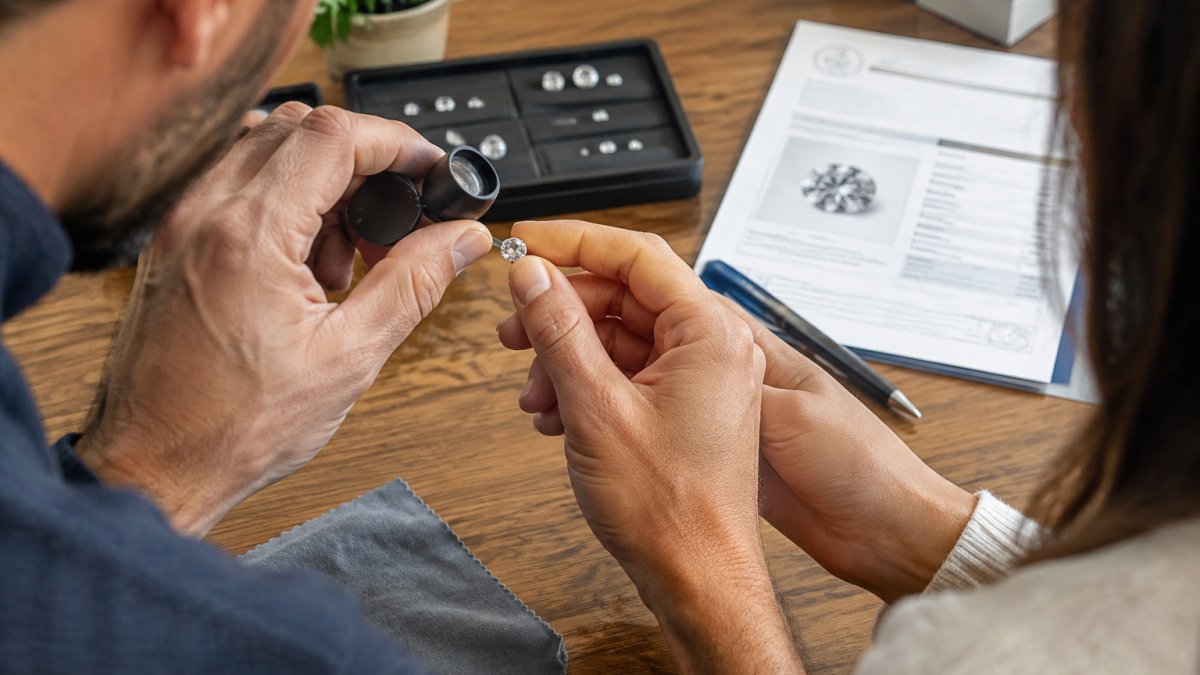
A couple examining a loose diamond under a loupe is the kind of close check that documentation supports. Ask for the paperwork and read it before you pay.
Step 5: Ask the Right Questions Before You Order
Send these questions to the seller before you order:
- Where was this specific stone mined or created?
- Which grading laboratory issued the report?
- What is your return window, and who pays return shipping?
- What warranty covers the setting and the stone?
Online shoppers should also confirm the return policy on the product page. Clear answers to these questions are a good sign. Vague replies are a warning.
Choosing Your Anniversary Diamond With Confidence
An ethically sourced anniversary diamond is one you can document, afford and wear with confidence. Set your budget, decide between natural and lab-grown, verify the paperwork and ask the seller direct questions. Explore our specialized cross-themed jewelry and current offers, then choose the piece that suits your style.
Frequently Asked Questions
Where can I buy ethically sourced diamonds?
Ethically sourced diamonds are sold by independent jewelers, certified online retailers, and some large chains that publish sourcing policies. The most reliable options disclose where their stones come from, provide grading reports from recognized gemological laboratories, and explain how they trace supply. Before buying, check that the seller names its sourcing standards in writing, and contact Carlotta directly for its current sourcing information and pricing, since prices depend on quantity, dates, and delivery.
Can you get an ethically sourced natural diamond?
Yes. Natural diamonds can be responsibly sourced when the seller can document the chain of custody from mine to market. Look for sellers that follow recognized responsible-sourcing programs, provide written sourcing disclosures, and supply a grading report for each stone. Ask whether the seller can name the country or mine of origin, since a seller that cannot answer that question has not verified its supply chain.
Are lab-grown diamonds more ethical than natural diamonds?
Lab-grown diamonds avoid mining-related labor and land concerns, but they are not automatically more sustainable, because production still uses significant energy. Natural diamonds can be ethically sourced when traceability is documented. The better choice depends on which concerns matter most to you, so compare each seller's disclosures for both types rather than relying on a general label.
What should I ask a jeweler before buying an anniversary diamond?
Ask where the diamond was mined or grown, which sourcing program the seller follows, and whether the stone comes with a grading report from a recognized gemological laboratory. Also ask about the return policy, warranty, and whether the setting is recycled or reclaimed metal. Get the answers in writing, and keep the invoice with the grading report so you can verify the stone later.
