

Affordable Gold Cross Necklace for Men: Buyer's Guide
Table of Contents
- Quick Comparison: Affordable Gold Cross Necklaces for Men
- Gold Plated vs Solid Gold Cross Necklace: What You Get at Each Price
- Best Chain Length for Men's Pendants: A Body-Type Guide
- How to Style a Gold Cross Necklace for Men
- Skin Sensitivity and Metal Allergies: What to Look For
- Caring for Your Gold Cross Necklace: Maintenance That Prevents Tarnish
- Conclusion: Choosing an Affordable Gold Cross Necklace That Lasts
- Frequently Asked Questions
Last Updated: September 29, 2026
Quick Comparison: Affordable Gold Cross Necklaces for Men
Shopping for an affordable gold cross necklace for men means weighing three things: how the metal is built, how long the chain should be, and whether it survives a year of daily wear.

| Build Type | Base Metal | Typical Wear Life | Best For | Price Signal |
|---|---|---|---|---|
| Gold plated | Sterling silver or stainless steel | 1-3 years with care | Daily wear, tighter budgets | Lowest |
| Gold filled | Brass or copper core | 5-10 years | Frequent wear, sensitive skin | Mid-range |
| Solid gold | Solid gold alloy | Decades | Heirloom intent, heavy wear | Highest |
Gold Plated vs Solid Gold Cross Necklace: What You Get at Each Price
Gold plated jewelry is a base metal core covered with a thin layer of gold, gold filled bonds a thicker gold layer to a base core, and solid gold is the same alloy all the way through. The difference shows up in durability, price, and how the piece ages.
| Build Type | How the Gold Is Applied | Gold Content (by weight) | Typical Wear Life | Relative Cost |
|---|---|---|---|---|
| Gold plated | Electroplated or dipped over a base core | A microscopic layer; often under 0.5 microns | 1-3 years with care | Lowest |
| Gold filled | Gold layer mechanically bonded and heat-fused to a base core | Legally at least 5% gold by weight (commonly 1/20 of total weight) | 5-10 years | Mid-range |
| Solid gold | Entire piece is a gold alloy | 100% of the metal is gold alloy | Decades | Highest |
Plating Thickness Is the Number That Actually Matters
Plating thickness, measured in microns, is the best predictor of how long a plated cross necklace will last. A single thin coat wears through at friction points, usually the clasp and where the pendant rubs the chain. Triple-coated pieces last far longer because each layer adds thickness and the final coat seals those beneath.
How Gold Plating Over Sterling Silver or Stainless Steel Works
Sterling silver and 316L stainless steel are the two base metals worth considering. Both resist corrosion, so the gold layer protects appearance rather than preventing rust.
Gold Filled: The Middle Tier Most Buyers Skip
Gold filled sits between plated and solid, and for many men it is the smartest buy. The gold layer is bonded under heat and pressure rather than electroplated, so it is far thicker and does not flake. In the U.S., gold filled must contain at least 5% gold by weight, usually expressed as "1/20 14k gold filled."
When Solid Gold Makes Sense (and When It Doesn't)
Solid gold earns its price when the necklace never comes off, is meant to be passed down, or you want zero maintenance beyond a wipe. It also holds resale value and can be repaired or resized by any jeweler.
The Practical Trade-Off: Purity vs. Daily Wearability
Higher karat does not mean better for daily wear, it means softer. Pure gold (24k) is too soft for a men's necklace that takes bumps, gym sessions, and snags, which is why solid gold is almost always alloyed down to 14k or 18k.
- 10k gold is the hardest common alloy, the most scratch-resistant, and the most affordable solid option. Its color is slightly paler because it contains less gold.
- 14k gold is the everyday standard: a good balance of warm color, durability, and price. It resists scratching well enough for daily wear.
- 18k gold has the richest yellow color and the highest gold content of the common alloys, but it is softer and shows scratches faster. It suits occasional wear more than rough daily use.
Best Chain Length for Men's Pendants: A Body-Type Guide
The best chain length for men's pendants depends on height, chest width, and where you want the cross to sit. Most men land between 20 and 24 inches, with 22 inches the safest default.
Chain Length by Height and Build
- Under 5'8", slim build: 18-20 inches sits at the collarbone and reads clean and modern.
- 5'8" to 6'0", average build: 20-22 inches places the pendant mid-chest, the most versatile range.
- Over 6'0" or broad chest: 22-24 inches keeps the cross from riding too high and looking small.
- Layered look: Start with a 20-inch base and add a 24-inch chain over it.
The goal is proportion. A large pendant on a short chain crowds the neck; a micro pendant on a long chain disappears against a shirt.
Chain Thickness and Clasp Types That Hold Up Daily
Chain thickness runs from about 1mm (delicate) to 5mm+ (bold). For daily wear with a pendant, 2-3mm is the sweet spot: heavy enough to carry the cross, light enough to forget.
How to Style a Gold Cross Necklace for Men
Styling a gold cross necklace comes down to matching metal tone, choosing the right neckline, and knowing when to layer. A single cross on a clean chain works with almost everything.
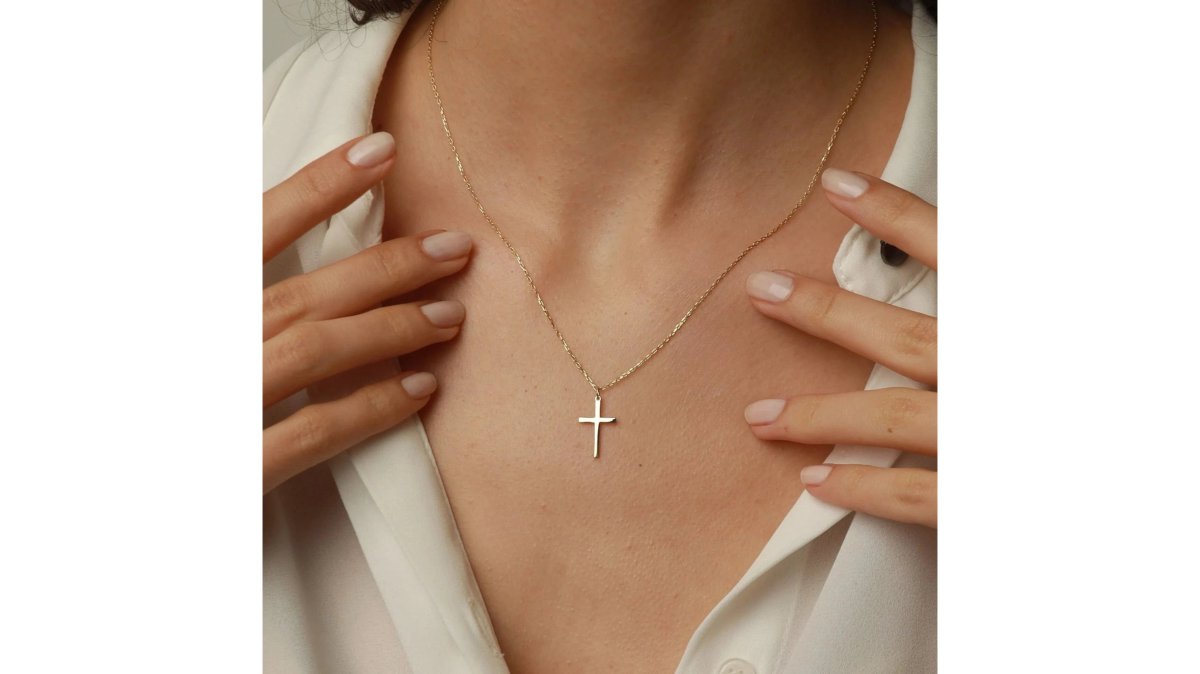
Layering with Other Chains and Necklines
Layering works when chains differ in length by at least 2 inches. A 20-inch cross under a 24-inch plain chain creates depth without clutter.
Skin Sensitivity and Metal Allergies: What to Look For
Nickel is the most common cause of jewelry skin reactions and the reason cheap chains turn necks green. The fix is choosing a base metal that doesn't contain it.
Caring for Your Gold Cross Necklace: Maintenance That Prevents Tarnish
Gold plated jewelry lasts years with a simple routine: keep it dry, store it separately, and wipe it after wear. Tarnish is preventable if you understand what is happening to the metal.
Why Gold Jewelry Tarnishes (and Why Plated Pieces Tarnish Differently)
Pure gold does not tarnish, it is chemically inert, which is why solid gold pieces can sit in a drawer for decades and look the same. What tarnishes is either the alloyed metals mixed into the gold (like copper or silver) or, on plated pieces, the base metal showing through as the gold wears thin.
Tarnish Resistance by Build Type
- Solid gold (10k-18k): Highest resistance. The alloyed metals can darken slightly over years, but a soft cloth restores the shine. No base metal to expose.
- Gold filled: High resistance. The thick bonded gold layer keeps the base metal sealed for years, so tarnish is rare unless the piece is scratched deeply.
- Gold plated over stainless steel: Good resistance. Stainless steel does not rust, so even if the plating thins, the core will not turn green or corrode.
- Gold plated over brass or copper: Lowest resistance. These base metals react with sweat and air, which is the classic cause of a green or black mark on the skin.
If tarnish resistance is your priority, the base metal under the plating matters as much as the plating itself. Stainless steel and sterling silver cores are the safer choices.
The Green-Neck Problem, Explained
The green or black mark some men get is not the gold reacting with their skin. It is a reaction between sweat and the base metals, usually copper or nickel, underneath or alloyed into the piece. Sweat is slightly acidic and accelerates corrosion, leaving a residue on the skin.
A Care Routine That Actually Prevents Damage
- Remove before showering, swimming, or heavy sweating
- Wipe with a soft dry cloth after each wear to remove sweat and oils
- Store in a pouch or box, away from other jewelry that can scratch the finish
- Put the necklace on last, after perfume, lotion, and hair products have dried
- Clean gently with warm water and mild soap monthly, then dry fully
- Check the clasp and jump rings every few months for wear
The biggest killer of plated jewelry is moisture trapped against the metal. Sweat, chlorine, and soap speed up wear at the plating's thin points, and the clasp and pendant contact points wear first.
How to Tell Surface Tarnish from Plating Wear
Before you scrub a dull spot, figure out which problem you have. Surface tarnish is a thin film that wipes away with a soft cloth or mild soapy wash. Plating wear is a patch of base metal showing through that will not clean off because the gold is gone at that spot.
Storage and Rotation
Storing each piece separately prevents scratches, and scratches are where plating fails first. Rotating the cross a few days a week spreads wear and extends its life. For a piece you never take off, choose gold filled or solid gold; for occasional wear, a well-cared-for plated cross looks new for years.
Conclusion: Choosing an Affordable Gold Cross Necklace That Lasts
Finding a cross necklace that holds up doesn't require a huge budget, just the right questions: what's the base metal, how many coats of gold, what's the clasp, and what chain length fits your frame.
Frequently Asked Questions
What is the difference between gold-plated and solid gold cross necklaces?
Gold-plated necklaces have a thin layer of gold over a base metal like sterling silver or stainless steel, while solid gold is gold all the way through. For an affordable gold cross necklace for men, gold plating offers the same look at a fraction of the price. Carlotta's CROSS NECKLACE uses S925 sterling silver coated three times with 14k gold, and the CZ STONE CROSS uses solid 14k gold over a 316L stainless steel core with an anti-tarnish coating.
How do I choose the right chain length for a men's cross necklace?
Chain length depends on your height, build, and where you want the pendant to sit. A 20-inch chain typically rests at the collarbone for average builds, while 22 to 24 inches falls mid-chest. Shorter men or those with narrower shoulders may prefer 18 to 20 inches. Carlotta's 20" Cross Chain and the 45cm rope chain included with several pendants give you a starting point that works for most men.
Are gold-plated cross necklaces durable enough for daily wear?
Yes, if the plating is thick and the base metal is quality. Look for triple-coated gold over sterling silver or 316L stainless steel, which resists tarnishing and skin reactions. Carlotta's [CZ STONE CROSS](https://carlottatch.com/products/cz-cross-necklace) is coated in Solid 14k Gold, over a premium 316L Stainless Steel core, and finished with our Anti-Tarnish Coating. Avoid exposure to sweat, perfume, and water when possible, and wipe your necklace with a soft cloth after wearing.
How can I keep my gold cross necklace from tarnishing?
Store your necklace in a dry pouch or box away from sunlight and humidity. Put jewelry on last after lotions and cologne have dried, and take it off before swimming or showering. Wipe it with a soft cloth after each wear to remove oils. Pieces with an anti-tarnish coating, like Carlotta's CZ STONE CROSS, add an extra layer of protection that helps the polished finish last longer between cleanings.
Is it appropriate to wear a cross necklace as a fashion statement?
Many men wear a gold cross necklace as both a faith symbol and a style piece. The key is choosing a design that matches your intent, whether that is a subtle micro pendant for everyday wear or a bolder iced-out cross for a street-style look. Carlotta's collection ranges from the clean Zirconia Cross Necklace to the minimalist FAITHLET CROSS, so you can pick a piece that feels meaningful and fits your wardrobe.