

Why Does Cheap Jewelry Turn Skin Green?
Table of Contents
- The Chemical Reaction Behind Green Skin from Cheap Jewelry
- Metals That Turn Skin Green: The Main Culprits
- Is Green Skin from Jewelry Harmful?
- How to Seal Jewelry to Prevent Green Skin
- How to Keep Cheap Jewelry from Turning Your Skin Green
- How to Clean Jewelry and Remove Green Tarnish
- Which Jewelry Metals Are Safe for Sensitive Skin?
- Conclusion
Last Updated: August 16, 2026
The Chemical Reaction Behind Green Skin from Cheap Jewelry
Why does cheap jewelry turn skin green? When certain metals react with moisture, oxygen, and the acids on your skin, they form copper salts and other chemical compounds that leave a greenish residue. This is a completely harmless cosmetic reaction, but one of the most common complaints about affordable accessories. At Carlotta, we hear this concern regularly, so here's exactly what's happening at a chemical level and what you can do about it.
The primary culprit is copper. Most affordable jewelry is made from base metals like brass, zinc, or copper alloys, sometimes with a thin layer of gold or silver plating. When copper oxidizes, it produces copper carbonate and other copper salts, the same process that turns the Statue of Liberty green, except it happens in hours on your wrist rather than decades because your body provides a much more reactive environment.
How Sweat, pH Levels, and Body Chemistry Speed Up Oxidation
Your skin is not a neutral surface. Everyone has unique body chemistry, and the acidity of your perspiration plays a significant role in how fast jewelry oxidizes. People with more acidic sweat see faster discoloration because acidic sweat accelerates copper corrosion. According to American Chemical Society's chemistry education resources, copper reacts readily with weak acids, exactly what perspiration is. The more you sweat, the faster the reaction, which is why green skin appears more in summer, during workouts, or after stress.
Your pH levels shift with diet, hydration, hormones, and stress. Some people never see green skin from a bracelet that turns another person's wrist green within an hour. It is not a quality defect: it is body chemistry at work.
How Lotions, Perfumes, and Soaps Make It Worse
Cosmetics accelerate oxidation significantly. Lotions, perfumes, hand soaps, and sunscreens contain chemical compounds that react with metal alloys and speed up surface wear. Perfume is particularly aggressive because it contains alcohol and aromatic acids that strip protective coatings. The simple solution: put jewelry on last, after skincare and perfume have dried, and remove rings before washing your hands.
Metals That Turn Skin Green: The Main Culprits
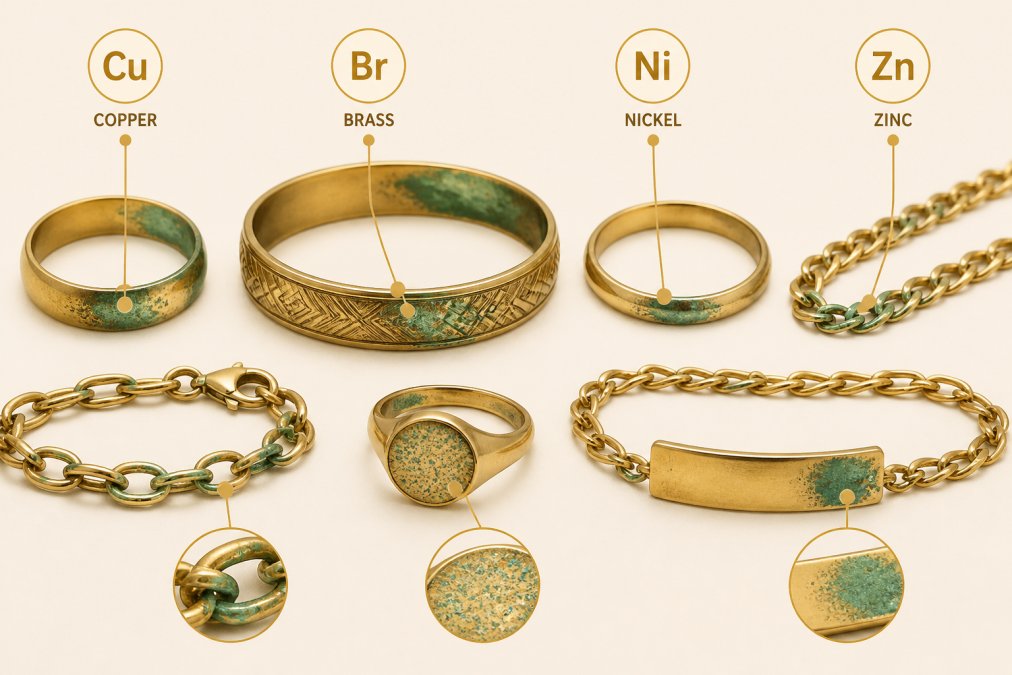
Metals that turn skin green are almost always copper-based or copper-containing alloys. The green staining results from copper oxidation, not a sign that jewelry is "fake", even high-end pieces can cause discoloration if they contain copper.
Copper, Brass, and Zinc: The Base Metal Problem
Copper is the primary offender. Brass, an alloy of copper and zinc, carries the same oxidation risk. Many affordable chains, rings, and bangles are made from brass because it is inexpensive and takes plating well. Any scratch or area of surface wear exposes the brass beneath, and oxidation begins immediately.
Zinc is rarely found alone in jewelry, it is almost always part of an alloy with copper or nickel, which accelerates tarnish and skin discoloration.
| Metal | Why It Causes Green Skin | Common Use in Jewelry |
|---|---|---|
| Copper | Forms copper carbonate (green) on oxidation | Core material in many alloys |
| Brass | Copper-zinc alloy; oxidizes the same way | Budget rings, chains, bangles |
| Bronze | Copper-tin alloy; similar oxidation | Vintage-style pieces |
| Zinc alloy | Reacts with sweat acids | Die-cast costume jewelry |
| Nickel | Causes allergic reactions, not just staining | Clasps, earring posts |
Nickel, Thin Plating, and Surface Wear
Nickel deserves separate mention because its effects go beyond green staining. Nickel is a common allergen, and many people develop allergic contact dermatitis from nickel-containing jewelry. The American Academy of Dermatology guidance on contact dermatitis identifies nickel as one of the most common causes of skin allergic reactions from jewelry.
Thin gold or silver plating does not eliminate the problem. Electroplating adds a superficial layer of precious metal over base metal, but this layer wears through with regular use. Cheap jewelry often has very thin plating, measured in microns, so surface wear happens faster. Thicker plating or gold-filled construction offers better longevity, but even these will eventually expose base metal if worn daily without care.
Is Green Skin from Jewelry Harmful?
Green skin from jewelry is almost always harmless. The copper salts that cause discoloration are not toxic at the trace amounts produced by wearing jewelry. The staining washes off with soap and water and leaves no lasting mark.
Oxidation Staining vs. Allergic Contact Dermatitis
Oxidation staining and allergic contact dermatitis are two completely different reactions that can look similar.
Oxidation staining is a chemical reaction between the metal and your skin chemistry. It produces green or blue-green discoloration on the skin surface with no itching, swelling, or redness. The stain washes off cleanly.
Allergic contact dermatitis is an immune response, typically triggered by nickel. It produces redness, itching, swelling, and sometimes blistering at the point of contact. The skin reaction persists and worsens with continued exposure.
If your skin turns green but feels fine, you are dealing with oxidation. If you experience itching, a rash, or swelling, stop wearing the piece and consult a dermatologist.
How to Seal Jewelry to Prevent Green Skin
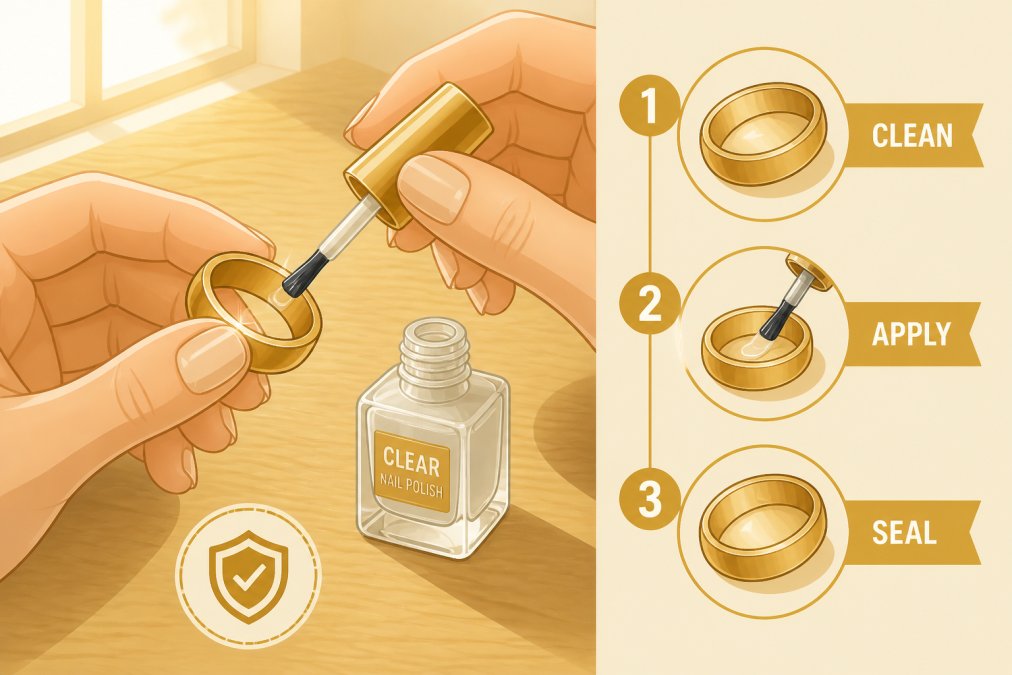
Sealing jewelry to prevent green skin is one of the most effective preventative measures and costs almost nothing. The goal is to create a barrier between the metal and your skin so moisture, sweat, and cosmetics cannot reach the metal surface.
Clear Nail Polish vs. Jewelry Shield Sealant
Clear nail polish is the classic solution. Apply a thin coat to any surface contacting your skin and let it dry fully before wearing. It is inexpensive and widely available, but chips within a few weeks of regular wear, requiring reapplication every two to four weeks.
Jewelry shield sealants are purpose-built products more flexible and longer-lasting than nail polish, formulated to resist moisture and perspiration better. They are a worthwhile upgrade for daily wear.
How to apply either sealant:
- Clean the jewelry thoroughly with a soft cloth to remove tarnish, oils, or residue.
- Let the piece dry completely. Moisture trapped under sealant accelerates corrosion.
- Apply a thin, even coat to all skin-contact surfaces. Avoid stones or decorative elements.
- Allow to cure fully before wearing, typically 30 to 60 minutes for nail polish.
- Reapply when the coating chips or skin discoloration returns.
How to Keep Cheap Jewelry from Turning Your Skin Green
Prevention is more reliable than treatment:
- Remove jewelry before washing hands, swimming, or exercising. Water and sweat are the biggest accelerants of oxidation.
- Apply cosmetics and perfume before putting on jewelry. This minimizes direct chemical contact between cosmetics and metal.
- Wipe jewelry down after wearing. A quick pass with a soft, dry cloth removes sweat and oils before they react with the metal.
- Avoid wearing jewelry in hot, humid conditions for extended periods. Heat and humidity accelerate corrosion.
- Use a sealant on skin-contact surfaces (see the section above for full instructions).
- Buy pieces with thicker plating or gold-filled construction for daily wear. The thicker the plating, the longer before base metal is exposed.
Climate, Humidity, and Storage Tips
High humidity accelerates tarnish on all metals. If you live in a coastal area or somewhere with consistently high humidity, your jewelry will tarnish faster regardless of wear habits.
Storage matters as much as wear habits. Leaving jewelry on a bathroom counter exposes it to steam, humidity, and cosmetic residue. Instead:
- Store jewelry in a sealed zip-lock bag or airtight container when not in use.
- Add a small silica gel packet to your jewelry box to absorb excess moisture.
- Keep pieces separated to prevent scratching, which damages protective plating.
- Store away from direct sunlight and heat, both of which degrade plating.
How to Clean Jewelry and Remove Green Tarnish
Cleaning jewelry regularly removes oxidized residue before it builds up.
For light tarnish: Mix mild dish soap with warm water, use a soft toothbrush to gently scrub metal surfaces, rinse thoroughly, and dry immediately with a soft cloth. Never air-dry, as residual moisture continues oxidation.
For heavier tarnish: A paste of baking soda and water applied with a soft cloth can lift stubborn copper carbonate deposits. Rub gently, rinse well, and dry completely. Avoid abrasive scrubbing on plated pieces, as it removes plating along with tarnish.
What to avoid: Ultrasonic cleaners can damage thin plating and loosen stones. Harsh chemical cleaners strip plating and accelerate future tarnish. Soaking jewelry for extended periods introduces moisture into joints and clasps.
According to Gemological Institute of America's jewelry care guidance, proper storage and regular gentle cleaning are the two most effective measures for extending the life of plated jewelry.
Which Jewelry Metals Are Safe for Sensitive Skin?
The safest metals for sensitive skin are those with no copper content and no nickel:
- Solid gold (10k, 14k, 18k): Contains gold alloyed with silver and other metals. High-karat gold is generally well tolerated.
- Sterling silver: An alloy of silver and copper with low copper content that most people with sensitive skin tolerate well. Some pieces are rhodium-plated for extra protection.
- Surgical-grade stainless steel: Widely used in body jewelry and hypoallergenic pieces. Resistant to corrosion and generally nickel-free.
- Titanium: One of the most hypoallergenic metals available. Lightweight, corrosion-resistant, and suitable for severe metal sensitivity.
- Niobium: Highly hypoallergenic and often used in earring posts for people who react to everything else.
- Gold-filled (not gold-plated): Has a much thicker layer of gold bonded to base metal, significantly more resistant to surface wear and skin contact with base metal.
Avoid if you have sensitive skin: brass, bronze, copper, and pieces labeled simply as "gold-tone," "gold-colored," or "metal alloy" without further specification. These are almost always copper-based.
For people wanting the look of gold without skin discoloration risk, gold-filled and high-quality gold-plated pieces with thick plating are a practical middle ground. Carlotta offers a curated collection of gold-plated chains, bracelets, and cross-themed accessories designed for exactly that. You can browse the full range and take advantage of up to 30% off select pieces during seasonal promotions.
If you are unsure whether a piece contains nickel or other reactive metals, Consumer Product Safety Commission guidance on metal jewelry safety provides information on metal content testing and what to look for when buying affordable jewelry.
Green skin from jewelry is a frustrating but solvable problem. The issue is not that affordable jewelry is inherently bad, but that most people do not know how to protect it or wear it correctly. Sealing skin-contact surfaces, cleaning regularly, and storing pieces properly makes a significant difference in how long any piece lasts without causing discoloration. Carlotta offers a curated collection of gold-plated chains, bracelets, and cross-themed accessories designed for exactly that. Shop All and find pieces that work with your skin, not against it.
Frequently Asked Questions
How do I stop cheap jewelry from turning my skin green?
The most reliable steps are: coat the metal with a jewelry sealant or clear nail polish, remove pieces before showering or exercising, and store them in a dry, sealed bag. Avoiding direct contact with lotions, perfumes, and soaps also slows the oxidation process. For everyday wear, choosing nickel-free or gold-filled pieces over thin-plated brass or copper alloys makes the biggest difference long-term.
Is it safe to wear jewelry that turns your skin green?
For most people, the green color is harmless copper carbonate staining the skin, it washes off with soap and water. However, if you develop redness, itching, swelling, or a rash, that points to allergic contact dermatitis, most often triggered by nickel. In that case, stop wearing the piece and consult a dermatologist. Copper oxidation alone is not a health risk, but a metal allergy reaction is a separate issue that needs attention.
Does sterling silver turn skin green?
Genuine sterling silver (92.5% silver, 7.5% copper) can cause mild green staining in people with acidic sweat, because the copper content oxidizes over time. It is far less likely to stain than brass or copper alloys, and it does not contain nickel in its standard form. Keeping sterling silver clean and dry significantly reduces any discoloration risk.
How long does green skin from jewelry take to go away?
The green stain from copper salts typically fades within a few hours of removing the jewelry and washing the area with soap and water. In some cases with prolonged wear or heavy perspiration, it can take a day or two to fully clear. If the skin stays irritated, red, or itchy after the stain fades, that suggests a dermatological reaction rather than simple oxidation staining.
This article was written using GrandRanker