

How to Spot Fake Jewelry Photos: 7 Red Flags to Check
Table of Contents
- Why Fake Jewelry Photos Cost Online Shoppers Real Money
-
How to Spot Fake Jewelry Photos: 7 Red Flags to Check Before You Buy
- Red Flag 1: Stock Photography and Reverse Image Search for Jewelry
- Red Flag 2: Missing or Edited EXIF Data
- Red Flag 3: Impossible Metal Luster and Patina
- Red Flag 4: Gemstone Clarity That Defies Physics
- Red Flag 5: Plated Metal vs. Solid Metal That Photos Hide
- Red Flag 6: No Hallmarks, Maker's Marks, or Clasp Detail Shots
- Red Flag 7: Lighting and Macro Photography Tricks
- How to Run a Reverse Image Search for Jewelry in Under 2 Minutes
- Online Jewelry Scam Red Flags: Seller Behavior and Listings
- How to Verify Jewelry Authenticity Before You Buy
- What High-Quality Jewelry Photography Should Show You
- Conclusion: Shop Smarter, Not Scared
- Frequently Asked Questions
Last Updated: September 30, 2026
Why Fake Jewelry Photos Cost Online Shoppers Real Money
Fake jewelry photos are edited or misrepresented images that make cheap pieces look like fine jewelry, and they cost online shoppers real money.
How to Spot Fake Jewelry Photos: 7 Red Flags to Check Before You Buy
Learning how to spot fake jewelry photos comes down to checking seven red flags. Each is a clue; two or more together usually mean you should walk away.
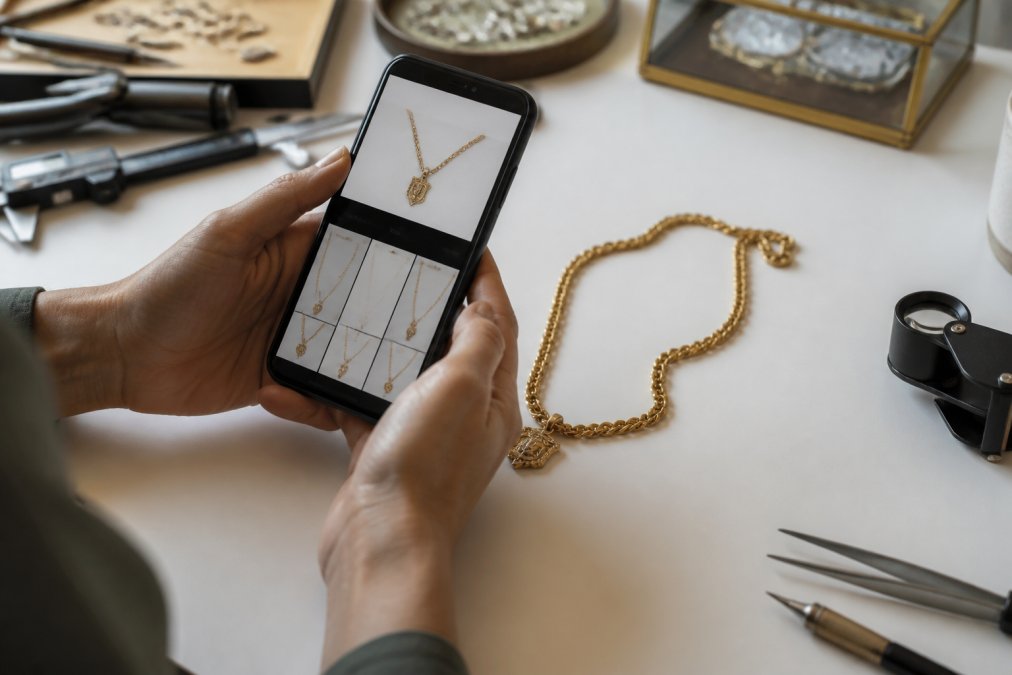
Here's the full list at a glance:
| Red Flag | What It Signals | Quick Check |
|---|---|---|
| Stock photography | Photo isn't the real item | Reverse image search |
| Missing EXIF data | Image was edited or downloaded | Check file properties |
| Impossible luster | Metal is plated, not solid | Look for even shine |
| Too-perfect clarity | Stone may be synthetic | Look for inclusions |
| Hidden plating | Base metal under gold | Ask for close-ups |
| No hallmarks | No maker's marks or stamps | Request clasp shots |
| Lighting tricks | Flaws are being hidden | Look for shadows |
Red Flag 1: Stock Photography and Reverse Image Search for Jewelry
Stock photography is the easiest red flag to catch, and a reverse image search for jewelry exposes it fast. If the same photo appears on ten different stores, it isn't a photo of your item. Look for a flawless white background with no shadows, the same image reused across unrelated shops, and catalog-style model shots. Run the image through a reverse search tool; if it shows up on other sites, that's a warning sign.
Red Flag 2: Missing or Edited EXIF Data
EXIF data is the hidden information a camera saves inside a photo, like the date, device, and settings. Real product photos usually keep it. Fake ones often don't.
Red Flag 3: Impossible Metal Luster and Patina
Luster is how a metal reflects light. Real sterling silver and karat gold have a soft, even glow, while plated metal often looks too shiny or too flat. Patina is another clue: a brand-new piece with heavy fake aging is suspicious, and so is a "vintage" piece with zero wear.
Red Flag 4: Gemstone Clarity That Defies Physics
Gemstone clarity refers to how clean a stone looks inside. Real stones almost always have tiny flaws called inclusions; a stone with none at all is often synthetic or a simulant. Real refraction scatters light naturally, while a flat, glassy look usually means it's not the real thing.
Red Flag 5: Plated Metal vs. Solid Metal That Photos Hide
Plated metal is a base metal core coated with a thin layer of gold or silver; solid metal is the real thing all the way through. Photos can make the two look identical. Terms like "gold-filled" and "rhodium plating" tell you it's a coating, not solid gold, fine if the price matches, a problem when a seller calls plating "solid gold."
Red Flag 6: No Hallmarks, Maker's Marks, or Clasp Detail Shots
Hallmarks and maker's marks are the tiny stamps inside real fine jewelry, showing the metal content and the maker. A listing with no close-ups of these is hiding something. Ask for a clear photo of the stamp inside the band or clasp, the clasp mechanism, and any engraving or signature. No detail shots? That's a red flag.
Red Flag 7: Lighting and Macro Photography Tricks
Macro photography uses extreme close-ups and can hide a lot. Under-lighting makes flaws disappear, and bright studio lighting can make cheap metal look expensive. Good sellers use honest lighting; bad ones hide surface wear, thin plating, and cloudy stones.
How to Run a Reverse Image Search for Jewelry in Under 2 Minutes
- Google Lens / Google Images, best for finding the same photo reused on retail sites, marketplaces, and Pinterest boards. Click the camera icon in the search bar, then upload the file or paste the image URL.
- TinEye, best for finding the oldest instance of an image. TinEye sorts results by "oldest," which tells you whether the seller's "new" listing is actually a photo that has been circulating for years.
- Yandex Images, often surfaces matches on overseas marketplaces and social feeds that Google misses, which matters when a listing photo was lifted from a foreign wholesale catalog.
Read the results like a jeweler, not a shopper.
- Same photo on unrelated stores at wildly different prices? That is stock photography, and the seller never handled your item.
- Same photo dated years earlier on a wholesale or dropship catalog? The seller is reselling a generic piece as something unique.
- Same design but different photos across many sellers? That is a mass-produced casting, not a one-of-a-kind piece, fine if the price reflects it, a red flag if the listing claims "handmade" or "vintage."
- No matches at all? A good sign, but not proof, it only means the photo has not been indexed yet.
Do this before you buy anything online. It is the single highest-yield habit for spotting fake jewelry photos, and it costs nothing but two minutes.
Online Jewelry Scam Red Flags: Seller Behavior and Listings
Online jewelry scam red flags often show up in how a seller behaves, not just in the photos. The strongest signal is the gap between what the photos show and what the seller will actually do when you ask.
-
Refuses to send a new photo of the specific piece, only re-sends the listing images
-
Sends a "close-up" that is just the listing photo cropped and zoomed
-
Claims the item is "already packed" or "in the vault" so no new photos are possible
-
Answers metal questions with marketing language ("luxury gold tone") instead of a spec ("14k yellow gold")
-
Will not photograph the clasp, the stamp, or the back of the piece
-
Present and consistent with the seller's claimed location and timeline, a good sign.
-
Stripped or missing, common when an image was downloaded from a catalog, screenshotted, or exported by editing software. Not proof of fraud alone, but a pattern worth noting.
-
Camera model that does not match the seller's story, a "small artisan studio" whose photos all come from the same stock-photo camera profile is worth a second look.
-
Creation date far older than the listing, a "new arrival" photo taken three years ago is a reused image.
-
Account created recently, with a burst of listings and no selling history
-
Reviews posted in clusters on the same day, or all using similar phrasing
-
Price far below what the metal and stone content would cost at scrap value
-
Return policy that is buried, conditional, or excludes "custom" or "final sale" items
-
Stock-style model shots mixed with one or two real photos, a sign of a padded listing
How to Verify Jewelry Authenticity Before You Buy
Verifying jewelry authenticity before you buy means combining what the photo shows with what the seller tells you. No single check is enough.
Use this checklist before you check out:
- Reverse image search comes back clean
- Listing shows clear close-ups of hallmarks and clasps
- Metal is described as solid, gold-filled, or plated, not just "gold"
- Seller answers questions within a day
- Return policy is clear and easy to find
- Reviews mention the item matching the photos
- Price fits the materials described
What High-Quality Jewelry Photography Should Show You
High-quality jewelry photography should show you the truth, not just a pretty picture. Honest sellers photograph the whole piece, flaws and all. Look for:
- Multiple angles, including the back and clasp
- Close-ups of any hallmarks or stamps
- Natural lighting alongside studio shots
- Clear views of the metal's luster and any surface wear
- Sharp, high-resolution images you can zoom into
Conclusion: Shop Smarter, Not Scared
Spotting fake jewelry photos isn't about being paranoid. It's about knowing what honest listings look like and walking away from the ones that don't add up. A reverse image search and a close look at the clasp catch most fakes before you ever pay.
Frequently Asked Questions
What is the 2:1:1 rule in jewelry?
The 2:1:1 rule is a quick guideline for identifying plated or fake jewelry: look for two different metals, one hallmark, and one color. If a piece claims to be solid gold but shows two metal tones, only one hallmark, or inconsistent color, it's likely plated or imitation. This rule helps you spot inconsistencies in photos and listings before you buy.
Can you tell if jewelry is real by looking at a photo?
You can't confirm authenticity from a photo alone, but you can spot red flags. Look for missing hallmarks, unrealistic luster, and stock photography. Use reverse image search for jewelry to see if the same photo appears on multiple sites. Check EXIF data for editing. If a seller won't provide close-ups of marks and clasps, treat it as a warning sign.
What are the most common online jewelry scam red flags?
Common online jewelry scam red flags include prices far below market value, stock photos with no original angles, sellers who avoid answering questions about materials, missing hallmarks in photos, and pressure to pay outside secure platforms. Also watch for new accounts with few reviews, generic return policies, and no physical address. Trust your instincts if something feels off.
How can I verify the authenticity of a jewelry seller online?
Verify a seller by checking for a business address, reading independent reviews, and looking for clear return and contact policies. Ask for additional photos of the actual item, including hallmarks and clasps. Run a reverse image search on their product photos. Legitimate sellers provide detailed images and responsive support, so don't hesitate to ask questions before buying.