

How to Choose the Right Chain Length for Layering Necklaces
Table of Contents
- Understanding Necklace Length Categories and Their Layering Potential
- How to Measure Necklace Length for Accurate Layering
- Spacing Rules: Creating Visual Balance Between Layers
- Necklace Lengths for Different Necklines
- Layering Necklaces with Pendants
- How to Layer Necklaces Without Tangling
- Step-by-Step: Building Your First Layered Necklace Combination
- Common Mistakes to Avoid When Layering
- Frequently Asked Questions
Last Updated: October 13, 2026
Understanding Necklace Length Categories and Their Layering Potential
Standard necklace lengths fall into predictable ranges. A choker sits snugly at the base of your neck, typically 14 to 16 inches.
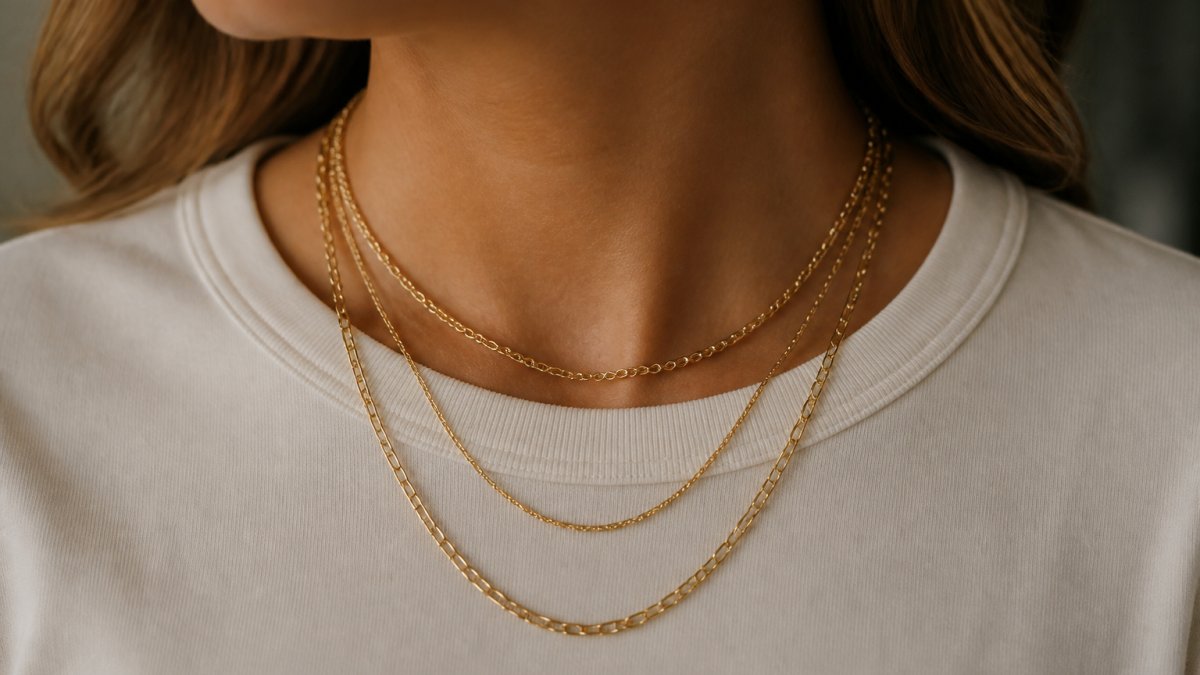
Why do these categories matter for layering? Because they create natural visual separation. When you stack chains at different lengths, each one occupies its own space on your body.
At Carlotta, we've found that understanding how to choose the right chain length for layering necklaces helps you build combinations with confidence.
Standard necklace length ranges
Most chains follow these established measurements:
- Choker: 14-16 inches (sits at base of neck)
- Princess: 16-18 inches (sits at collarbone)
- Matinee: 20-24 inches (sits at mid-chest)
- Opera: 28-34 inches (drops below chest)
- Rope: 36+ inches (extends to waist or beyond)
These aren't arbitrary numbers. They're based on average neck and torso proportions, refined through decades of jewelry design.
Why length categories matter for layering
Layering works because different lengths create depth. When all your chains are similar lengths, they stack on top of each other and look cluttered. When they vary significantly, each necklace has breathing room.
The categories also help you communicate with jewelry retailers. When you're shopping for pieces to layer, you can ask for specific lengths rather than guessing.
How to Measure Necklace Length for Accurate Layering
Accurate measurement is the foundation of successful layering. You need to know two things: how long the chain actually is, and how it will sit on your specific body.
Measuring your neck circumference
Start by finding your base measurement. Wrap a soft measuring tape around the fullest part of your neck. Keep it snug but not tight. Write down this number.
This measurement tells you the shortest necklace you can comfortably wear. If your neck circumference is 13 inches, a 14-inch choker will sit very close to your skin.
Most people fall between 12 and 14 inches for neck circumference. If you're larger or smaller, adjust your expectations for how chains will fit.
Determining drop length and fit
Drop length is how far a necklace hangs below your collarbone. This is different from total length.
To measure drop, put on a necklace you already own and love. Measure from your collarbone down to where the chain ends.
Now measure the total length of that necklace from clasp to clasp.
Understanding this relationship helps you predict how a new chain will sit before you buy it.
Spacing Rules: Creating Visual Balance Between Layers
The space between layered necklaces determines whether your look feels intentional or accidental. Too little space and chains tangle and blend together. Too much space and they look disconnected.
The two-to-four-inch spacing principle
The most reliable rule is maintaining 2 to 4 inches between the lowest point of one necklace and the starting point of the next. This creates clear separation without looking sparse.
If your first chain drops to 8 inches below your collarbone, your second should start around 10 to 12 inches. Your third layer might begin at 14 to 18 inches.
This spacing principle works across all body types and necklines. It's the single most consistent guide for building balanced combinations.
Building a short-to-long cascade
The cascade effect happens when you arrange necklaces from shortest to longest. This creates a visual flow down your body.
Start with your shortest chain at the top. Add your second layer 2 to 3 inches below. Add your third layer another 2 to 4 inches lower.
This progression feels natural because it mirrors how your eye travels down your body. It also prevents tangling because each chain has its own zone.
Necklace Lengths for Different Necklines
Your clothing neckline changes how a chain looks and sits. The same length chain behaves differently on a crew neck versus a V-neck.
Crew neck and high necklines
High necklines cover your collarbone and upper chest. Chains worn with crew necks need more length to avoid getting hidden.
A princess length (16-18 inches) will disappear into a high crew neck. A matinee length (20-24 inches) works better because it drops below the neckline and remains visible.
For layering with crew necks, start your first chain at 20 inches minimum. Add your second layer at 24-26 inches. This ensures both chains sit below the neckline where they can be seen.
V-necks and scoop necks
V-necks and scoop necks expose more of your chest. This gives you flexibility to use shorter chains.
A princess length (16-18 inches) works beautifully with a V-neck because it sits right in the opening. A choker (14-16 inches) becomes visible because the neckline drops away from your neck.
For layering with V-necks, you can use more dramatic spacing. Your first chain might be 14-16 inches. Your second could be 20-22 inches. The V-neck creates natural separation between layers.
Off-shoulder and strapless styles
Off-shoulder and strapless necklines expose your shoulders and collarbone fully. This creates an opportunity for longer chains and more visible layering.
Longer chains work beautifully here. A matinee length (20-24 inches) becomes a focal point. An opera length (28-34 inches) creates drama.
For layering with strapless styles, consider using a choker as your shortest layer. The exposed collarbone and shoulders give the choker room to shine.
Layering Necklaces with Pendants
Pendants add weight, visual interest, and complexity to layered combinations. They change how chains sit and interact with each other.
How pendant weight and size affect spacing
Heavy pendants pull chains down slightly. This affects the drop length and spacing between layers.
A delicate pendant adds minimal weight. A bold pendant with significant mass can change how a chain hangs by a quarter-inch or more.
When layering with pendants, account for this weight difference.
Size matters too. A large pendant takes up visual space. A smaller pendant allows tighter spacing between layers.
Pairing delicate chains with statement pendants
The most striking layered looks pair delicate chains with statement pendants strategically. This creates contrast and prevents visual overload.
Use thin, dainty chains as your supporting layers. Add one statement pendant on your longest chain. This draws the eye without overwhelming your look.
Alternatively, use pendant-free chains for your first two layers. Add a beautiful pendant to your third layer. This creates a focal point at the bottom of your cascade.
How to Layer Necklaces Without Tangling
Tangling is the biggest frustration with layered necklaces. The right chain styles and fastening techniques prevent this problem almost entirely.
Choosing chain thickness and style
Thicker chains tangle less than delicate ones. A 2-millimeter chain resists tangling better than a 1-millimeter chain.
Different chain styles also matter. A link chain (where each link connects visibly) tangles less than a snake chain (smooth, continuous). A cable chain offers a middle ground.
For layering, use at least one thicker chain. Make your thinnest chain your top layer where it's less likely to move around. Use progressively thicker chains as you go longer.
Fastening order and adjustable extenders
How you fasten your chains prevents tangling before it starts. Put on your shortest chain first. Then add your second layer. Finally, add your longest chain.
This order prevents longer chains from wrapping around shorter ones while you're getting dressed.
Adjustable extenders give you flexibility. They let you lengthen any chain by an inch or two.
Many people find that adjustable chains make layering easier. You can fine-tune spacing to match your specific body and outfit.
Step-by-Step: Building Your First Layered Necklace Combination
Building a layered look follows a simple process. Start with a plan, add pieces one at a time, and adjust as you go.
Step 1: Select your base length
Choose your shortest chain first. This becomes your anchor piece. Most people start with a princess length (16-18 inches) or a matinee length (20-24 inches).
If you're new to layering, start with a 18-inch chain. This length works with most necklines and body types.
At Carlotta, we offer a CROSS CHAIN in 18-inch length that works beautifully as a base layer. The cross pendant adds meaningful symbolism while the length provides a solid foundation for building.
Step 2: Add your second layer with proper spacing
Once your base layer is secure, add your second chain 2 to 3 inches below the first.
If your first chain drops to 8 inches, aim for your second to start around 10 to 12 inches below your collarbone.
Fasten this second chain and check the spacing. Adjust if needed before moving forward.
Step 3: Introduce a third layer or pendant
Your third layer can be a simple chain or a chain with a pendant. Space it 2 to 4 inches below your second layer.
This creates the cascade effect. Your eye travels naturally from top to bottom.
Consider adding a statement pendant piece at this stage if you want a focal point. The pendant draws attention to your layering work.
Step 4: Adjust and secure
Once all layers are in place, check each clasp. Make sure every chain is fastened securely.
Look in a mirror from the front and the side. Check that spacing looks balanced. Adjust any layers that feel too close or too far apart.
Common Mistakes to Avoid When Layering
Learning what not to do saves you time and frustration.
Choosing all delicate chains. Thin chains tangle easily when layered.
Ignoring your neckline. High crew necks hide short chains. Off-shoulder styles showcase them.
Overcrowding with pendants. Multiple heavy pendants create visual chaos.
Forgetting to account for pendant weight. Heavy pendants pull chains down.
Fastening in the wrong order. Always put on your shortest chain first.
Layering necklaces transforms your everyday jewelry into something more intentional and striking.
Frequently Asked Questions
What is the best spacing between layered necklaces?
The most common spacing rule is two to four inches between each layer, measured from where one chain ends to where the next begins. This creates visual separation and prevents tangling. However, spacing depends on your body proportions and neckline. Smaller frames may need tighter spacing (two to three inches), while larger frames can handle four inches or more. Start with three inches and adjust based on how the layers look on your body.
How do you measure your neck to choose the right chain length for layering?
Use a soft measuring tape around your neck where you want the chain to sit, keeping it snug but not tight. For a choker, measure at your collarbone; for a princess length, measure about two inches below your collarbone. Write down these measurements in inches. Then, when selecting chains, check the product description for the drop length (how far the chain hangs from your neck). Add your neck measurement to the drop length to find the total chain length, which helps you choose combinations that layer properly.
Can you layer necklaces of the same length?
Layering necklaces of the same length is generally not recommended because they will sit directly on top of each other, creating bulk, tangling, and no visual separation. The layering effect works best when each chain has a different drop length, creating a short-to-long cascade down your chest. If you love a specific length, consider using chains with different thicknesses or styles (like a dainty chain paired with a thicker chain) to create visual contrast and prevent tangling.
What chain lengths work best with pendants?
Pendants are typically worn on longer chains (18 to 24 inches) so they have room to hang and stand out. When layering with pendants, keep your shorter chains (16 to 18 inches) pendant-free so the pendant necklace becomes the focal point. Heavier or larger pendants need longer chains to balance their visual weight. Delicate pendants can work on slightly shorter chains. Consider the pendant's size: larger pendants need more chain length to prevent crowding at your neckline, while small, symbolic pendants like cross necklaces can work across a range of lengths.